Search for a “hifz program Ottawa” and you will find everything from a full-time memorization school to a two-evening-a-week mosque class, a Sunday halaqah or a one-to-one tutor. For most families whose children attend regular school, the realistic choice is a part-time hifz program: a few structured sessions a week with a qualified teacher, steady daily revision at home, and clear progress reports. This guide explains the formats available in Ottawa, how to judge any program, and how QAF’s halaqat track hifz progress for parents.
Key takeaways
- Ottawa families can choose between full-time hifz schools, part-time evening or weekend classes, halaqat and private tutors. Each suits a different age, schedule and goal.
- The best hifz program is the one your child can attend consistently for years, with a teacher who corrects recitation and runs a real revision system.
- Ask every program how it handles sabaq (new lesson), sabqi (recent revision) and manzil (older revision), and how it reports progress to you.
- QAF runs Quran and hifz halaqat with a parent portal that shows attendance and hifz progress, and QAF Sunday Camp (ages 8–15) includes Quran every Sunday.
What is a hifz program?
A hifz program is a structured course for memorizing the Quran by heart, usually with the goal of completing all 30 juz. A student who completes it is called a hafiz (or hafizah for a girl). Unlike a general Quran class, where the focus is reading, tajweed and a handful of short surahs, a hifz program sets a daily memorization target, tests each lesson in front of a teacher and builds in revision so nothing is lost.
Allah describes the Quran as preserved in the hearts of those given knowledge:
بَلْ هُوَ ءَايَـٰتٌۢ بَيِّنَـٰتٌ فِى صُدُورِ ٱلَّذِينَ أُوتُوا۟ ٱلْعِلْمَ
“Rather, it [i.e., the Qur’an] is distinct verses [preserved] within the breasts of those who have been given knowledge.” (from Surah Al-Ankabut 29:49)
Not every child needs to aim for the full Quran right away. Many Ottawa families start with a smaller goal, such as Juz Amma or Juz Tabarak, inside a hifz-style structure. If you are still deciding between general Quran lessons and memorization, our overview of Quran classes in Ottawa explains the difference.
Types of hifz program Ottawa families can choose
Here is how the main formats compare. Hours and paces are typical ranges, not promises; every program sets its own.
| Format | Typical time commitment | Typical pace | Best for |
|---|---|---|---|
| Full-time hifz school | Most of the school day, 5 days a week | Often a page or more a day | Committed students, usually 8+, whose families plan academics around hifz |
| Part-time evening program | 2 hours, 3–4 weekday evenings | A few lines to half a page a day | Children in public, Catholic or private school |
| Weekend hifz class or halaqah | 2–4 hours on Saturday or Sunday | Small weekly portion plus home revision | Busy families, younger beginners, steady long-term progress |
| One-to-one tutor (in person or online) | 30–60 minutes, 2–5 times a week | Tailored to the child | Children who need individual correction or a flexible schedule |
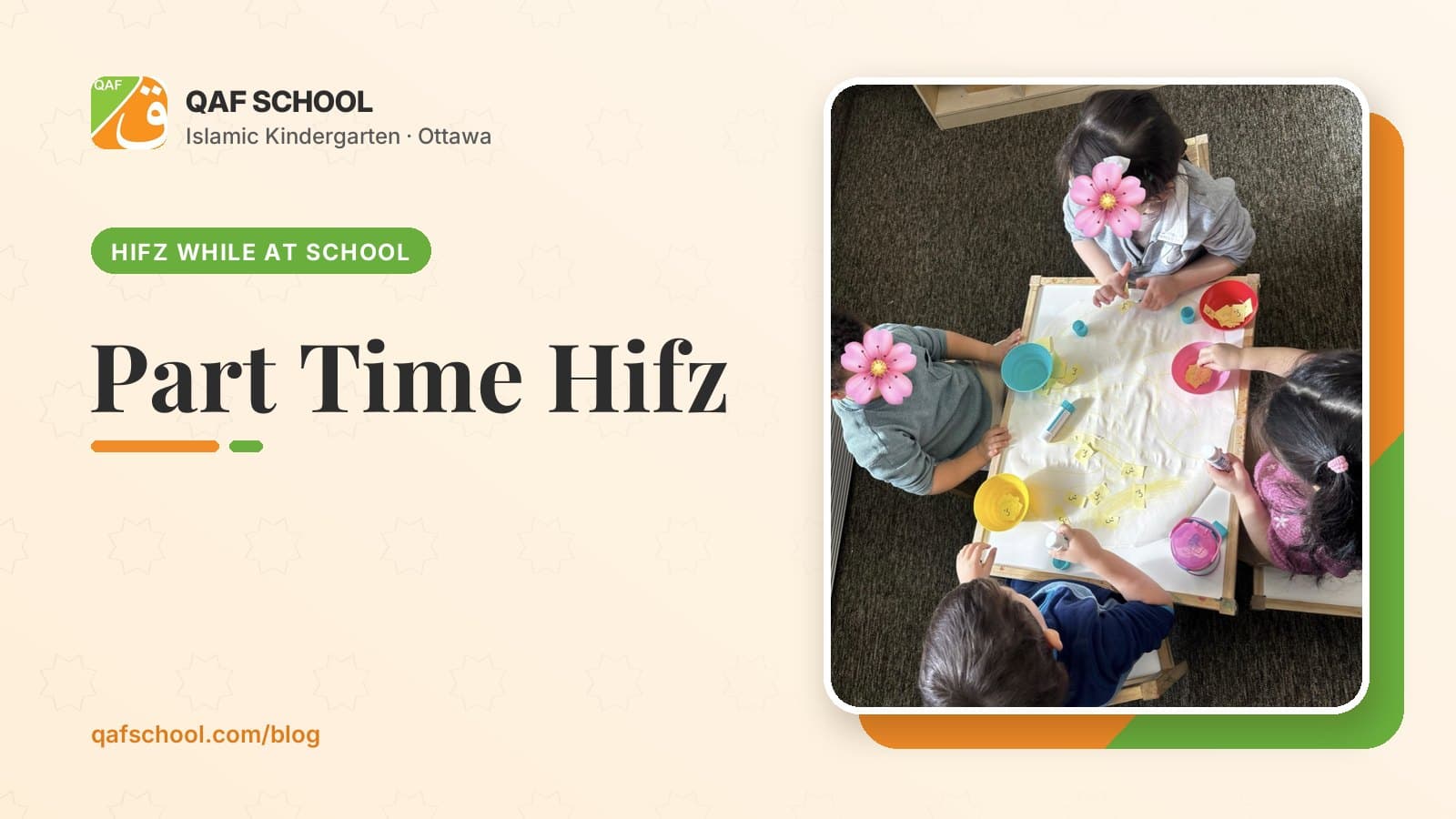
A full-time hifz school can produce a hafiz in a few years, but it asks a lot of a child and a family. Part-time and weekend formats move more slowly, yet they fit around regular school and are far more common in Ottawa. We look at how families make that work in our guide to part-time hifz.
Where to find a hifz program in Ottawa
Ottawa’s Muslim community runs more memorization options than many parents realize. Schedules and fees change each year, so treat these as starting points and confirm details directly.
Mosque-based part-time programs
The Ottawa Main Mosque (Ottawa Muslim Association) on Northwestern Ave has run a part-time program called Prepare a Hafiz, organized in levels that take students from reading and tajweed into memorization and revision. Check ottawamosque.ca for the current semester and registration.
In the east end, Darul Uloom Ottawa (2803 St. Joseph Blvd, Orléans) lists hifz classes on its website, including weekday morning and evening sessions from Monday to Thursday and weekend hifz classes. It is a natural option for Orléans and Cumberland families.
Many other masajid offer children’s Quran classes that include memorization, even if they do not call them “hifz programs.” Our list of weekend Islamic schools in Ottawa covers programs by area.
Full-time hifz
In 2023, CBC Ottawa profiled local huffaz, including a student who completed the Quran in a three-year program at Al-Furqan School in Ottawa. She started each day with a new page, recited it to her teacher and repeated it until she could say it correctly without looking. Full-time programs like this are intensive, so ask about academics, intake ages and how students keep up with the Ontario curriculum.
Halaqat, camps and tutors
Smaller halaqat, Sunday programs and private teachers fill the gaps. QAF runs Quran and hifz halaqat, and QAF Sunday Camp includes Quran in small groups every Sunday for ages 8 to 15. For one-to-one options, see our guide to choosing a Quran tutor in Ottawa. Online lessons can work for focused older children, but younger children usually do better in person.
How to evaluate any hifz program
A good hifz program in Ottawa is not defined by how fast students finish, but by how well they recite and retain. Use these questions on any visit or phone call.
The teacher
- What are the teacher’s qualifications? Ask whether they hold an ijazah or have completed hifz with a recognized teacher. An ijazah is a teacher’s certification that the student recites correctly, usually with a chain of teachers.
- Who listens to my child’s lesson each day? Every new portion should be heard and corrected by a qualified person, not only by an older student.
- How many students per teacher? Hifz needs individual listening time. A large group with one teacher means each child recites for only a few minutes.
The method
- How do you balance new memorization and revision? Look for a clear sabaq, sabqi and manzil routine. A program that only talks about new pages is a warning sign. Our hifz revision schedule guide shows what a healthy balance looks like.
- Is tajweed taught, or only memorization? Mistakes memorized early are hard to undo.
- How do you decide a child’s starting point and pace? A good teacher assesses reading first and sets a realistic daily target.
The partnership with parents
- What does my child need to do at home? Most part-time hifz depends on 15–30 minutes of daily revision at home.
- How will I know how my child is doing? Weekly notes, a marked mushaf, a notebook or an online portal all work, as long as they are consistent.
- What happens when a child falls behind or loses motivation? Listen for patience and a plan, not pressure.
Safety and logistics
- Ask about supervision, pick-up procedures, gender arrangements and who is in the room during one-to-one lessons.
- Ask about fees, registration costs, materials and what happens during holidays.
Tip: Ask to sit in on part of a session. Watch how the teacher corrects a mistake. A calm, precise correction is one of the best signs you will see.
How QAF halaqat track hifz progress
The most common reason part-time hifz stalls is that parents cannot see what is happening. A child says “it went fine,” the weeks pass, and only at a test does anyone notice that older surahs have faded.
At QAF, our Quran and hifz halaqat use a parent portal that shows attendance and hifz progress. Parents can see whether their child attended and how their memorization is moving, which makes it much easier to support revision at home and to raise concerns early.
Whatever program you choose, look for progress tracking that answers three questions:
- What was memorized? Surah and ayah ranges, or pages, for each new lesson.
- How strong is it? A simple quality note, such as solid, needs revision or repeated mistakes on specific ayat.
- What should we revise at home this week? A clear target so home practice supports the class.
If you prefer to keep your own record alongside a program’s reports, a simple notebook with the date, lesson, revision and teacher notes works well.
What a hifz program in Ottawa costs
Costs vary widely, so ask each program for its current fees in writing. In general:
- Mosque-run part-time programs are often among the most affordable options, and some offer sibling pricing.
- Full-time hifz schools cost more because they run most of the day, sometimes alongside academic classes.
- Private tutors usually charge per session, so the total depends on how many lessons a week your child needs.
- QAF Sunday Camp is $190 a month from September to June and covers four hours every Sunday, 11 AM to 3 PM, at 900 Dynes Rd: Quran, Arabic reading and writing, math and STEM, and soccer.
When you compare prices, compare teacher listening time per child, not just hours on the timetable. A one-hour class with focused individual recitation can be worth more than a longer class where your child mostly waits.
How long a part-time hifz program takes
Parents always ask this, and the honest answer is that it depends on pace, consistency and revision. A child memorizing a few lines a day, five days a week, will take many years to finish the Quran. A child memorizing a page a day can finish in a few years. Both are valid paths.
The Prophet ﷺ said: “The best among you are those who learn the Qur’an and teach it” (Sahih al-Bukhari 5027). The virtue is in the learning itself, not only in the finish line. For realistic timelines by pace, read how long it takes to memorize the Quran.
Is QAF right for your family?
QAF is a good fit if you live in or near Nepean, Barrhaven, Centretown or the south end and want a hifz path that fits around regular school. Our halaqat give parents visibility through the attendance and progress portal, and Sunday Camp suits children aged 8 to 15 who benefit from Quran alongside Arabic, STEM and sport with friends.
QAF is probably not the right fit if your child is ready for a full-time hifz school with a page-a-day target, or if you live in Orléans or Kanata and a weekly drive to 900 Dynes Rd is not realistic. In that case, a program closer to home that your child can attend every week will serve them better. For younger children aged 4 and 5, our Islamic kindergarten in Ottawa includes daily Quran with short surahs from Juz Amma, which is a gentle first step before formal hifz. You can also compare Ottawa’s Islamic schools side by side.
Choosing your hifz path
The right hifz program in Ottawa is the one your child can attend for years, with a teacher who listens carefully, a method that protects revision and reports that keep you involved. Start small, stay consistent and judge success by strong, beautiful recitation, not speed.
Ready to start? Contact us to ask about current QAF Quran and hifz halaqah levels and times, or call or WhatsApp us. We will help you find the right starting point for your child.