Full-day vs half-day kindergarten comes down to time: a full-day program runs the length of a regular school day, while a half-day program runs about two and a half to three hours. Research shows full-day kindergarten gives children a clear early boost in reading, math and self-regulation, especially in Ontario studies. Still, a few children, often the youngest, need a gentler start. Here is how to weigh it for your child, with the Ontario rules explained.
Key takeaways
- In Ontario, publicly funded JK and SK are full-day programs for children aged 4 and 5. Kindergarten is optional, because school becomes compulsory only in September of the year a child turns six.
- An Ontario study of 592 children found full-day kindergarten children were ahead in self-regulation, reading, writing and number knowledge through the end of Grade 2.
- International reviews agree on early academic gains, but find they can fade without strong teaching in later grades.
- Half-day can suit a child who tires easily or struggles with separation, but it usually means arranging your own pick-up and child care.
- Most children adjust to a full day within a few weeks when the day mixes play, rest, outdoor time and short lessons.
Full-day vs half-day kindergarten at a glance
| Full-day kindergarten | Half-day kindergarten | |
|---|---|---|
| Length | A full school day, about 6 hours (for example, 9:00 to 3:00) | About 2.5–3 hours, morning or afternoon |
| In Ontario | The standard model in public, Catholic and French boards since full rollout in 2014 | Not offered as a separate program by public boards; some families arrange shorter days with the principal |
| Learning time | Long play periods, small-group lessons, outdoor play, lunch, rest, specials | Compressed: less time for deep play, projects and outdoor time |
| Academic effect | Stronger early gains in reading and math | Smaller early gains |
| Social effect | More time to build friendships and self-regulation | Less time with peers, but more time at home |
| Fatigue | Can be tiring in the first weeks, especially for younger JKs | Easier for children who tire quickly |
| Logistics | Matches a typical work day; before/after care may fill the gaps | Needs midday pick-up and child care for working parents |
| Cost (Ontario) | Free in public boards; tuition in private schools | Free hours in public school, but you pay for any extra child care |
What is full-day kindergarten?
Full-day kindergarten is a program where children attend for the length of a regular school day, five days a week. In Ontario, kindergarten is a free two-year program for 4- and 5-year-olds, and the province gives an example day of arriving at 8:45 a.m. and leaving at 3:15 p.m. Exact bell times vary by school.
Ontario began phasing in full-day kindergarten in 2010, and by 2014 every eligible child in a publicly funded school had access to it. Classes of more than 16 children are led by a team: a teacher and a registered early childhood educator.
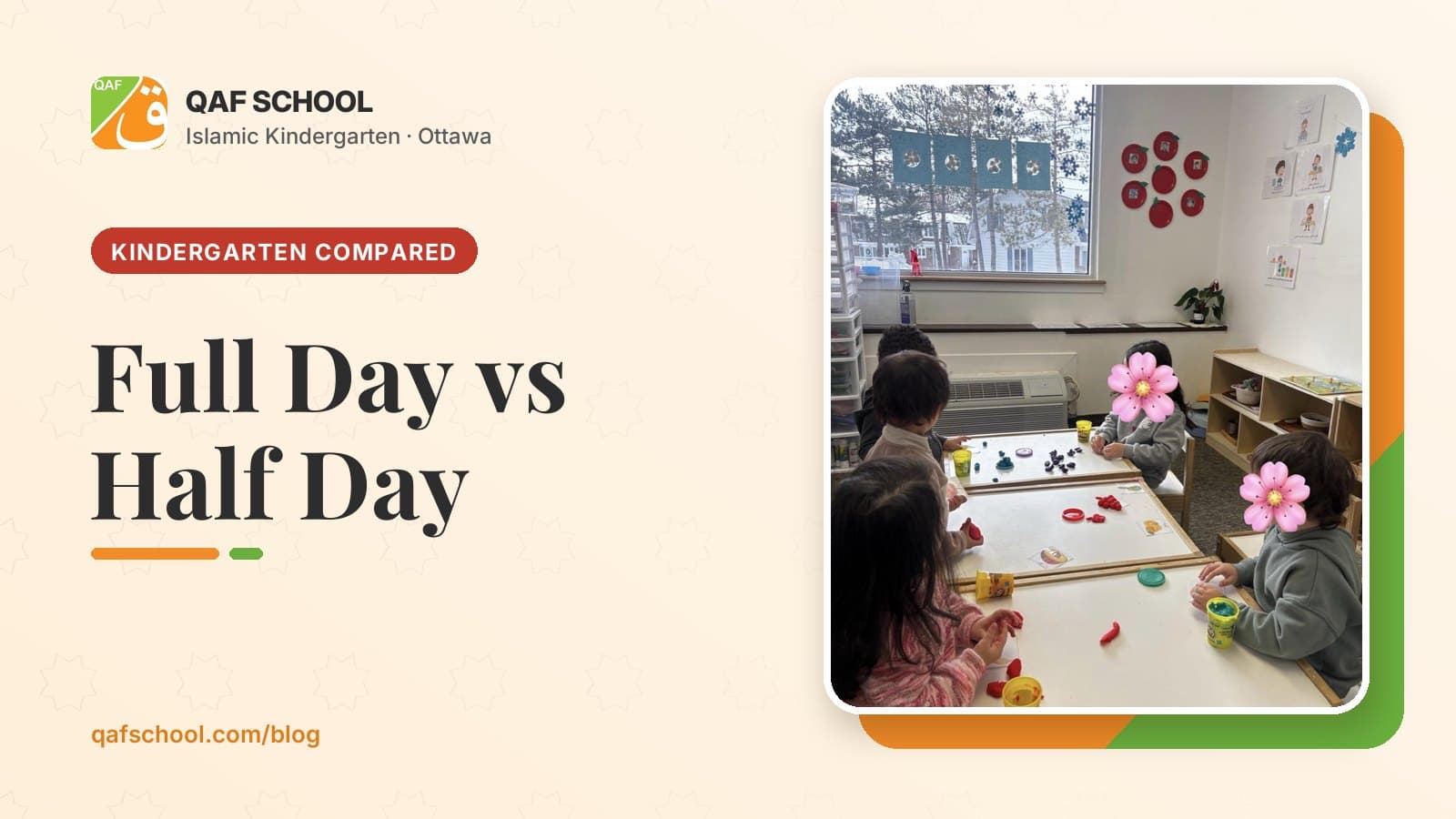
A full day is not six hours of lessons. A typical full-day kindergarten mixes:
- Arrival routines and a morning meeting
- A long period of play-based learning centres and small-group teaching
- Outdoor play, often twice a day
- Lunch and snack
- Quiet or rest time
- Stories, music, physical activity and short whole-group lessons
What is half-day kindergarten?
Half-day kindergarten is a shorter program, usually two and a half to three hours, offered in the morning or the afternoon. Before 2010, it was the norm in Ontario, and it is still common in some other provinces, US states and private nursery programs.
Half-day programs cover the same basics, such as circle time, centres, stories and outdoor play, but there is less time for each. Children also tend to miss lunch with classmates and the afternoon activities that build stamina for Grade 1.
What the research says
The evidence on full-day vs half-day kindergarten is fairly consistent on the short term and more mixed on the long term.
Ontario's own evidence
Because Ontario phased in full-day kindergarten over five years, researchers could compare similar children in full-day and half-day classes. Janette Pelletier's team at the University of Toronto followed 592 children from two school boards. They found that full-day children scored higher on self-regulation, reading, writing and number knowledge and stayed ahead to the end of Grade 2. Full-day children were also more likely to meet provincial expectations in Grade 3. The researchers described these results as preliminary.
Not every Ontario analysis agrees. A Queen's University analysis of 2012 provincial data on senior kindergarten children found small negative effects on self-regulation and numeracy and no effect on literacy, and its authors pointed to large classes in small rooms as a possible factor. In other words, the length of the day matters, but so does the quality of the classroom.
International evidence
A 2010 meta-analysis led by Harris Cooper, published in the Review of Educational Research, found that full-day kindergarten gave a modest academic advantage by the end of kindergarten, which often faded by Grade 3. It also found positive links with children's confidence and ability to work and play with others. The authors recommended that full-day kindergarten be available to all children, without necessarily being required for every child.
The US Community Preventive Services Task Force recommends full-day kindergarten programs based on improved reading and math achievement, while noting that gains may fade without continued high-quality schooling.
What this means for parents: a full day gives most children a head start, especially in early literacy. Whether that lasts depends on what follows: good teaching in Grades 1 to 3, and reading at home.
Benefits of full-day kindergarten
- More time for deep play. Long, uninterrupted play periods are where children build language, problem-solving and cooperation.
- Stronger early reading. Ontario's 2026 kindergarten curriculum includes explicit teaching of sounds and letters. More time means more short lessons and more practice.
- Easier transition to Grade 1. Children are already used to a full day, lunch at school and following routines.
- Steadier routine for working families. The school day lines up more closely with work hours.
- More outdoor time. Many full-day classes go outside twice a day, which matters for health and attention.
When half-day might suit your child
Full-day is the right choice for most children, but not all. A shorter day can make sense when:
- Your child is among the youngest. In Ontario, a child born in December can start JK at three and a half. Read our guide to late birthdays and junior kindergarten in Ontario.
- Your child still naps for long periods and becomes exhausted or upset by mid-afternoon.
- Separation is very hard, and a shorter day lets your child build confidence step by step. See our kindergarten separation anxiety plan.
- A parent or grandparent is home and you want more family time in the year before school becomes compulsory.
- Your child has medical or developmental needs and the care team recommends a gradual start.
Half-day is often best as a temporary bridge: shorter days for the first weeks, then full days once your child is settled.
Can you choose half-day kindergarten in Ontario?
Ontario public boards do not run a separate half-day program. However, kindergarten itself is not compulsory, and the province notes that parents who send their child at different times must arrange their own transportation. In practice, some families agree on a shorter schedule with the principal, particularly for a child's first weeks. Policies and attitudes vary, so ask your school directly.
If you need care beyond school hours, Ontario requires school boards to offer before and after school programs for JK to Grade 6 where there is enough demand. Fees are set by the board or provider, and subsidies may be available through your local service manager. In Ottawa, see our child care subsidy guide.
Private schools set their own hours. Some offer half-day options, and others run only full days. Ask before you register.
How to help your child handle a full day
Most children adjust to a full kindergarten day within a few weeks. These steps help:
- Move bedtime earlier in the two weeks before school starts. Canada's 24-Hour Movement Guidelines for the Early Years recommend 10 to 13 hours of good-quality sleep for three- and four-year-olds, which can include a nap.
- Practise the morning routine a few times: breakfast, dressing, shoes, out the door.
- Pack a filling lunch and two snacks, and practise opening every container. Our kindergarten supply list covers what else to send.
- Keep afternoons calm for the first month: no extra activities, plenty of downtime.
- Expect after-school meltdowns. A child who held it together all day often lets go at home. A snack and quiet time help more than questions.
- Talk to the teacher if exhaustion continues past the first month. A short-term reduced schedule may help.
For broader preparation, see our JK readiness checklist.
Is QAF right for your family?
QAF School runs a full-day Islamic JK and SK program for children aged 4 and 5 at 900 Dynes Rd in Nepean, Ottawa. Drop-off is 8:45 to 9:00 a.m., the day runs 9:00 a.m. to 3:00 p.m., Monday to Friday, and pick-up is 3:00 to 3:15 p.m. The day balances a Montessori-inspired morning work cycle (9:20 to 11:00) and lunch with daily Arabic immersion, Quran, duas and adab, aligned with Ontario's kindergarten curriculum. See what a day looks like at QAF.
QAF suits families who want a full, structured Islamic school day for a four- or five-year-old. It may not suit you if you need a half-day-only program, care before 8:45 a.m. or after 3:15 p.m., or a school close to the east or west end of the city. In that case, compare other Islamic schools in Ottawa, or consider public kindergarten plus weekend Islamic schools in Ottawa. Tuition is $690 a month for 10 months plus a $190 annual resource fee.
The bottom line
For most four- and five-year-olds, full-day kindergarten is the better choice: more time for play, language and early reading, and an easier step into Grade 1. Half-day can be a sensible bridge for a very young or easily tired child. Whichever you choose, the quality of the classroom and the reading you do at home matter as much as the hours.
Want to see a full kindergarten day in action? Book a visit to QAF's Islamic JK/SK classroom in Nepean and ask us how the day is paced for four-year-olds. Submit an inquiry, or call or WhatsApp us.