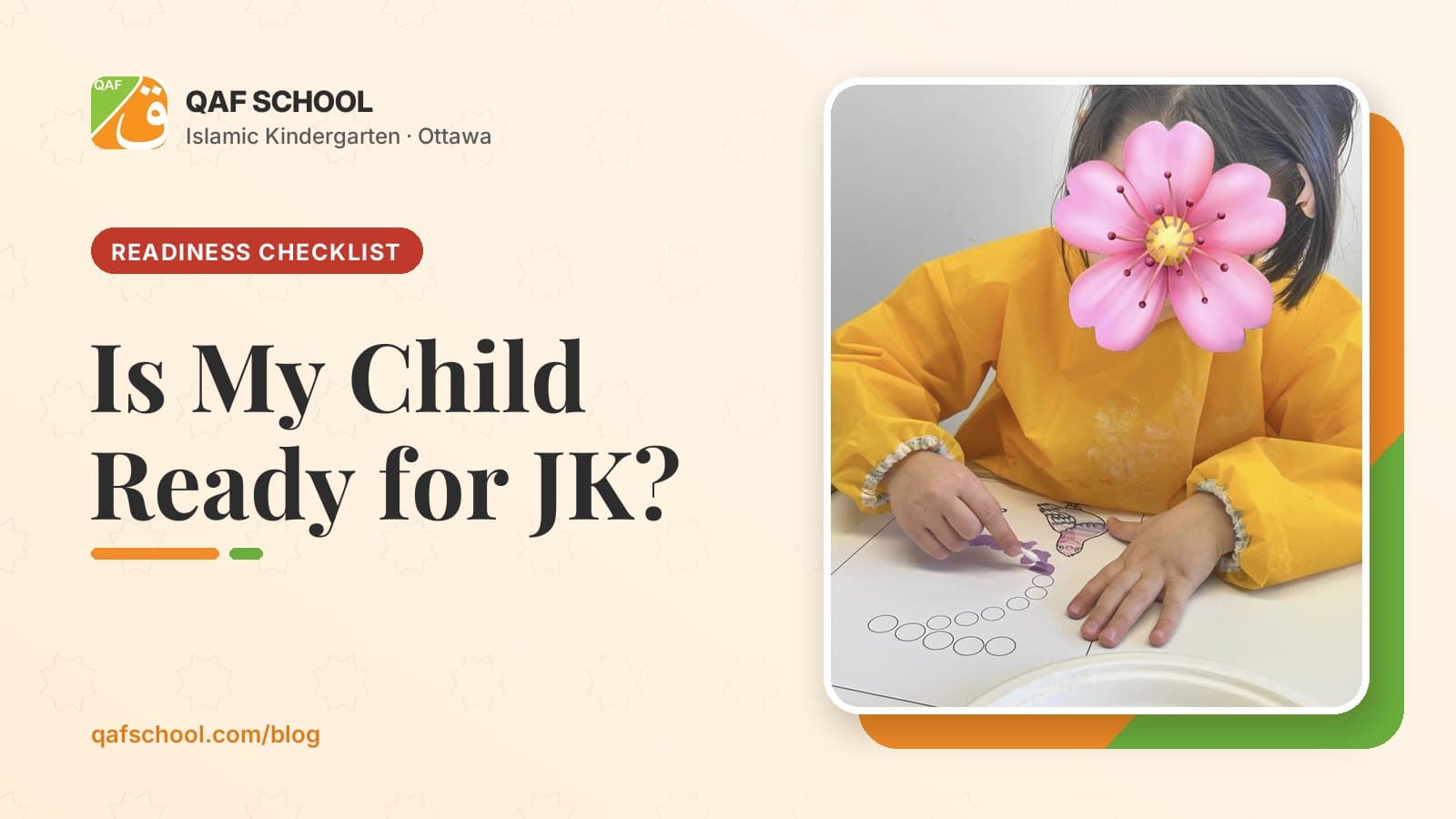
Is my child ready for JK? For most four-year-olds the honest answer is yes. In Ontario, eligibility for Junior Kindergarten is based on age, not a test, and kindergarten is designed for children who are still learning to dress themselves, share and hold a pencil. This JK readiness checklist helps you spot the skills worth practising now, so your child walks in on the first day feeling capable rather than overwhelmed.
Key takeaways
- JK readiness is about independence, routines and comfort with other adults, not reading or writing.
- The most useful skills to practise are toileting, dressing, opening lunch containers, following two-step directions and saying "I need help."
- Your child does not need to read, write their name perfectly, count to 100 or sit still for long periods.
- A calm summer plan (sleep, routines, short separations, a school visit) does more than any workbook.
- Separation tears in September are normal and usually fade within a few weeks.
What a JK readiness checklist really measures
JK readiness means a child can manage the basic routines of a school day with some support and feel safe enough to learn. In Ontario, children start JK in September of the year they turn four, and the province notes that children start kindergarten at different stages of development. Teachers expect a wide range.
If you are still working out registration dates, age cutoffs or which school to choose, start with our guide to junior kindergarten in Ottawa. This post focuses on the child: what to practise, what to stop worrying about, and how to handle the first weeks.
Use the checklists below as a guide, not a pass/fail test. If your child can do most items in a section, they are in good shape. If several items are new, you have a clear list to practise over the next few months.
Self-care and toileting checklist
Self-care is the area that makes the biggest difference to a child's first weeks, because it affects confidence all day long.
- Uses the toilet independently most of the time, including pulling pants down and up
- Tells an adult when they need the bathroom (or knows to go before an activity)
- Wipes, flushes and washes hands with soap without step-by-step reminders
- Puts on and takes off a jacket, and is learning to zip it
- Puts on shoes, ideally Velcro or slip-on
- Opens their own lunch containers, water bottle and snack bags
- Eats with a spoon and fork, and stays seated for a short meal
- Blows their nose and throws the tissue away
- Recognizes their own belongings (backpack, lunch bag, water bottle)
A note on toileting
Many parents worry most about toileting. The Canadian Paediatric Society notes that most children start toilet learning between 2 and 4 years of age and that the process often takes three to six months, with accidents along the way. Ontario's guidance suggests checking your school board's toilet-training expectations and speaking with the principal. Expectations differ between public boards and private schools, so ask directly.
Two practical points: avoid starting toilet training right before school begins or during another big change, and send a full change of clothes in a labelled bag. Accidents in the first weeks are common, even in fully trained children, because school is busy and exciting.
Social and emotional readiness checklist
Social-emotional skills matter more to JK teachers than academic ones, because they determine whether a child can join in and learn.
- Can separate from a parent for a few hours (with a family member, at a program or a playdate)
- Plays alongside and with other children, even briefly
- Is beginning to take turns and share, with reminders
- Can name basic feelings: happy, sad, angry, scared
- Accepts comfort or help from an adult who is not a parent
- Can wait a short time (for a turn, for snack) without a meltdown most days
- Recovers from small frustrations with support
- Says "I need help" or "Can you help me?" instead of melting down
Do not expect a four-year-old to have mastered these. Kindergarten exists precisely to grow them. In Ontario's kindergarten curriculum, self-regulation and well-being and belonging and contributing are two of the four strands of learning, which tells you how seriously educators treat this area. We explain those strands in Ontario's kindergarten program explained.
Language and communication checklist
You are listening for a child who can make themselves understood and follow the flow of a classroom.
- Speaks in sentences of four or more words (in any language)
- Can be understood by adults outside the family most of the time
- Follows two-step directions ("Put your shoes on and get your bag")
- Answers simple questions about themselves: name, age, a family member's name
- Listens to a short picture book and talks about it
- Asks questions and describes something they did
What if English is not my child's first language?
That is completely fine. Children who speak Arabic, Urdu, Somali, French or another language at home are not behind; they are building a second (or third) language. Keep speaking your home language richly. Ontario's own guidance encourages reading together in your home language. If your family is juggling several languages, our post on raising trilingual kids in Canada covers what to expect.
Fine motor and physical skills checklist
Small hand muscles develop at very different rates. These skills affect drawing, cutting, zippers and, later, writing.
- Holds a crayon or thick marker (any grip is fine at this stage)
- Draws lines, circles and simple shapes
- Is learning to use child-safe scissors
- Builds with blocks, Lego or play dough
- Turns the pages of a book one at a time
- Runs, climbs, jumps with two feet and catches a large ball
Easy ways to build fine motor strength
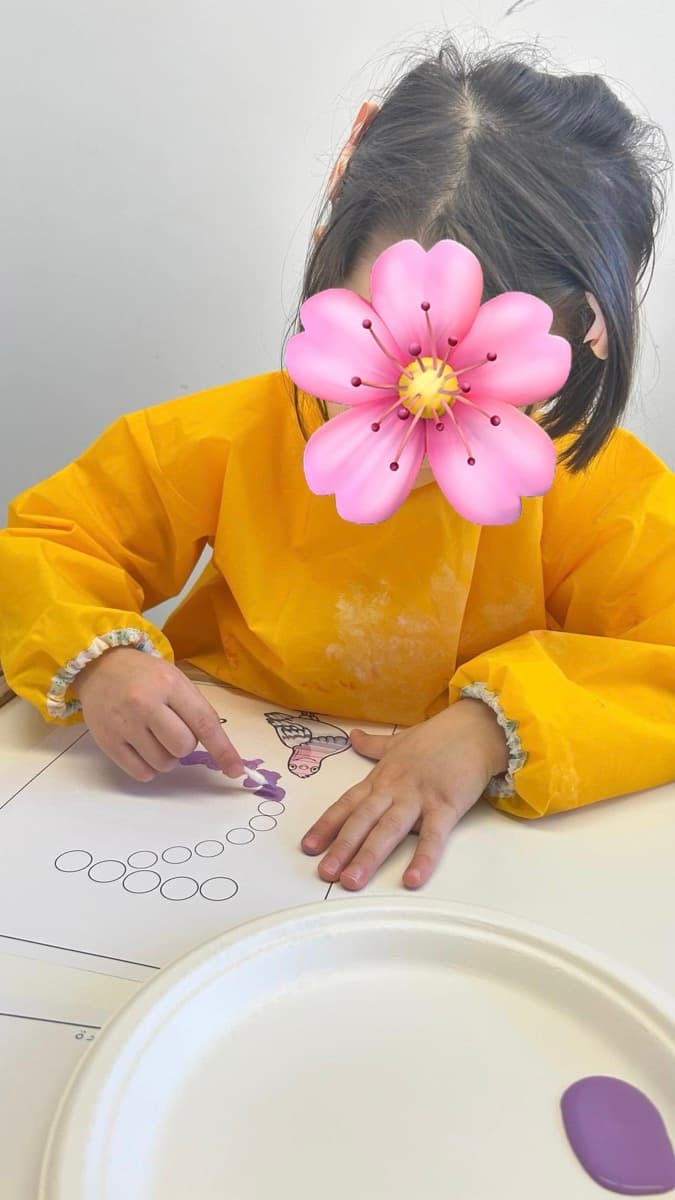
- Play dough: rolling, pinching, cutting with a plastic knife
- Peeling stickers and putting them on paper
- Threading large beads or pasta onto a string
- Pouring water between cups at the sink or in the bath
- Using clothespins to hang up small items
- Tearing paper for a collage
These are the same "practical life" activities you would see in a Montessori classroom. In our classroom we have found that children who have done plenty of pouring, spooning and pinching come to pencil work with more control and less frustration.
Routines and independence checklist
School runs on routine. Children who have practised a predictable day at home adjust faster.
- Has a consistent bedtime and wake-up time
- Can manage a full morning (or day) without a nap, or with a short rest
- Is used to eating at set times, not grazing all day
- Helps tidy up toys when asked
- Can sit for a short story or circle time of about 10 minutes
- Transitions between activities with a warning ("Five more minutes, then we clean up")
What your child does NOT need before JK
This list may be the most reassuring part of the post. Your child does not need to:
- Read. Ontario's kindergarten curriculum teaches early reading skills, including sounds and letters, over two years.
- Write their name perfectly. Recognizing it is a nice bonus; writing it is a kindergarten goal.
- Know the whole alphabet or count to 100. Counting to 10 and singing the alphabet song are plenty.
- Sit still for long periods. Four-year-olds learn by moving. Kindergarten is built for that.
- Tie shoelaces. Velcro exists for a reason.
- Speak fluent English. Children pick up the classroom language remarkably fast.
- Never cry. Tears at drop-off are not a sign your child isn't ready.
- Complete workbooks. Worksheets at home can make some children anxious about school. Play, talk and read instead.
Tip: If you are going to "teach" one academic skill before JK, make it a love of books. Read aloud every day, in whatever language you speak best.
How to prepare over the summer before JK
A gentle, step-by-step plan over July and August works better than a last-minute rush. Here is the sequence we suggest to families.
Step 1: Shift sleep in early August. Move bedtime and wake-up time 15 minutes earlier every few days until you reach your school-year schedule. Tired children struggle with separation and big feelings.
Step 2: Practise the morning routine. Run a few "pretend school mornings": dressed, breakfast, shoes, backpack, out the door. Time it so you know how long it really takes.
Step 3: Do a lunch rehearsal. Pack a real school lunch in the actual containers and let your child eat it at the table without help. Swap any container they cannot open. If your school is nut-free or requires halal food, as QAF does, plan a handful of go-to meals now; our halal lunch ideas for kids can help.
Step 4: Build short separations. Leave your child with a relative or trusted friend for an hour, then two, then a morning. In Ottawa, EarlyON Child and Family Centres offer free drop-in programs where children get used to new adults and group routines, with you nearby.
Step 5: Talk about school positively. Read picture books about starting kindergarten. Describe what will happen: who will greet them, where they will hang their backpack, when you will come back.
Step 6: Visit the school. Walk or drive past, play in the playground if allowed, and attend any orientation. Familiar places feel safe.
Step 7: Label everything. Jackets, shoes, water bottle, lunch bag, spare clothes. It saves a surprising amount of stress.
Handling separation anxiety at drop-off
Separation anxiety is a normal developmental stage, and the start of school is one of the most common times it appears. The Canadian Paediatric Society's guidance on anxiety in children recommends preparing the night before so mornings are not rushed, letting a child bring a comfort item, and offering a warm goodbye without repeated farewells.
What works in practice:
- Keep goodbyes short and consistent. A hug, a special phrase or a quick dua, then go. Lingering usually makes it harder.
- Never sneak out. It erodes trust and can make the next morning worse.
- Tell them exactly when you will be back in terms they understand: "after outdoor play and snack."
- Hand over to a person. Wait until a teacher is with your child before you leave.
- Stay calm and confident. Children read your face. If you believe they will be fine, it helps them believe it too.
- Trust the teacher. Most children settle within minutes of a parent leaving. Ask the teacher for a quick update if you are worried.
Muslim families sometimes find comfort in a simple dua at the door. Teaching your child to say "Bismillah" as they walk in gives them a small ritual of their own.
When to talk to a professional
Most children settle within the first few weeks. Talk to your child's teacher and family doctor if distress is still intense after the first month, if your child refuses to go to school most days, or if worries are affecting sleep, eating or play. The CPS notes that fears interfering with normal daily activities, such as attending school, are a reason to seek help.
What the first weeks of JK usually look like
Expect tired, hungry and occasionally grumpy children after school for the first month. That is not a sign something is wrong; it is the effort of a big new world. Plan quiet afternoons, early bedtimes and a good snack at pick-up.
Many schools stagger the first days or start with shorter hours. At QAF School in Ottawa, the day runs from 9:00 AM to 3:00 PM with drop-off between 8:45 and 9:00, and parents receive photos and updates through ClassDojo, which reassures many families in the first weeks. You can learn more about how our classrooms run on the program page.
If you are already looking ahead, our post on preparing your child for Grade 1 explains how kindergarten skills build towards the next transition.
The bottom line
A child who can manage the bathroom, open their lunch, ask for help and say goodbye without falling apart is ready for JK, even if they cannot read a single word. Spend the months before school on routines, independence and lots of reading aloud. Then trust your child, and their teachers, to do the rest.
Wondering whether our JK class is the right fit? QAF School offers full-day Islamic Junior and Senior Kindergarten in Ottawa for ages 4 and 5. Submit an inquiry to book a visit, meet our teachers and ask any readiness questions in person.