If you have just arrived in Canada, the good news is that Ottawa schools for newcomers are free, open year-round and legally required to welcome your child, whatever your immigration status. Your main jobs are to choose a school board, gather three or four documents, register, and report your child's vaccines to Ottawa Public Health. This guide walks newcomer families through each step, explains how English language support works, and shows where kindergarten and Islamic schools fit in.
Key takeaways
- In Ontario, children under 18 cannot be refused a public school place because of their own or their parents' immigration status.
- Ottawa has four public school boards (two English, two French). All are free, including full-day kindergarten for ages 4 and 5.
- Kindergarten and Grade 1 children register directly at their local school. Newcomers in Grades 2 to 12 usually have an English and math assessment first.
- Parents, not doctors, must report vaccines to Ottawa Public Health. Bring your child's records from home, translated if possible.
- Private and Islamic schools are a separate, tuition-based option. Many families combine a public school with weekend Quran and Arabic.
How Ottawa schools for newcomers work at a glance
Ontario has a single provincial curriculum, but schools are run by local school boards. Your home address decides your designated school in each board. Here is the system in one table.
| Stage | Ages (by Dec 31 of the school year) | Required? | Cost in public schools |
|---|---|---|---|
| Junior Kindergarten (JK) | Turns 4 | Optional, but most children attend | Free |
| Senior Kindergarten (SK) | Turns 5 | Optional, but most children attend | Free |
| Elementary (Grades 1–8) | Turns 6 in Grade 1 | Yes, from age 6 | Free |
| Secondary (Grades 9–12) | About 14–18 | Yes, until 18 or graduation | Free |
| Private and Islamic schools | Varies | Alternative to public school | Tuition |
According to Ontario's kindergarten page, kindergarten is a free two-year program for 4- and 5-year-olds, and children must attend school in September of the year they turn 6. Since September 2026, all kindergarten classes follow the new Ontario Curriculum, Kindergarten, 2026.
Children are placed in kindergarten by birth year, not by their age in September. A child born in 2023 starts JK in September 2027; a child born in 2022 starts SK. This can surprise families from countries that use a different cut-off date. Elementary students arriving from abroad are generally placed in a grade that suits their age, with language support as needed.
Your child's right to attend school
This is the first thing newcomer parents ask, so here is the direct answer. All children living in Ontario have the right to attend school. The legal-information site Steps to Justice explains that a school cannot refuse a child under 18 because of their immigration status or their parents' status.
That applies to permanent residents, refugee claimants, children of parents on work or study permits, and families still waiting on paperwork. Visitors are treated differently, so if you are in Canada on a visitor visa, contact the board's admissions office before you register.
The boards ask some families to contact admissions first. The OCDSB, for example, asks diplomats, refugees, families on military or NATO orders, parents on study or work permits, and parents with visitor visas to submit immigration documents to its admissions department before registering.
Choosing between Ottawa's four school boards
Ottawa has four publicly funded boards:
- OCDSB (Ottawa-Carleton District School Board): English, secular. Any Ottawa resident can register.
- OCSB (Ottawa Catholic School Board): English, Catholic. Families of all faiths are welcome.
- CEPEO: French, secular.
- CECCE: French, Catholic.
The French boards automatically admit children of French-language rights holders, which requires Canadian citizenship. Other families can apply through an admission committee. Many newcomers from Morocco, Algeria, Tunisia, Lebanon or West Africa take this route. Our comparison of Ottawa school boards explains eligibility, French programs and busing in detail, including how French is taught in each.
For most newcomer families, the decision comes down to three questions: Which language do we want school in? Are we comfortable with Catholic religious education? Which school is closest, and is my child eligible for the bus?
Step-by-step: registering your child
The steps are similar across boards. Here is the process for the two English boards, which most newcomer families use.
Step 1: Find your designated school. Use the board's online school locator with your Ottawa address. You need an address to register, so do this once you have a lease or a place to stay.
Step 2: Register online. The OCDSB's kindergarten registration page notes that its form must be completed on a computer or laptop, not a phone or tablet. If you do not have a computer, a public library branch or a settlement agency can help.
Step 3: Submit your documents. Upload them or bring them to the school (see the checklist below).
Step 4: Book the newcomer assessment (Grades 2–12 only). See the next section.
Step 5: Report vaccines to Ottawa Public Health. This is a separate step from school registration.
Step 6: Meet the school. Ask about the start date, the bell times, lunch and nutrition breaks, before- and after-school care, and who to contact with questions.
Schools register newcomers throughout the year. You do not need to wait for September.
Documents checklist for newcomer families
Requirements vary slightly by board, so check the board's page before you go. Expect to need:
- Proof of your child's age: birth certificate, passport, permanent resident card or confirmation of landing.
- Immigration documents for your child, if they were not born in Canada.
- Proof of your Ottawa address: a lease or purchase agreement, property tax bill or utility bill. The OCDSB asks for two proofs of address for kindergarten and does not accept a driver's licence or mobile phone bill. The OCSB also does not accept a driver's licence or cell phone bill.
- Immunization records from your home country.
- Previous school records and report cards, if you have them. They help the school place and support your child.
- Custody documents, if they apply.
Tip: Keep a folder (paper and phone photos) with every document. You will use the same set for school, child care, health card and benefits applications.
Newcomer assessment and English language support
Kindergarten and Grade 1
Children entering JK, SK or Grade 1 register directly at their local school, not at a newcomer centre. The OCDSB says kindergarten and Grade 1 students register at the school. The OCSB asks families with a child entering JK, SK or Grade 1 (with no older sibling already in the board) to contact the school's Multicultural Liaison Officer.
Young children pick up English quickly in a play-based classroom, and the teacher and early childhood educator team adapts activities for English language learners.
Grades 2 to 12
Older children usually complete an assessment before they start:
- The OCDSB's Family Reception Centre assesses English reading, writing, listening and speaking, and reviews math. It takes about two hours for elementary students. Appointments can only be booked once the child has arrived in Canada, there is no fee, and a parent or guardian must attend.
- The OCSB's Family Welcome Centre asks you to register online first, then book an assessment. It takes about one hour for Grades 2 to 8. Staff can help with forms at the appointment.
After the assessment, students who need it receive English as a Second Language (ESL) or English Literacy Development (ELD) support. ESL is for students who have had schooling in their first language; ELD is more intensive and is for students with interrupted schooling. Both are free.
Multicultural Liaison Officers
Both English boards work with OCISO (Ottawa Community Immigrant Services Organization) to provide Multicultural Liaison Officers (MLOs). They help newcomer families understand the school system, explain school notices, and connect you with community services. Many speak Arabic, Farsi, Dari and other languages. Ask your school office how to reach yours.
Vaccines: the step many newcomers miss
Ontario's Immunization of School Pupils Act requires students to be vaccinated against nine diseases, including measles, mumps, rubella, diphtheria, tetanus, polio and pertussis, or to have a valid exemption. Ottawa Public Health reviews records and can suspend students whose records are not up to date.
The important part for newcomers: your doctor does not send vaccine records to Ottawa Public Health. You do. Report your child's vaccines through Ottawa Public Health's immunization page.
If your child's records are in Arabic, Dari or another language, a public health nurse or your new family doctor can review them and tell you which Canadian-schedule vaccines your child still needs. A certified English or French translation makes this faster. If you do not have a family doctor yet, Ottawa's newcomer health services can help with catch-up vaccines.
Where kindergarten, child care and Islamic schools fit
Public kindergarten
Full-day public kindergarten in Ottawa follows the school day (bell times vary by school, often around 8:45 AM to 3:15 PM), with a teacher and an early childhood educator in larger classes. English boards teach kindergarten 50% English and 50% French. If you need care before 9 or after 3, apply separately for before- and after-school programs, and ask about the City of Ottawa child care subsidy if cost is a concern. Our junior kindergarten guide covers registration timing in detail.
Private and Islamic schools
Private schools are a legal alternative to public school in Ontario. They charge tuition, set their own admission process and do not receive government funding. Newcomer Muslim families often consider them for one reason: a school where daily prayer, Quran and Arabic are normal, during a year when everything else is unfamiliar.
You can compare the options in our guide to Islamic schools in Ottawa. For a straight look at the trade-offs, read Islamic school vs public school in Ontario.
Weekend programs
If public school is the right choice for now, you can still build Quran and Arabic on weekends. Our roundup of weekend Islamic schools in Ottawa lists the main options by area.
Common worries for newcomer parents
"My child does not speak English." This is normal. Ottawa classrooms include many children learning English. Young children often understand far more than they say for the first few months. Keep speaking your home language at home; a strong first language supports English learning.
"We arrived mid-year." Schools accept registrations year-round. A short adjustment period is expected, and teachers are used to welcoming new students in January or March.
"Will my child keep their faith and language?" Public schools in Ottawa accommodate religious needs such as Eid absences, but they will not teach Quran or Arabic. That part is up to your family, a weekend program or an Islamic school. Small daily habits at home, such as duas at meals and bedtime, matter more than any single program.
"Where should we live?" School choice and housing are linked. If you have not settled yet, read our guide for Muslim families moving to Ottawa, and if Arabic is your home language, see our guide for Arabic-speaking families.
Is QAF right for your newcomer family?
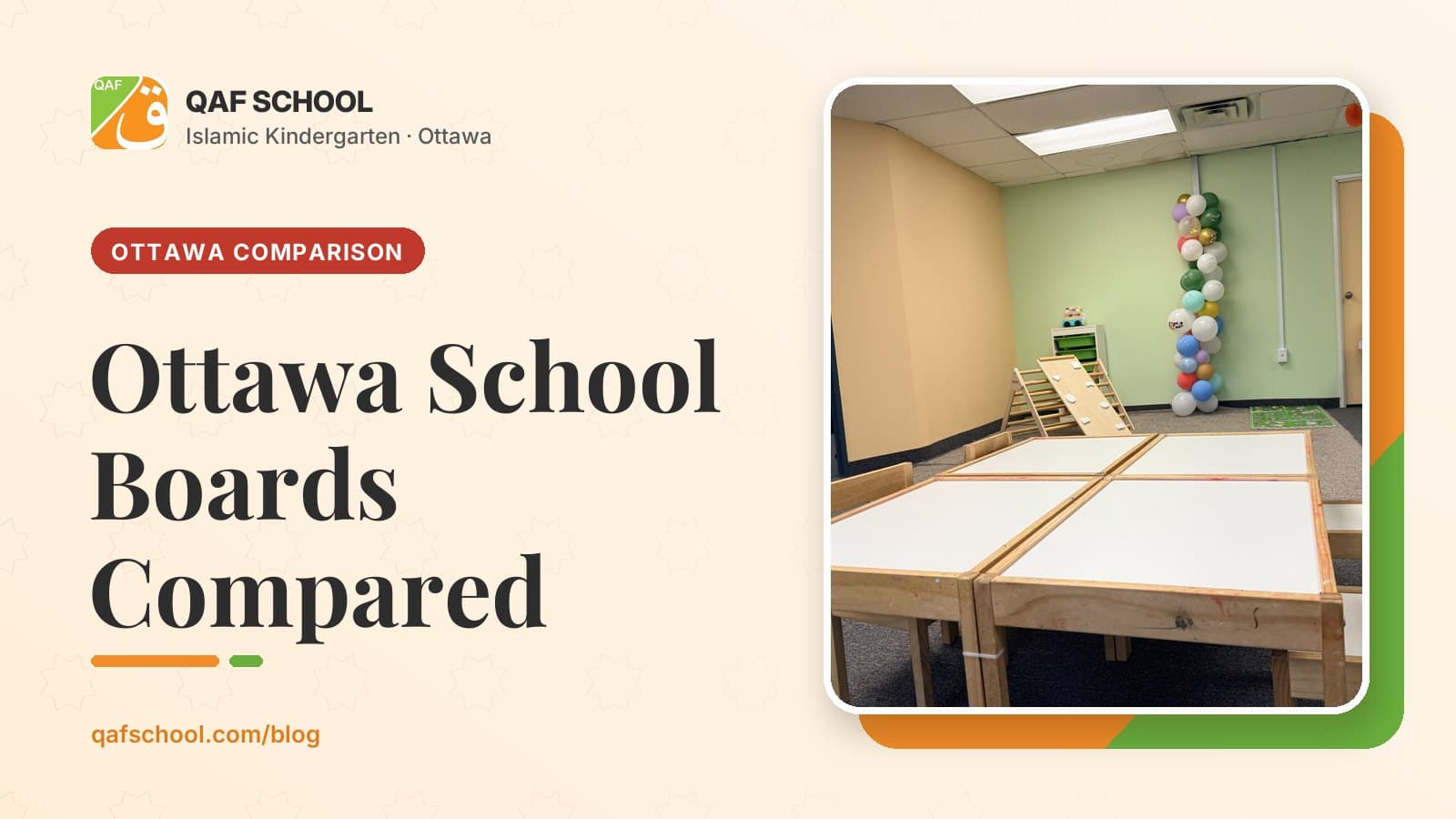
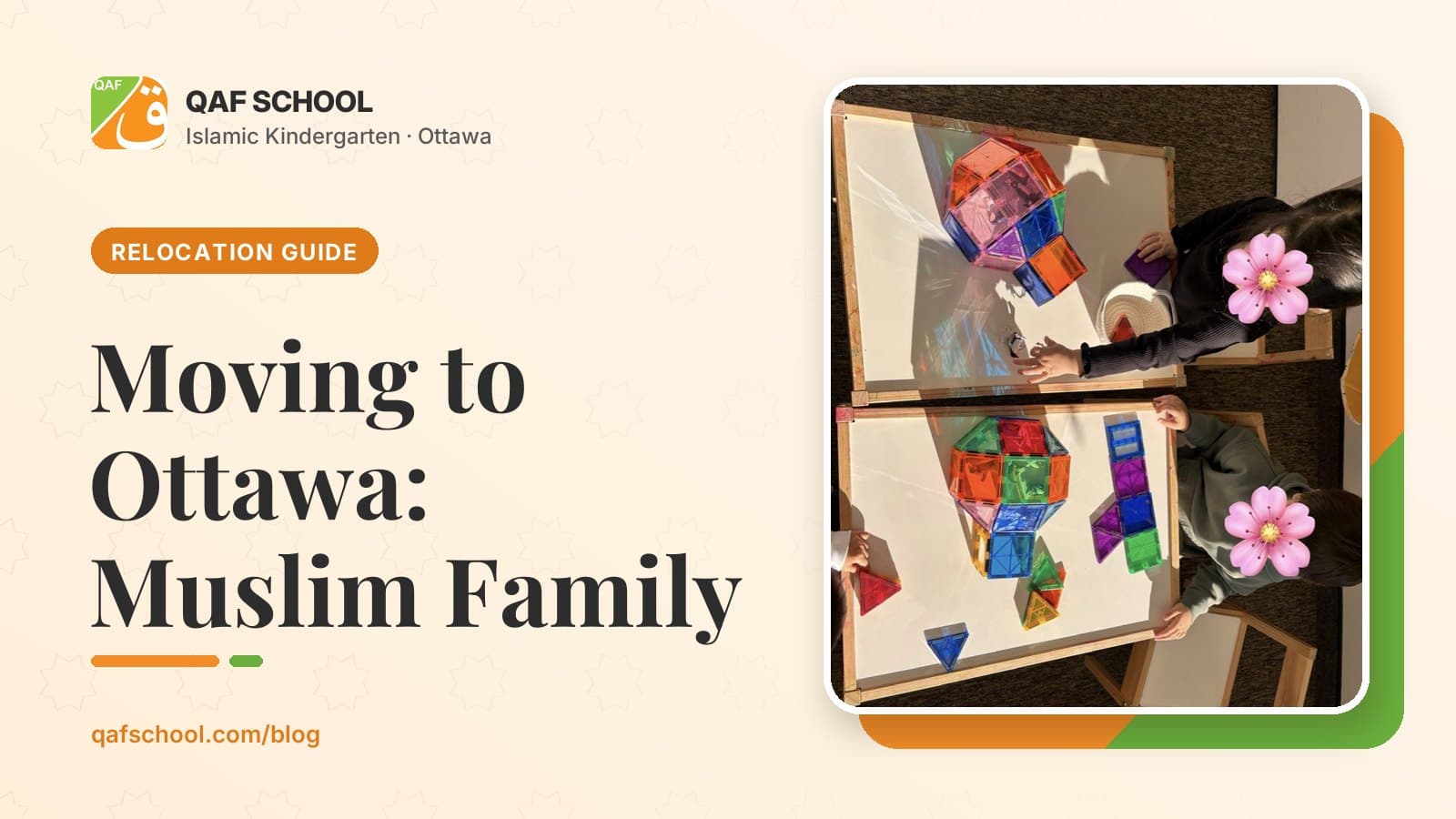
QAF School is a full-day Islamic kindergarten for ages 4 and 5 (JK and SK) at 900 Dynes Rd in Nepean, near Prince of Wales Drive. The day runs 9:00 AM to 3:00 PM, Monday to Friday, September to June, with daily Arabic immersion, Quran from Juz Amma, Islamic Studies and a Montessori-inspired classroom aligned with Ontario's kindergarten curriculum. Tuition is $690 a month for 10 months plus a $190 annual resource fee, with a sibling discount.
It tends to suit newcomer families who:
- Have a 4- or 5-year-old and want a gentle, faith-centred first year in Canada.
- Live in or near Nepean, Barrhaven or the south-west, so the daily drive is manageable.
- Can plan for tuition, since public kindergarten is free.
It is not the right fit if your child is 6 or older, if you need free school, or if you live far across the city. For ages 8 to 15, our Sunday Quran and Arabic camp in Ottawa runs on Sundays at the same address. See our Islamic JK/SK program for the full picture.
Conclusion
Ottawa schools for newcomers are designed to take your child as they are: any language, any month, any immigration status. Pick a board, gather your documents, register, report vaccines, and lean on your school's Multicultural Liaison Officer. Then decide what your family wants for faith and language, whether that is a public school plus weekend classes or an Islamic kindergarten for the first two years.
New to Ottawa with a 4- or 5-year-old? Come and see a QAF classroom before you decide. Submit an inquiry to book a visit, or message us on WhatsApp with your questions.