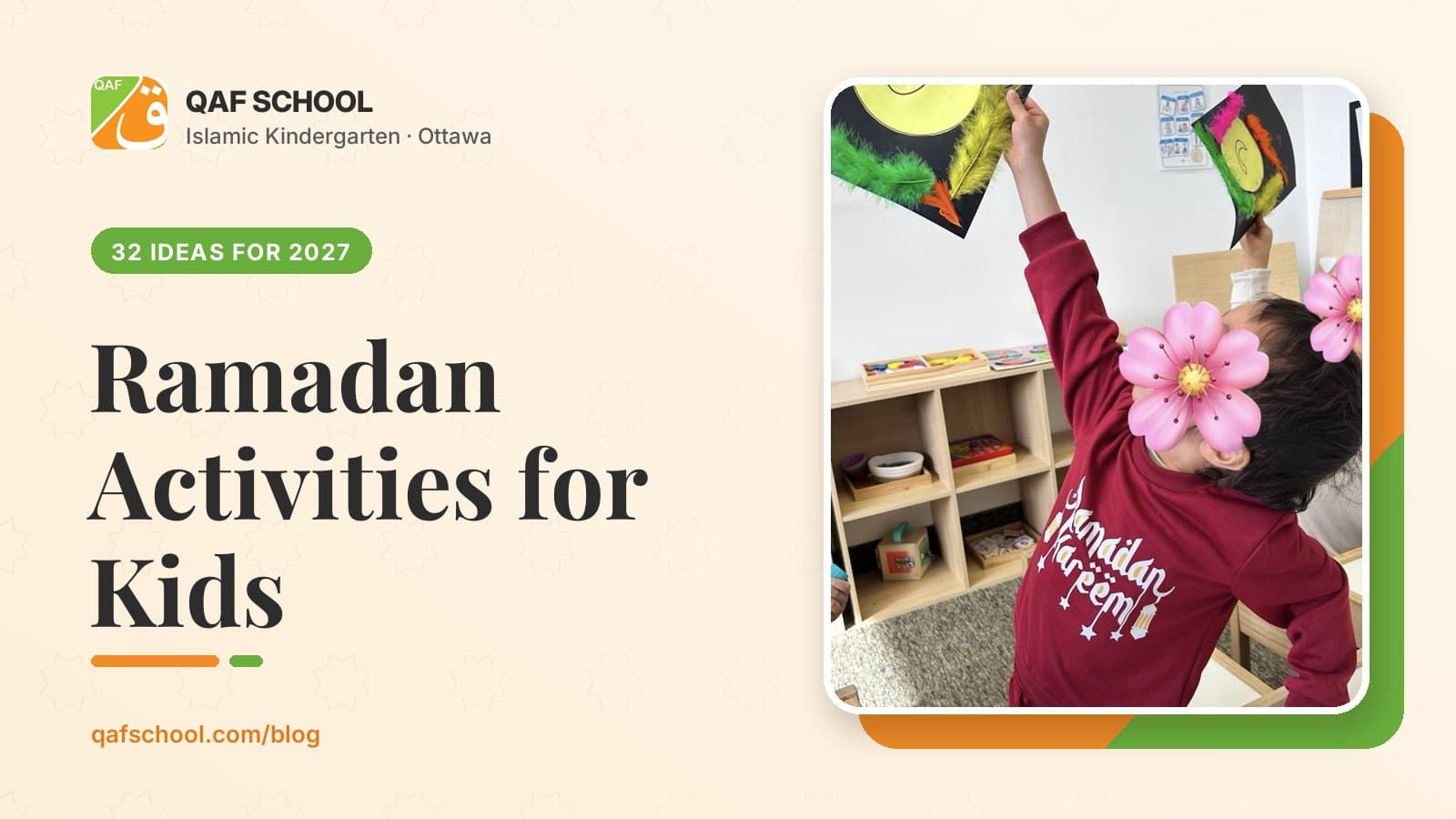
The best Ramadan activities for kids are short, hands-on and repeated every day: a good-deed calendar, a simple craft, one small Quran or dua goal, and a real job at iftar. Below are 32 Ramadan activities for kids, sorted by type and labelled by age, plus a ready-made 30-day calendar for Ramadan 2027.
Key takeaways
- Ramadan 2027 is expected to begin on or around Monday, February 8, 2027, with Eid al-Fitr around March 9 or 10 (depending on moon sighting).
- Pick one daily anchor (a good-deed calendar or a countdown) and add one or two extras. Children remember routines more than big one-off events.
- Match the activity to the age: toddlers need sensory and helping jobs, 4–6s love crafts and charts, and 7–10s are ready for real goals and practice fasts.
- Make the last ten nights feel different, and let kids lead some of the Eid preparations.
When is Ramadan 2027?
Ramadan 1448 AH is expected to start around Sunday evening, February 7, 2027, with the first fast on Monday, February 8. Eid al-Fitr is expected on Tuesday, March 9 or Wednesday, March 10, 2027. Exact dates depend on moon sighting, so confirm with your local mosque. Astronomical projections for North America are published at moonsighting.com.
| Milestone | Expected date (2027) |
|---|---|
| First taraweeh night | Sunday evening, Feb 7 |
| First day of fasting | Monday, Feb 8 |
| Last ten nights begin | Around the evening of Feb 27 |
| Eid al-Fitr | Tuesday, Mar 9 or Wednesday, Mar 10 |
A February Ramadan is good news for families in Canada. Days are short, so in Ottawa iftar falls at roughly 5:15 PM at the start of the month and around 6 PM by the end. That means children can sit at the iftar table without staying up late. Check your mosque's timetable for exact times.
Ramadan activities for kids by age
Not every idea suits every child. Use this table to pick activities that fit your child's attention span.
| Age | Attention span for one activity | Best activity types | Role in fasting |
|---|---|---|---|
| 2–3 | 5–10 minutes | Sensory play, moon-watching, simple helping jobs | None; join the family at iftar |
| 4–6 | 10–20 minutes | Crafts, sticker charts, short surahs, role-play | Optional "practice fasts" of a few hours, if parents choose |
| 7–10 | 20–45 minutes | Goals, journals, cooking, charity projects | Gradual partial or full-day fasts, guided by parents and health |
| 11+ | Longer projects | Leading family activities, volunteering, Quran goals | Many are approaching or at puberty, when fasting becomes obligatory |
Each activity below lists the ages it works best for. Choose five or six for the month rather than trying all of them.
Ramadan crafts for kids
Crafts give younger children a physical way to "see" Ramadan arriving. Make them in the week before Ramadan so they become part of the home for the whole month.
1. Moon-phase tracker
Draw a large circle divided into 30 sections on poster board. Each night, your child shades or sticks on a picture of the moon they saw (or would have seen, if it was cloudy). This teaches that Islamic months follow the moon. Best for: ages 4–10.
2. Paper lanterns (fanoos)
Fold coloured paper into simple lanterns and hang them over the iftar table or in a window. Older kids can cut star and crescent shapes so light shines through. Best for: ages 4–10, with adults handling scissors for younger ones.
3. Good-deed calendar
Make 30 pockets from envelopes or paper cups, each holding a small card with one good deed. Your child opens one each morning. This is the single most useful Ramadan activity for kids because it creates a daily habit. Best for: ages 3–10.
4. Sadaqah box
Decorate a tissue box or jar as the family charity box. Children add coins from chores or pocket money, then choose where it goes at the end of the month. Best for: ages 3–12.
5. Ramadan paper chain
Every time your child completes a good deed, they write or draw it on a paper strip and add it to the chain. By Eid, the chain may stretch across the room, which is a powerful visual for young kids. Best for: ages 4–8.
6. Mosque or prayer-corner model
Build a mosque from boxes, cups and paper towel rolls, or set up a small prayer corner with a child-sized prayer mat. Talking about the parts of the mosque (minaret, mihrab, wudu area) turns this into a lesson. Best for: ages 4–9.
Good deeds and charity activities
Ramadan is a month of generosity, and children learn generosity by doing it. Keep tasks small enough to finish in a day.
7. Neighbour treat bags
Pack small bags of dates or homemade cookies with a note explaining Ramadan, and deliver them to neighbours. This also gives non-Muslim neighbours a friendly introduction. Best for: ages 4–12.
8. Toy and clothing sort
Halfway through the month, ask your child to choose toys and clothes in good condition to donate. Let them pack the bag themselves. Best for: ages 4–12.
9. Food bank shopping trip
Give your child a small budget and a list of what your local food bank needs most, then shop together. In Ottawa, the Ottawa Food Bank and many mosque food drives post lists of their most-needed items. Best for: ages 6–12.
10. Kindness notes
Children write or draw short thank-you notes for teachers, grandparents, the bus driver or the mosque cleaner. Younger kids can colour a card and sign their name. Best for: ages 3–10.
11. Feed a fasting person
The Prophet (peace be upon him) said that whoever gives food to a fasting person to break their fast receives a reward like theirs, without reducing the fasting person's reward (Jami' at-Tirmidhi 807). Let children hand out dates and water at the mosque or to guests at home. Best for: ages 3–12.
12. Family charity vote
At the start of the last ten days, show your kids three causes (an orphan sponsorship, a local shelter, a water project) and let them vote on where the sadaqah box goes. Best for: ages 6–15.
Quran, dua and learning activities
A Quran goal for a child should be small and visible. One new short surah or one dua for the whole month is a real achievement for a four-year-old. Stories and games then explain why we fast, and work well in the late afternoon, when energy is low and the wait for iftar feels long.
13. One surah for Ramadan
Choose one short surah from Juz Amma, such as Al-Ikhlas or Al-Kawthar, and practise it after one prayer each day. Our list of short surahs for kids has easy starting points. Best for: ages 3–8.
14. Quran sticker chart
Track daily recitation with a chart: one sticker per page read, verse memorised or session listened to. Celebrate at the end of each week. Best for: ages 4–10.
15. The iftar dua
Teach the dua the Prophet (peace be upon him) used to say when breaking his fast:
ذَهَبَ الظَّمَأُ وَابْتَلَّتِ الْعُرُوقُ وَثَبَتَ الأَجْرُ إِنْ شَاءَ اللَّهُ
Dhahaba al-zama' wabtallat al-'urooq wa thabata al-ajru in sha' Allah: "The thirst has gone, the veins are moistened, and the reward is confirmed, if Allah wills" (Sunan Abi Dawud 2357). Let your child say it aloud for the family each night. Best for: ages 4–12.
16. Dua jar
Family members write duas on slips of paper and put them in a jar. Before iftar, when dua is especially hoped to be answered, a child pulls out a few and the family makes them together. For more ideas, see our guide to daily duas for kids. Best for: ages 4–12.
17. Listen-along time
For toddlers, simply playing a short surah during a calm moment each day builds familiarity. Many families use the free recitations on Quran.com for this. Best for: ages 2–5.
18. Bedtime Ramadan stories
Read one short story about Ramadan, the prophets or kindness each night. Our list of the best Islamic books for kids includes picture books about Ramadan and Eid. Best for: ages 2–10.
19. Prophet story of the week
Each week, focus on one prophet's story, followed by a drawing or a short retelling at iftar. Best for: ages 4–10.
20. Ramadan word hunt
Hide cards around the house with Ramadan words: suhoor, iftar, sadaqah, taraweeh, Laylat al-Qadr. Kids find them and explain each word. Best for: ages 5–10.
21. Islamic quiz night
Older children write five quiz questions about what they have learned and quiz the family after iftar. Best for: ages 7–15.
22. Gratitude journal
Each day, your child writes or draws one thing they are thankful for. Fasting makes children notice everyday blessings like water and food. Best for: ages 5–12.
23. Mini prayer practice
Invite young children to stand beside you for one prayer each day. Short and positive is better than long and forced. Our guide on how to teach kids salah gives a step-by-step approach. Best for: ages 4–10.
Iftar and suhoor helpers
Children who help prepare iftar feel part of the fast even if they are not fasting. Give each child a named job.
24. Date counter
The youngest child places dates on a plate, one or three per person. This builds counting skills and gives a toddler an important job. Best for: ages 2–5.
25. Table setter
Children set the table, fold napkins and fill water cups before the adhan. A simple picture checklist helps non-readers. Best for: ages 3–8.
26. Junior chef night
Once a week, let an older child plan and help cook one dish, such as a fruit salad, smoothie or simple soup. Stay close for anything involving knives or heat. Best for: ages 6–12.
27. Adhan watcher
A child keeps an eye on the clock or prayer app and announces "Five minutes to Maghrib!" This teaches time-telling and prayer awareness. Best for: ages 5–10.
28. Weekend suhoor club
On weekends, older children can wake for suhoor, even if they are not fasting the whole day. Eating together in the quiet early morning is often one of the strongest Ramadan memories. Best for: ages 7+.
Last ten nights and Eid countdown
The last ten nights include Laylat al-Qadr, which Allah describes as "better than a thousand months" (Surah Al-Qadr 97:3). Mark these nights so children feel the change.
29. Special night lights
Switch on fairy lights or lanterns only during the last ten nights. Children quickly link the lights with "the special nights." Best for: ages 2–10.
30. Laylat al-Qadr family hour
On one or more odd nights, hold a short family session: a story, one surah, a family dua and a special snack. Keep it to 20–30 minutes for younger children. Best for: ages 4–12.
31. Eid card workshop
Children make Eid cards for grandparents, teachers and friends. Mail them early if family lives far away. Best for: ages 3–12.
32. Eid decoration and gift prep
Let children decorate the house and wrap small gifts for siblings or cousins. Our Eid gift ideas for kids guide has ideas by age and budget. Best for: ages 3–15.
A 30-day Ramadan calendar for kids
Here is a simple plan you can copy onto your good-deed calendar. Swap any day for something that suits your family.
| Week | Daily focus | Activities |
|---|---|---|
| Before Ramadan | Get ready | Make the good-deed calendar (3), moon tracker (1) and lanterns (2) |
| Days 1–7 | Routines | Iftar dua (15), date counter (24), table setter (25), choose a surah (13), kindness notes (10) |
| Days 8–14 | Giving | Neighbour treat bags (7), sadaqah box top-up (4), food bank trip (9), prophet story (19) |
| Days 15–20 | Learning | Toy sort (8), word hunt (20), junior chef night (26), quiz night (21), gratitude journal (22) |
| Days 21–30 | Worship and Eid | Night lights (29), family hour (30), charity vote (12), Eid cards (31), decorations (32) |
Tip: Keep the daily good-deed cards realistic for school days. "Help pack your lunch" or "say salaam to a classmate" works better on a Monday than "volunteer for an afternoon."
Should young children fast?
Fasting becomes obligatory at puberty, so young children are not required to fast. Many families still offer "practice fasts" so children feel included. The companions did this too: Ar-Rubayyi' bint Mu'awwidh described how they had their children fast and gave them toys made of wool to keep them busy until iftar (Sahih al-Bukhari 1960).
A gentle approach for school-age children:
- Step 1: Start with a "half-day" fast on a weekend, such as from suhoor or breakfast until lunch.
- Step 2: Extend gradually by an hour or two as your child shows they are comfortable.
- Step 3: Keep water available for younger children, and make sure suhoor and iftar are nourishing.
- Step 4: Stop the fast immediately if your child seems unwell, dizzy or very tired.
Health guidance, such as the Saudi Ministry of Health's advice on children fasting, stresses a gradual start and breaking the fast at any sign of dehydration or exhaustion. If your child has a medical condition, talk to your doctor first.
In our classroom, we have found that children who are not fasting still feel fully part of Ramadan when they have a role: handing out dates, leading a dua, or telling the class about their family's iftar.
Ramadan with kids in Ottawa
Ottawa has a large and active Muslim community, and Ramadan here is very much a shared experience. Here is how local families typically make the most of it.
- Community iftars: Many Ottawa mosques serve iftar during Ramadan, and some host family nights. Islamic charities such as Islamic Relief Canada and IDRF have also held ticketed community iftars in Ottawa in past years. Check your mosque's website or social media in January for the 2027 schedule.
- Taraweeh with kids: Children are often welcome for part of taraweeh. Bring a quiet activity, sit near the back, and leave early with younger ones. Because iftar is early in February, taraweeh starts early enough for many families to attend.
- School days: Ramadan 2027 falls during the school term, including Ontario's Family Day long weekend (Monday, February 15, 2027). Plan bigger activities for weekends and that long weekend.
- Winter weather: February in Ottawa is cold. Moon-watching may happen through a window, so the moon tracker (activity 1) is ideal.
At QAF School, Ramadan is woven into the school day through Quran, duas and Islamic Studies, so the habits you build at home are reinforced in class. You can read more about our full-day Islamic kindergarten program or what building Islamic identity in the early years looks like in practice.
Making Ramadan memorable for kids
The goal of Ramadan activities for kids is not perfection. It is for your child to feel, year after year, that Ramadan is the best month of the year. Choose a daily anchor, give each child a job, mark the last ten nights, and let them help get ready for Eid.
Start small this year. A four-year-old who learns one surah, fills a sadaqah box and hands out dates at iftar has had a wonderful Ramadan.
Looking for an Islamic kindergarten in Ottawa? QAF School offers full-day Islamic JK and SK with daily Arabic, Quran and Islamic Studies, so Ramadan values continue every day of the year. Submit an inquiry or book a visit.