Does small class size in kindergarten actually matter? The research says yes, especially in the early years, but with an important caveat: a smaller class only helps if the adults in the room teach differently because of it. This guide explains what the evidence shows, how Ontario's kindergarten class size rules work, and how to tell whether a "small class" is genuinely benefiting your child.
Key takeaways
- The strongest class size research comes from the early grades. The Tennessee STAR experiment found benefits from classes of about 13–17 students in kindergarten to Grade 3.
- In Ontario public schools, full-day kindergarten classes are capped at 29 (with limited exceptions), with a board-wide average of 26. Classes of 16 or more usually have a teacher and an early childhood educator.
- Small classes help most through more one-on-one talk, faster feedback and calmer routines, not through the number itself.
- Ask about the adult-to-child ratio and how the day is organized, not just the headcount.
- Teacher quality and warmth matter as much as size. A great teacher in a class of 24 can beat a weak one in a class of 12.
What counts as a small class size in kindergarten?
A small class size in kindergarten generally means about 15–18 children or fewer, ideally with two adults in the room. That benchmark comes partly from research and partly from comparison with Ontario's public system.
Here is how the numbers compare:
| Setting | Typical rule or benchmark | Adults in the room |
|---|---|---|
| Ontario public full-day kindergarten | Cap of 29 per class; board average of 26 or less | Teacher plus a designated early childhood educator when 16+ children |
| Ontario public Grades 1–3 | 23 maximum; 90% of classes at 20 or fewer | Usually one teacher |
| Licensed child care, kindergarten age group | 1 staff to 13 children; groups of up to 26 | Varies with group size |
| Tennessee STAR "small" classes (research) | 13–17 students | One teacher |
| Private and independent schools | Set by each school | Set by each school |
The public school figures come from Ontario's class size regulation, O. Reg. 132/12, which also allows up to 10% of a board's kindergarten-only classes to exceed 29 (to a maximum of 32) in limited circumstances. The early childhood educator rule is in O. Reg. 224/10, which exempts boards from assigning an early childhood educator to a class with fewer than 16 kindergarten pupils (one class per school, under certain conditions). Child care ratios are set by the Child Care and Early Years Act regulation.
Private schools are not bound by the public class size caps. Each sets its own numbers, which is why you need to ask.
What the research says about class size
The Tennessee STAR experiment
The best-known study on class size is Tennessee's Project STAR, run in the late 1980s. Children entering kindergarten were randomly assigned to small classes (13–17 students) or regular classes (22–25 students) and stayed in that arrangement through Grade 3. Random assignment makes it unusually strong evidence.
Children in small classes scored higher in the early grades. A later follow-up by economist Raj Chetty and colleagues, summarized by J-PAL, found that being in a smaller class raised college attendance by 1.8 percentage points. The same research found that test score gains faded over time, while gains in non-cognitive skills such as effort and initiative lasted longer.
Who benefits most
A research review by Diane Whitmore Schanzenbach for the National Education Policy Center concluded that class size affects outcomes from test scores to broader life outcomes, and that smaller classes are particularly effective for children from lower-income families. Researchers also generally agree that the effects are largest in the earliest grades.
The honest caveats
Not every economist agrees on how big the effect is. Critics such as Eric Hanushek have argued that the benefits appear only with large reductions (down to the 13–17 range) and that small trims, say from 25 to 23, show little effect. Class size reduction is also expensive, so school systems weigh it against other spending.
The fair summary: small classes in kindergarten and the early grades can help, the effect is real but modest on test scores, and the longer-term benefits seem to flow through social and behavioural skills.
Why small classes help young children
The size itself does nothing. What matters is what a smaller group makes possible.
More back-and-forth conversation
Young children learn language through responsive exchanges with adults. Harvard's Center on the Developing Child calls this serve and return: a child says or does something, and an adult responds. With fewer children per adult, each child gets more of those exchanges every day.
Faster, more personal feedback
In a smaller group, a teacher notices sooner when a child is holding a pencil awkwardly, mixing up two Arabic letters or struggling to join play. Small problems get addressed in days instead of weeks.
Calmer routines
Transitions (coats on, lining up, washing hands, tidying) take less time with fewer children. That leaves more of the day for learning and play, and less time waiting.
Easier social learning
Four-year-olds are still learning to share, take turns and repair friendships. A teacher with fewer children can coach those moments as they happen instead of only stepping in when something goes wrong.
Better fit for individual learning
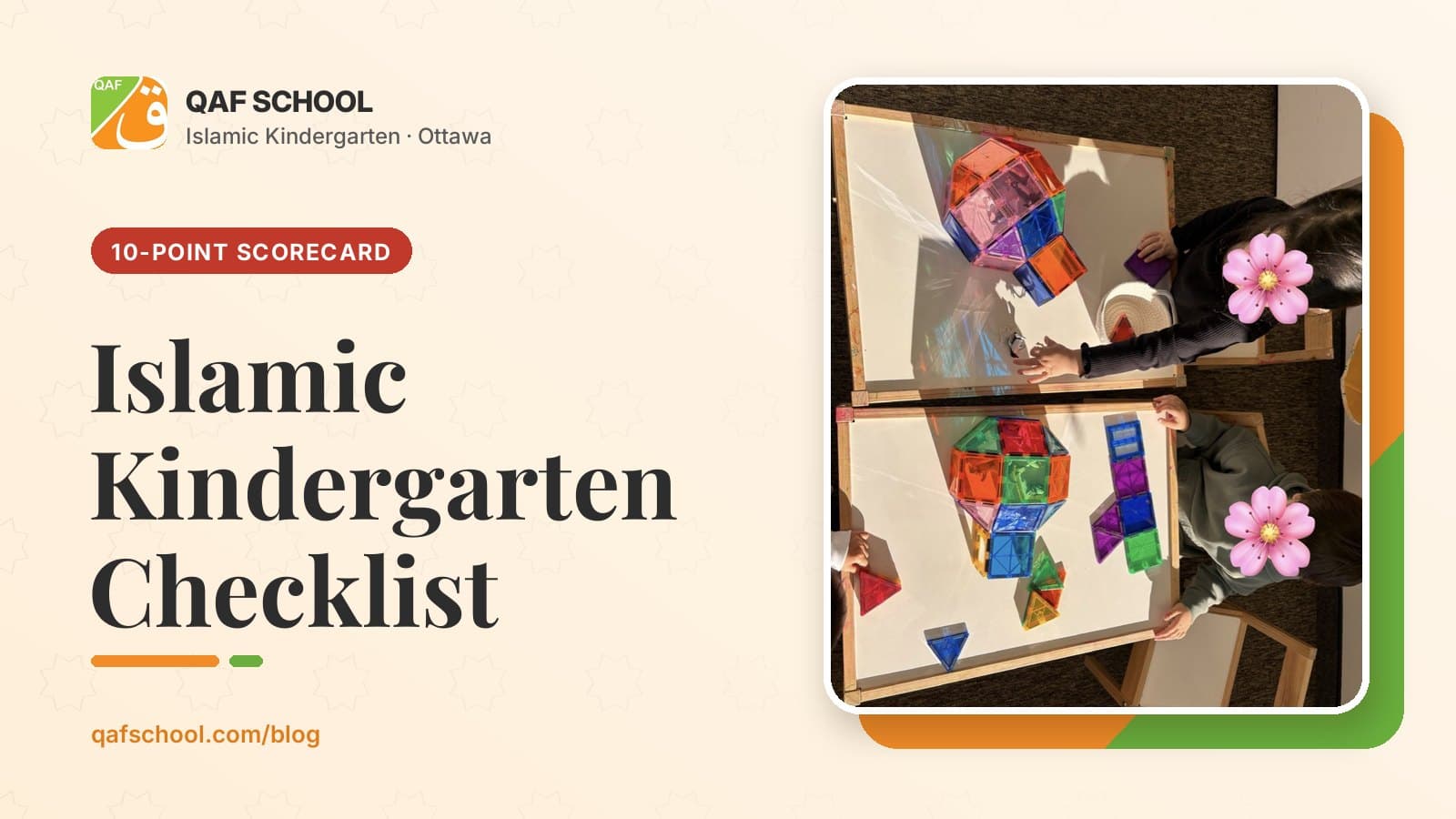
Approaches that let children choose and repeat activities, such as Montessori-inspired work periods, depend on an adult who can observe each child and present the next lesson at the right moment. That is much easier with a manageable group. Our post on Montessori meets Islamic values explains how this works in an Islamic classroom.
Class size vs ratio: which matters more?
Class size is the number of children in the room. Ratio is the number of children per adult. For kindergarten, ratio is often the better measure.
A class of 26 with a teacher and an early childhood educator has a ratio of 1:13. A class of 16 with one teacher has a ratio of 1:16. The second class is smaller but has less adult attention per child.
Ask about both, and ask how the adults work together. In the strongest classrooms, both adults are actively teaching, observing and talking with children, not one teaching while the other handles only supervision or paperwork.
Signs a small class is actually working
A low number on paper is not enough. When you visit, look for these:
- Children are talking with adults, not just listening. You should hear lots of individual conversation.
- The teacher knows each child well. Ask about a specific child's progress (your own, if they are enrolled). A teacher in a small class should answer with detail.
- Children work in small groups or alone, not always as a whole class. Small classes should mean less time sitting on the carpet waiting.
- Feedback to parents is specific. Updates mention what your child did, said or tried, not generic praise.
- The room is calm but busy. Purposeful noise, few long queues, smooth transitions.
Our list of questions to ask on a school tour includes the exact questions to ask about class size, staffing and teacher experience.
When a small class is not the deciding factor
Class size is one factor among many. For some families, other things matter more:
- Teacher quality. The STAR follow-up found that having a more experienced kindergarten teacher was linked to higher adult earnings. An excellent teacher matters enormously.
- Program content. If you want daily Arabic, Quran and Islamic Studies, a small class without them will not meet your goals.
- Distance and schedule. A school you can reach reliably every day beats a slightly smaller class an hour away.
- Cost. Smaller classes cost more to run, which is reflected in private school tuition. Our guide to private kindergarten in Ottawa explains what tuition typically covers.
If you are comparing schools on several criteria, our Islamic kindergarten checklist offers a scorecard that keeps class size in proportion.
Small classes in Ottawa's Islamic schools
Many families looking at Islamic schools in Ottawa mention class size as a reason for considering a private option. Sizes vary widely between schools and between grades, and they can change from year to year with enrolment, so always ask for current numbers for your child's specific class.
Useful questions to put to any school:
- How many children are in the JK/SK class this year, and what is the maximum?
- How many adults are in the room for most of the day?
- Are JK and SK combined or separate?
- What are the staff's qualifications and experience?
- Does the class split into smaller groups for Arabic or Quran?
Is QAF right for your family?
QAF is a full-day Islamic JK/SK for four- and five-year-olds at 900 Dynes Rd in Nepean, Monday to Friday, 9:00 AM to 3:00 PM, September to June. The day is built around a Montessori-inspired morning work cycle from 9:20 to 11:00, daily Arabic immersion, Quran from Juz Amma, Islamic Studies, duas and adab, aligned with Ontario's kindergarten curriculum. Parents see daily photos and updates through ClassDojo.
QAF suits families who want individual attention inside an Islamic environment, and who can manage a daily commute to Nepean. Tuition is $690 per month for ten months plus a $190 annual resource fee. If your child is outside the 4–5 age range, or private tuition does not fit your budget, a public kindergarten with a weekend Quran program may be the better choice. When you visit, ask us about this year's class size and staffing; we will give you the exact numbers. You can read more about our Islamic kindergarten in Ottawa.
See the classroom for yourself. Submit an inquiry to book a visit, meet the teachers and watch a morning work cycle, or call or WhatsApp us with questions.