Wondering what to expect at a school visit? A typical visit to an Islamic school or private kindergarten takes under an hour: a short welcome, a walk through the classroom and shared spaces, time to watch children at work, and a sit-down conversation about the program, schedule and fees. This guide explains each stage, what to bring, how to involve your child, and what to look for so you leave with a clear answer, not just a good feeling.
Key takeaways
- Most school visits follow the same pattern: inquiry, scheduled visit, classroom walk-through, Q&A, next steps.
- Visit on a regular school morning if you can. You learn far more from watching a real class than from an empty room.
- Bring your child for at least part of the visit. It helps you see how staff interact with them and makes September less scary.
- Watch the adults as closely as the space: tone of voice, how they handle a crying or distracted child, how they speak to each other.
- Leave with written information on fees, schedule and the next admissions step.
What to expect at a school visit, step by step
Every school runs visits a little differently, but the overall flow is similar.
Step 1: You submit an inquiry
Most Islamic and private schools ask you to start with an inquiry form, a phone call or a message. You share your child's name, birth year and the grade you are interested in, plus any questions. This lets the school check whether there is likely to be space and match you with the right staff member.
Step 2: The school arranges a time
Someone from the school contacts you to book a visit. Ask for a time during the school day, ideally mid-morning, when children are working or playing rather than arriving or eating lunch. If you work full-time, ask whether early or late slots are possible.
Step 3: Welcome and introductions
You will usually be met at the entrance or front office. This is a good moment to notice the basics: Is the entrance secure? Are visitors signed in? Is the welcome warm?
Step 4: Classroom walk-through and observation
This is the heart of the visit. You will see the classroom, washrooms, cubbies, prayer area if there is one, and outdoor play space. If class is in session, you may watch for 10 to 20 minutes. Try to stay quiet and in the background so the children carry on as normal.
Step 5: Conversation and questions
Afterwards, expect a conversation with the principal, director or a teacher. They will explain the program, a typical day, schedule, fees and admissions, then answer your questions.
Step 6: Next steps
A good visit ends with clarity. You should know whether a spot is available, what the application or registration step is, and when you need to decide.
Before the visit: how to prepare
A little preparation turns a pleasant tour into a useful one.
- Write down your top three priorities. For example: daily Quran and Arabic, a calm full-day schedule, and strong communication with parents.
- Bring a short question list. Our list of questions to ask on a school tour has 40 to choose from; pick the 8 to 10 that matter most to you.
- Check the website and FAQ first. Then you can spend the visit on questions the website does not answer.
- Plan the commute. Drive or take transit to the visit at the time you would do drop-off. It is the most honest test of whether the school works for your family.
- Prepare your child. Tell them simply: "We are going to see a school. You can look at the toys and say salaam to the teacher."
Should you bring your child?
Yes, for at least part of the visit. Seeing the school helps a young child imagine themselves there, and Ontario's kindergarten preparation advice suggests visiting the school ahead of time so children feel more comfortable.
Bringing your child also tells you something important: how staff respond to a new, possibly shy four-year-old. A teacher who crouches to eye level, says your child's name and invites them to look at something is showing you exactly how they will greet your child every morning.
If your child is very young, tired or easily overwhelmed, consider visiting alone first and returning with them for a short second visit.
What to look for in the classroom
The space tells you a lot, but the people tell you more.
The adults
- Do teachers speak calmly and kindly, even when redirecting a child?
- Are they at children's eye level, talking with them, or mostly standing and supervising?
- How do they handle a child who is upset or not following instructions?
- Do staff seem to work well together?
Responsive, back-and-forth interaction is one of the most important ingredients of early learning; Harvard's Center on the Developing Child calls it serve and return. You should see plenty of it.
The children
- Are most children engaged, or are many wandering or waiting?
- Do they seem comfortable approaching adults?
- Is the noise level purposeful rather than chaotic or silent?
The environment
- Are materials at child height and well organized?
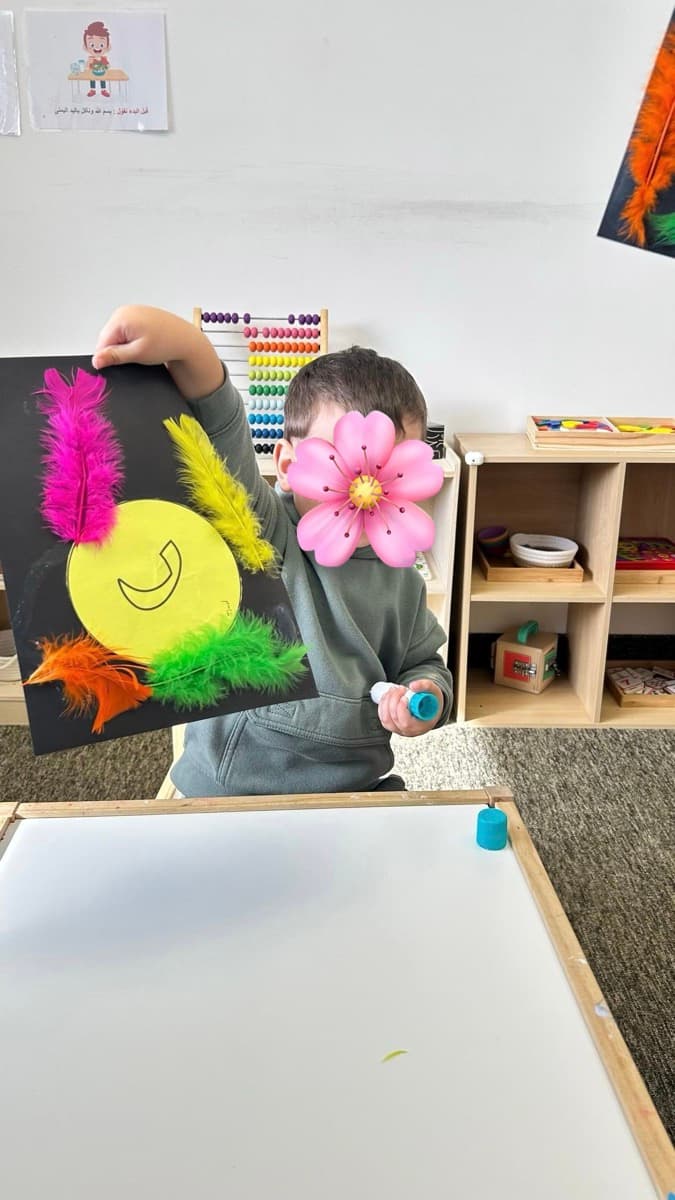
- Is children's work displayed, including Arabic letters or Quran-related work?
- Are washrooms clean and easy for small children to use?
- Is there safe outdoor space and a clear plan for winter?
The Islamic environment
- Is there a calm space for salah, and how is prayer introduced to young children?
- How are Quran, duas and Arabic woven through the day, beyond a single lesson?
- How do teachers model adab: greetings, gentleness, gratitude?
If you want to understand how Montessori-inspired classrooms in particular should look, our post on Montessori meets Islamic values explains the prepared environment.
Questions to ask in the conversation
You will not have time for everything. These are the questions that most often change parents' decisions:
- What does a typical day look like, hour by hour?
- How many children are in the class, and how many adults?
- How much time is spent on Arabic and Quran each day?
- How do you communicate with parents, and how often?
- How is the program aligned with Ontario's kindergarten curriculum, and how will you report progress? (Public kindergartens use Ontario's Communication of Learning reports, which is a useful comparison.)
- What are the total annual costs, including fees beyond tuition?
- What is your approach to behaviour and conflict between children?
- What are your policies on food, allergies and halal?
- What happens if my child struggles to separate at drop-off?
- What is the next step if we want to enrol, and by when?
Ontario's guidance on choosing a private school also suggests asking about staff background checks, the school's code of conduct, written fee and refund contracts, complaint procedures and student records policies.
Red flags and green flags
| Green flags | Red flags |
|---|---|
| Staff welcome your child by name and at eye level | Children are kept out of view or visits avoid class time |
| Clear, written information on fees and schedule | Vague answers about total cost or refund terms |
| Specific answers about how progress is shared | "We'll figure it out" on communication |
| Calm, purposeful classroom noise | Long waiting times, frequent shouting |
| Honest about who the school is not right for | Pressure to pay a deposit on the spot |
| Safe entry and visitor sign-in | Unclear who is allowed into the building |
No school is perfect. One small issue is not a deal-breaker, but a pattern of vague answers usually is.
After the visit: making the decision
Write down your impressions within an hour, while they are fresh. Note what your child did and said; their reaction is useful information.
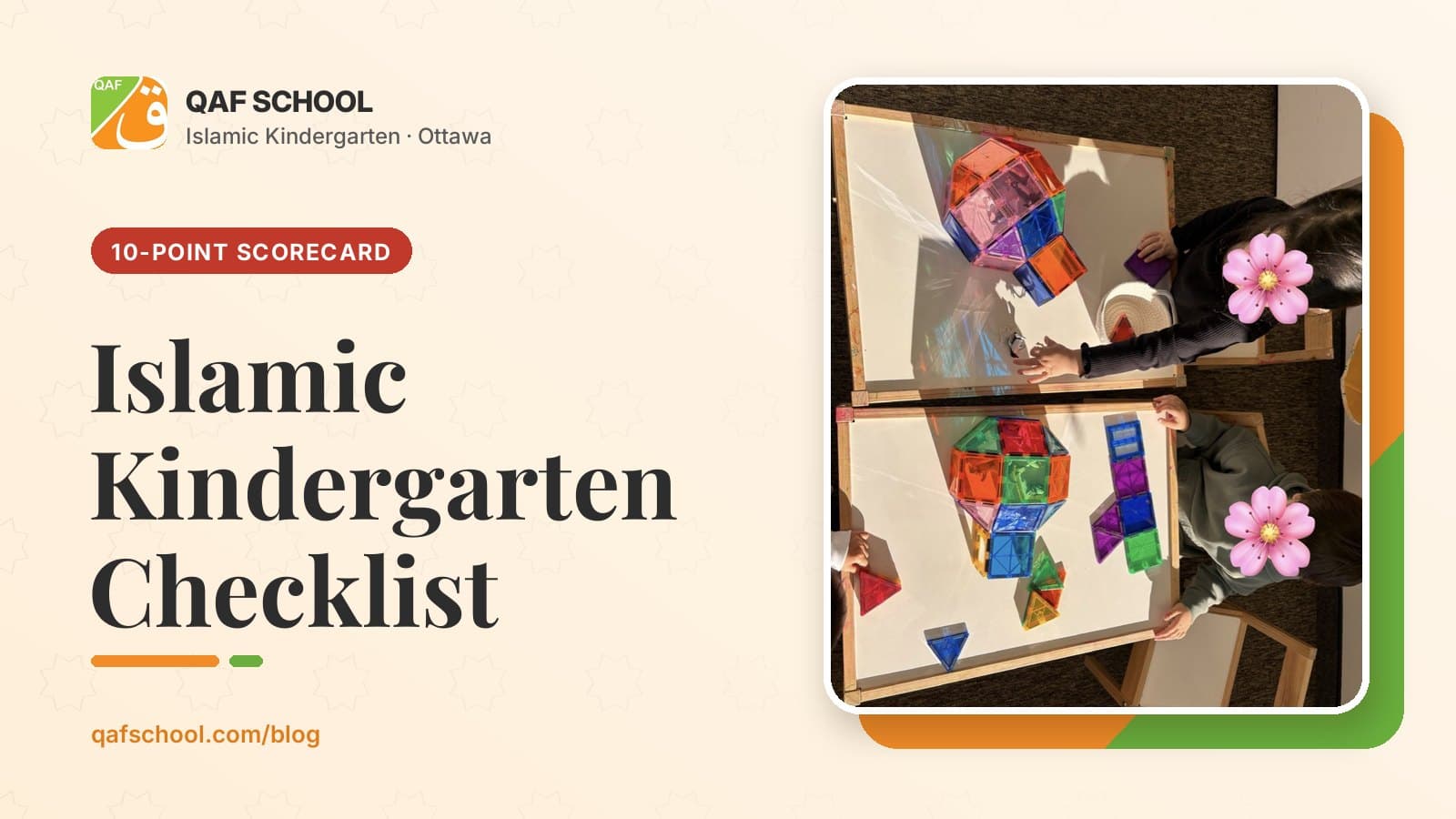
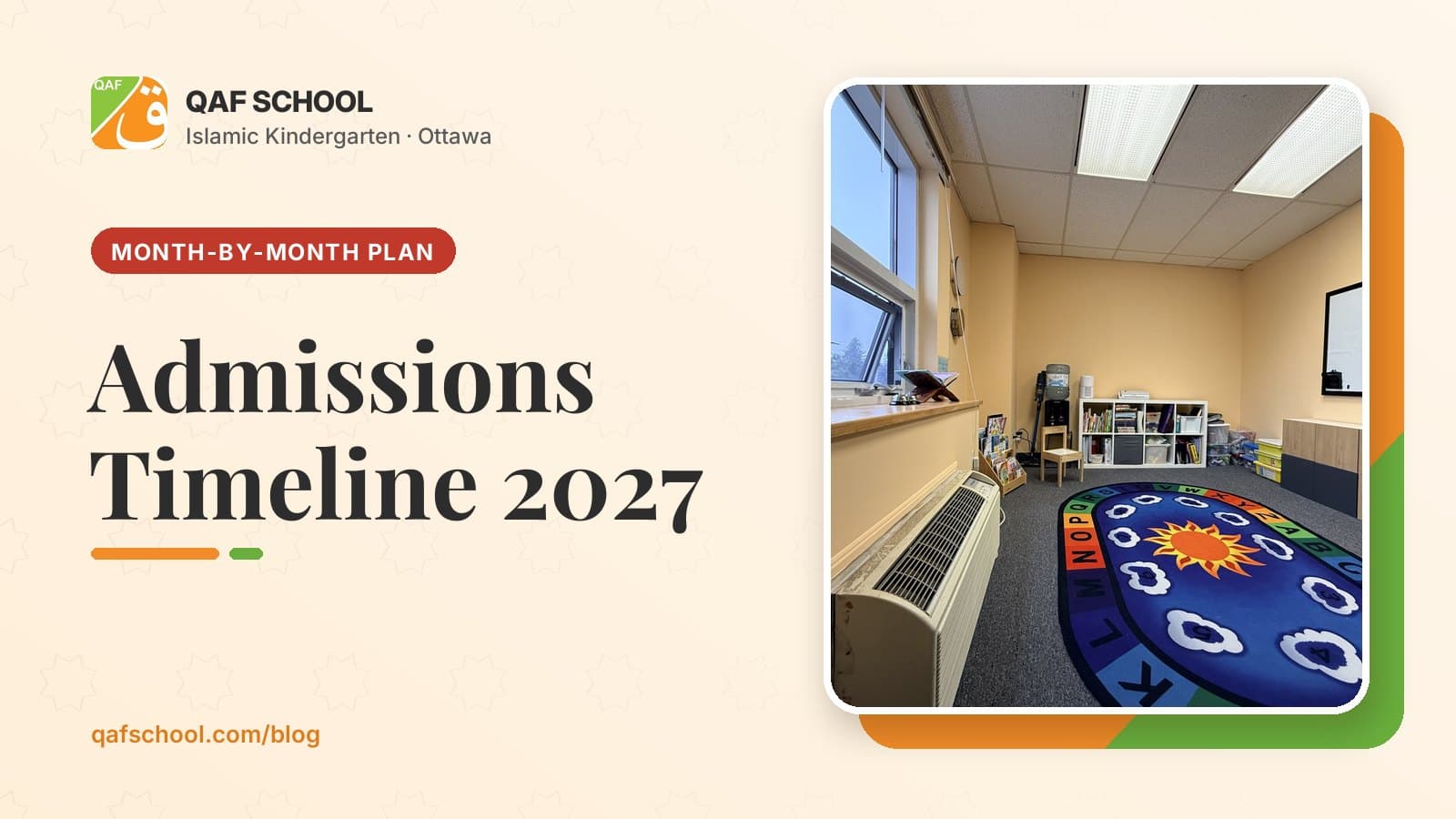
Then compare schools side by side. Our Islamic kindergarten checklist offers a simple scorecard, and our overview of Islamic schools in Ottawa helps if you want to add another school to your list. If timing matters, our Islamic school admissions timeline shows when to decide for September 2027.
It is completely normal to ask for a second visit, a call with the teacher, or time to discuss with family before committing.
What a visit to QAF looks like
At QAF, the path is simple: you submit an inquiry, our team follows up to arrange a time, and you visit with your child. If you can, ask for a time during the school day so you can see the Montessori-inspired morning work cycle, which runs from 9:20 to 11:00, along with Arabic, Quran and Islamic Studies in action.
During the conversation we will walk you through the day (9:00 AM to 3:00 PM, Monday to Friday, September to June), our approach to Arabic immersion and short surahs from Juz Amma, how we keep parents updated through ClassDojo, and fees: $690 per month for ten months plus a $190 annual resource fee, with a sibling discount. Bring your questions on food too; QAF is nut-free and all food must be halal, with families packing lunch and two snacks.
Is QAF right for your family?
QAF is a full-day Islamic JK/SK for four- and five-year-olds at 900 Dynes Rd in Nepean, aligned with Ontario's kindergarten curriculum, with daily Arabic, Quran, Islamic Studies, duas and adab. It suits families who want faith and Arabic woven through the whole school day and who can reach Nepean easily each morning.
It is not the right fit if your child is older than kindergarten age, or if a weekday commute to Dynes Rd would be a daily struggle. For children aged 8 to 15, our Sunday Quran and Arabic camp in Ottawa runs on Sundays at the same address. If you are still deciding whether a weekday Islamic school is right at all, a visit is the best way to find out. Read more about our Islamic kindergarten in Ottawa.
Ready to see the classroom? Submit an inquiry and we will arrange a visit for you and your child, or call or WhatsApp us with any questions first.