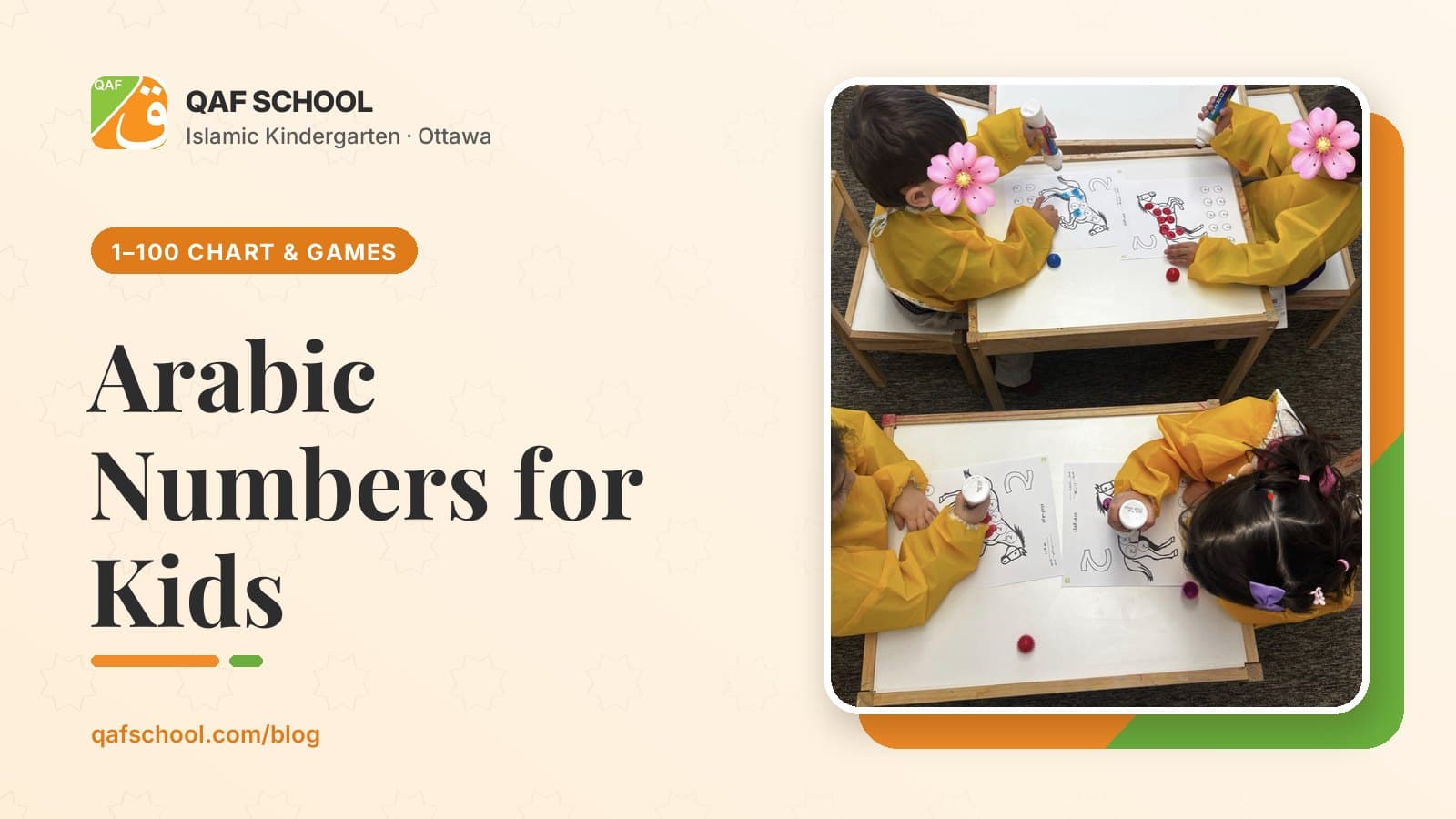
Arabic numbers for kids come in two parts: the number words (وَاحِد، اِثْنَان، ثَلَاثَة… one, two, three) and the digits used across much of the Arab world, called Eastern Arabic numerals (١ ٢ ٣). This guide gives you both, from 0 to 100, in clear tables with harakat and pronunciation, plus the simple rule for counting from 21 to 99, memory tricks for the digits, and games that make counting in Arabic stick.
Key takeaways
- Learn the words for 0–10 first. Everything up to 99 is built from them.
- Eastern Arabic digits (٠١٢٣٤٥٦٧٨٩) are used in much of the Middle East; North Africa mostly uses the 0–9 digits familiar in Canada.
- Multi-digit numbers are written left to right, even inside right-to-left Arabic text.
- From 21 to 99, Arabic says the ones first: "one and twenty" (وَاحِد وَعِشْرُون).
- Watch out for ٦ (six), which looks like an English 7, and ٧ (seven), which looks like a V.
Arabic numbers for kids: words and digits
Children learning Arabic numbers meet two separate things:
- Number words, which they say aloud when counting: وَاحِد (wāḥid, one), اِثْنَان (ithnān, two), and so on.
- Number symbols, the digits they read in books, on clocks and in the mushaf.
There is a fun twist for Canadian kids. The digits 0 to 9 used in English are themselves called "Arabic numerals." Historians trace the place-value system to India, and the system reached Europe through Arabic-speaking scholars in Spain and North Africa, which is how the name stuck (overview of Arabic numerals). The digits that look different, ١ ٢ ٣, are called Eastern Arabic numerals and are common in Arabic-speaking countries of the Middle East, often alongside the 0–9 digits. In the Maghreb, the 0–9 digits are the ones normally used (Eastern Arabic numerals).
So a child who can count in English already knows one set of "Arabic" digits. They just need the words, and the Eastern digits.
In the tables below, the words are written the way you say them when counting aloud, without the grammatical endings used inside sentences.
Arabic numbers 0–10
| Number | Eastern digit | Arabic word | Say it | Memory tip |
|---|---|---|---|---|
| 0 | ٠ | صِفْر | ṣifr | Zero is just a dot |
| 1 | ١ | وَاحِد | wāḥid | Looks like our 1 |
| 2 | ٢ | اِثْنَان | ithnān | One hook on top |
| 3 | ٣ | ثَلَاثَة | thalātha | Two hooks on top |
| 4 | ٤ | أَرْبَعَة | arbaʿa | Looks like a backwards 3 |
| 5 | ٥ | خَمْسَة | khamsa | A little circle (not a zero!) |
| 6 | ٦ | سِتَّة | sitta | Careful: looks like our 7 |
| 7 | ٧ | سَبْعَة | sabʿa | A V shape |
| 8 | ٨ | ثَمَانِيَة | thamāniya | An upside-down V |
| 9 | ٩ | تِسْعَة | tisʿa | Looks like our 9 |
| 10 | ١٠ | عَشَرَة | ʿashara | A 1 and a dot |
Pronunciation tips. The "th" in ثَلَاثَة and ثَمَانِيَة is the soft "th" of "three." The ع in أَرْبَعَة, سَبْعَة, تِسْعَة and عَشَرَة is a sound made deep in the throat that English doesn't have; let your child hear it from a native speaker or an app with clear audio. The خ in خَمْسَة is like the "ch" in the Scottish "loch."
Arabic numbers 11–100
Numbers 11–20
Numbers 11 to 19 combine a unit with عَشَر (ʿashar, ten), a little like "-teen" in English.
| Number | Eastern digits | Arabic | Say it |
|---|---|---|---|
| 11 | ١١ | أَحَدَ عَشَرَ | aḥada ʿashar |
| 12 | ١٢ | اِثْنَا عَشَرَ | ithnā ʿashar |
| 13 | ١٣ | ثَلَاثَةَ عَشَرَ | thalāthata ʿashar |
| 14 | ١٤ | أَرْبَعَةَ عَشَرَ | arbaʿata ʿashar |
| 15 | ١٥ | خَمْسَةَ عَشَرَ | khamsata ʿashar |
| 16 | ١٦ | سِتَّةَ عَشَرَ | sittata ʿashar |
| 17 | ١٧ | سَبْعَةَ عَشَرَ | sabʿata ʿashar |
| 18 | ١٨ | ثَمَانِيَةَ عَشَرَ | thamāniyata ʿashar |
| 19 | ١٩ | تِسْعَةَ عَشَرَ | tisʿata ʿashar |
| 20 | ٢٠ | عِشْرُون | ʿishrūn |
Notice that 11 uses أَحَدَ (aḥada), not وَاحِد. Children often say "wāḥid ʿashar" at first; a gentle correction is enough.
The tens: 20 to 100
The tens are easy once you spot the pattern: most are the unit word plus the ending ـُون (-ūn).
| Number | Eastern digits | Arabic | Say it | Built from |
|---|---|---|---|---|
| 20 | ٢٠ | عِشْرُون | ʿishrūn | (special form) |
| 30 | ٣٠ | ثَلَاثُون | thalāthūn | ثَلَاثَة + ūn |
| 40 | ٤٠ | أَرْبَعُون | arbaʿūn | أَرْبَعَة + ūn |
| 50 | ٥٠ | خَمْسُون | khamsūn | خَمْسَة + ūn |
| 60 | ٦٠ | سِتُّون | sittūn | سِتَّة + ūn |
| 70 | ٧٠ | سَبْعُون | sabʿūn | سَبْعَة + ūn |
| 80 | ٨٠ | ثَمَانُون | thamānūn | ثَمَانِيَة + ūn |
| 90 | ٩٠ | تِسْعُون | tisʿūn | تِسْعَة + ūn |
| 100 | ١٠٠ | مِائَة | miʾa | (special word) |
A spelling note on 100. You will see "one hundred" written two ways: مِائَة (the traditional spelling, with an alif that is not pronounced) and مِئَة (a modern spelling). Both are read miʾa. Children's books use either, so show your child both.
Bonus for older children: 1,000 is أَلْف (alf), written ١٠٠٠.
How to count from 21 to 99 in Arabic
Here is the rule that unlocks every number to 99: say the ones first, then وَ (wa, "and"), then the tens. Twenty-one is literally "one and twenty."
| Number | Eastern digits | Arabic | Say it |
|---|---|---|---|
| 21 | ٢١ | وَاحِد وَعِشْرُون | wāḥid wa-ʿishrūn |
| 22 | ٢٢ | اِثْنَان وَعِشْرُون | ithnān wa-ʿishrūn |
| 25 | ٢٥ | خَمْسَة وَعِشْرُون | khamsa wa-ʿishrūn |
| 34 | ٣٤ | أَرْبَعَة وَثَلَاثُون | arbaʿa wa-thalāthūn |
| 47 | ٤٧ | سَبْعَة وَأَرْبَعُون | sabʿa wa-arbaʿūn |
| 58 | ٥٨ | ثَمَانِيَة وَخَمْسُون | thamāniya wa-khamsūn |
| 63 | ٦٣ | ثَلَاثَة وَسِتُّون | thalātha wa-sittūn |
| 76 | ٧٦ | سِتَّة وَسَبْعُون | sitta wa-sabʿūn |
| 89 | ٨٩ | تِسْعَة وَثَمَانُون | tisʿa wa-thamānūn |
| 99 | ٩٩ | تِسْعَة وَتِسْعُون | tisʿa wa-tisʿūn |
Step 1: Look at the ones digit and say its word. Step 2: Say "wa." Step 3: Look at the tens digit and say its tens word.
Older children who know the old English nursery rhyme "four and twenty blackbirds" will recognize the pattern immediately.
Reading and writing bigger numbers
Arabic text runs right to left, but numbers run left to right, with the biggest place value on the left, just like in English. So 25 is written ٢٥ (the ٢ on the left), and 2027 is written ٢٠٢٧.
This surprises many children, who expect everything in an Arabic book to go the other way. A simple way to explain it: "Words go right to left; numbers keep their own order."
Writing tips for young children:
- Teach ٠ as a small dot, not a circle. The circle shape ٥ means five, so mixing them up changes the number.
- Practise ٦ and ٧ side by side, since children who know English digits often read ٦ as seven.
- Use large grid paper so each digit sits in its own box.
For families who use Urdu or Persian digits
If your family reads Urdu or Persian, you may know a slightly different set of digits. Persian and Urdu forms of 4, 5 and 6 (and, in Urdu, 7) look different from the Arabic ones shown here; the others are the same or very close. Children can learn both sets easily if you point out which ones differ, and Quran and Arabic class materials will usually use the Arabic forms.
Teaching Arabic numbers by age
| Age | Realistic goals | What works |
|---|---|---|
| 3–4 | Count 1–10 aloud in Arabic; recognize a few digits | Songs, finger counting, counting snacks and stairs |
| 5–6 | Count to 20; read and write ٠–٩; count by tens to 100 | Number hunts, playdough digits, calendar time |
| 7–9 | Count to 100 using the "ones and tens" rule; read page numbers | Board games, dice games, reading the mushaf's page numbers |
| 10+ | Use numbers in sentences; begin number–noun agreement | Telling time, prices, simple word problems in Arabic |
In our kindergarten classroom we have found that children learn numbers fastest when counting is woven into the day: counting classmates at circle, counting steps on the way outside, counting crackers at snack. Ten seconds of counting, many times a day, beats a long worksheet.
10 games for learning Arabic numbers
- Counting everything. Stairs, buttons, grapes, cars on the street. Count aloud in Arabic, every day.
- Number hunt. Hide cards with ٠–٩ around a room. Your child finds each one and says its name.
- Hopscotch. Chalk Eastern digits into the squares; say each number as you land.
- Dice duel. Roll two dice, add them, and say the total in Arabic. Swap in a die marked with Eastern digits for extra practice.
- Snap or memory. Pair a digit card (٧) with a word card (سَبْعَة) or a picture of seven objects.
- Clothespin count. Write a digit on a paper plate; your child clips that many clothespins around the edge.
- Phone and calculator. Many phones can switch to Arabic digits in their language settings. Let older children dial a family member's number or do simple sums in Arabic digits.
- Calendar time. Each morning, say today's date in Arabic and count the days until the weekend, Eid or a birthday.
- Shop and pay. Play store with price tags in Eastern digits; children "pay" and count change.
- Page-number race. Call out a number and race to find that page in an Arabic book or a mushaf.
For more ideas that cover letters and vocabulary too, see our list of Arabic learning games, and for a bigger word list beyond numbers, our guide to Arabic words for kids. Colours make a natural next step after numbers: try colours in Arabic for kids.
A note for older learners: numbers and gender
Once children use numbers in sentences, they meet a famous Arabic rule: the numbers 3 to 10 take the opposite gender of the thing being counted. With a masculine noun, the number takes the ة ending; with a feminine noun, it drops it:
- ثَلَاثَةُ أَقْلَامٍ (thalāthatu aqlām, three pens; قَلَم is masculine)
- ثَلَاثُ تُفَّاحَاتٍ (thalāthu tuffāḥāt, three apples; تُفَّاحَة is feminine)
There is no need to teach this to young children. For counting, the forms in the tables above are what they need. Around ages 10 and up, when grammar starts to matter, this rule becomes a fun puzzle.
Numbers in a Muslim child's day
Arabic numbers become meaningful when children see them in real life:
- The mushaf. Many printed copies of the Quran number pages and ayahs with Eastern Arabic digits. A child who can read them can find "page ٥٨٢" or "ayah ٤" on their own. You can also check ayah numbers on Quran.com.
- Dhikr. Counting SubhanAllah on the fingers after salah is a natural, daily counting practice.
- Prayer times. Read the times on a prayer calendar together.
- Ramadan countdowns. Count the days of Ramadan in Arabic on a paper chain or calendar.
Is QAF right for your family?
For ages 4 and 5, our Islamic kindergarten in Ottawa teaches Arabic through daily immersion, so counting, numbers and early math happen in Arabic as part of a Montessori-inspired day, alongside a program aligned with Ontario's kindergarten curriculum. Full-day JK and SK run 9:00 AM to 3:00 PM, Monday to Friday, September to June, at 900 Dynes Rd in Nepean. Tuition is $690 per month for 10 months plus a $190 annual resource fee.
For ages 8 to 15, QAF Sunday Camp combines Arabic reading and writing with Quran, math and STEM, and soccer, every Sunday from 11 AM to 3 PM, for $190 per month. See the Sunday Quran and Arabic camp in Ottawa.
Wherever you live in Ottawa, many families add structured Arabic through a weekend program or a full-time Islamic school. Our guide to Arabic classes for kids in Ottawa compares the routes, and our overview of Islamic schools in Ottawa covers full-time options.
QAF is less suitable if your child is 6 or 7 (between our two programs), or if a regular drive to Nepean is not realistic. In that case, a local weekend program plus daily counting games at home will still take your child a long way.
The bottom line
Arabic numbers for kids are easier than they look. Learn ten words, notice the pattern for the teens and tens, remember the "ones first" rule for 21 to 99, and spend a few days on the Eastern digits, especially ٦ and ٧. Then count everything, every day. By the time your child can find a page in the mushaf by its number, Arabic counting will feel completely natural.
See Arabic in a kindergarten day. Book a visit to our JK/SK classroom at 900 Dynes Rd and watch children count, sing and learn in Arabic. Submit an inquiry to book a visit, or call or WhatsApp us with your questions.