The best Arabic learning games are short, physical and repeatable: a letter hunt around the house, Arabic Simon Says, a pretend shop where every purchase needs a full sentence. Below are 20 games we'd actually use, grouped by skill and age, with what you need and how to play. Most take five minutes and nothing more than paper, a marker and a willing child.
Key takeaways
- Games work because they create repetition children enjoy. Five minutes a day beats a long session once a week.
- Match the game to the skill: movement and matching for ages 3–6, speaking and word-building for 6–9, grammar and vocabulary challenges for 9–15.
- Every game should make your child say or read Arabic, not just point or tap.
- You don't need to be fluent. Most games below work with a short word list and native-speaker audio.
- Use screens as a bonus, not the base, and play digital games together when you can.
Arabic learning games at a glance
| # | Game | Best ages | Skill | Prep |
|---|---|---|---|---|
| 1 | Letter sound hunt | 4–7 | Letter sounds | None |
| 2 | Sand tray letters | 3–6 | Letter shapes | 2 min |
| 3 | Dot detective | 5–8 | Similar letters | 5 min |
| 4 | Harakat moves | 5–8 | Short vowels | None |
| 5 | Letter-form memory | 6–10 | Connected forms | 10 min |
| 6 | Word builder | 6–10 | Blending and reading | 10 min |
| 7 | Arabic Simon Says | 3–8 | Listening, body words | None |
| 8 | Colour hunt | 3–6 | Colours | None |
| 9 | What's missing? | 4–8 | Vocabulary | 2 min |
| 10 | Number hopscotch | 4–8 | Numbers 1–10 | 5 min |
| 11 | Arabic bingo | 4–10 | Any vocabulary | 10 min |
| 12 | Hot and cold | 4–8 | Listening | None |
| 13 | The little shop | 5–10 | Speaking in sentences | 5 min |
| 14 | Arabic Go Fish | 6–12 | Questions and answers | 10 min |
| 15 | Who am I? | 8–15 | Descriptions | None |
| 16 | Last-letter chain | 9–15 | Vocabulary, spelling | None |
| 17 | Verb charades | 8–15 | Verbs | 5 min |
| 18 | Masculine or feminine? | 8–12 | Basic grammar | 10 min |
| 19 | Quran word match | 7–15 | Quranic vocabulary | 10 min |
| 20 | Teacher-made digital quizzes | 6–15 | Review | Varies |
How to choose the right Arabic game
Before you pick, ask two questions: what skill does my child need right now, and how long can they focus?
- Ages 3–6: Choose movement, songs and matching. Young children learn through their bodies, which is why Ontario's kindergarten curriculum keeps play at its centre (Ontario.ca). Keep games to three to five minutes.
- Ages 6–9: Add games that make children blend sounds, read short words and speak in full sentences. They can handle rules and turn-taking.
- Ages 9–15: Older kids want challenge and a bit of competition. Word chains, timed rounds and grammar puzzles work well, especially when they can beat a sibling or a parent.
One rule for every age: the child should produce Arabic. If a game only requires pointing, add a line they must say ("هَذَا أَحْمَر", "this is red") before the turn counts.
Alphabet and reading games
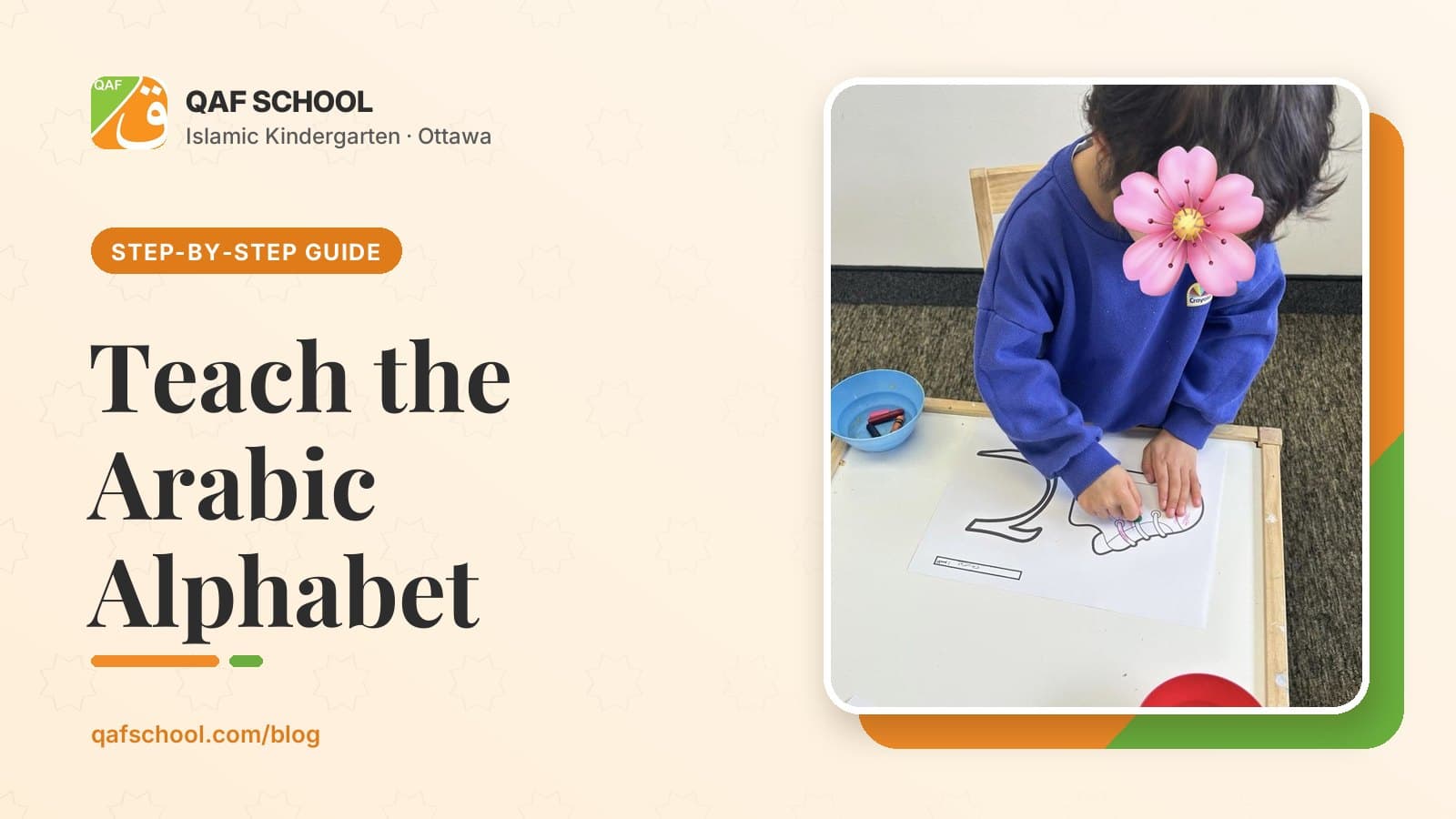
These six games build the foundation: letter sounds, letter shapes and reading. Pair them with our step-by-step guide to teaching the Arabic alphabet to kids.
1. Letter sound hunt
Ages: 4–7 · Skill: letter sounds · You need: nothing
Say a letter sound, such as "bā" for ب, and give your child one minute to find something in the house that starts with it: بَاب (door), بَيْت (house), بَطَّة (a toy duck). If your home language isn't Arabic, allow English words that begin with the same sound at first. The goal is hearing the sound.
2. Sand tray letters
Ages: 3–6 · Skill: letter shapes · You need: a shallow tray with sand, salt or semolina
Show a letter card, then let your child trace it in the tray with one finger while saying its sound. Shake to erase and try again. This Montessori-style activity builds the movement memory children later use with a pencil.
3. Dot detective
Ages: 5–8 · Skill: telling similar letters apart · You need: letter cards
Many Arabic letters share a shape and differ only in their dots. Lay out ب ت ث ن ي and ask, "Which one has two dots on top?" (ت) or "Which one has one dot underneath?" (ب). Then swap roles so your child asks you.
4. Harakat moves
Ages: 5–8 · Skill: short vowels · You need: nothing
Give each vowel mark an action: hands up for fatḥa (بَ, "ba"), hands down for kasra (بِ, "bi"), lips rounded and hands forward for ḍamma (بُ, "bu"), and freeze for sukūn. Call out a syllable and your child does the move, or show a written syllable and they say it and move.
5. Letter-form memory
Ages: 6–10 · Skill: beginning, middle and end forms · You need: paper cards
Arabic letters change shape depending on their position. Make pairs: the standalone letter on one card, a connected form on another (for example ع and عـ, or ه and ـهـ). Turn them face down and play classic memory. Start with five pairs, not twenty.
6. Word builder
Ages: 6–10 · Skill: blending letters into words · You need: letter tiles or cards
Give your child three letters and ask them to build a word: ب + ا + ب = بَاب (door), د + ا + ر = دَار (home), ن + و + ر = نُور (light). Once they can read it, ask them to write it from memory. For a full approach to reading, see how to teach kids to read Arabic.
Vocabulary and speaking games
These games get children using Arabic words out loud. Choose a theme each week: body parts, colours, food, family. Our list of Arabic words for kids gives you 100 words by theme to draw from.
7. Arabic Simon Says
Ages: 3–8 · Skill: listening, action words, body parts · You need: nothing
Use "قَالَ بَابَا" (Dad says) or "قَالَتْ مَامَا" (Mom says) instead of "Simon says." Commands to start with: قِفْ (stand), اِجْلِسْ (sit), اِقْفِزْ (jump), صَفِّقْ (clap), المِسْ رَأْسَكَ (touch your head). Children pick up commands remarkably fast because their bodies are doing the remembering.
8. Colour hunt
Ages: 3–6 · Skill: colours · You need: nothing
Ask "أَيْنَ الأَحْمَر؟" (Where is red?) and your child runs to touch something red, saying "هُنَا!" (here!). Add one new colour a day. Our guide to colours in Arabic for kids has the full list with harakat.
9. What's missing?
Ages: 4–8 · Skill: vocabulary recall · You need: five to eight small objects
Place objects on a tray and name each one in Arabic together. Your child closes their eyes, you remove one, and they ask themselves "مَاذَا يَنْقُصُ؟" (What's missing?) before naming it. Add objects as they get better.
10. Number hopscotch
Ages: 4–8 · Skill: numbers 1–10 · You need: chalk or painter's tape
Draw a hopscotch grid using Eastern Arabic numerals (١ ٢ ٣ ٤ ٥ ٦ ٧ ٨ ٩ ١٠). Your child says each number in Arabic as they hop: وَاحِد، اِثْنَان، ثَلَاثَة... For number lists and more games, see Arabic numbers for kids.
11. Arabic bingo
Ages: 4–10 · Skill: any vocabulary set · You need: bingo cards with pictures or words
Make 3×3 cards with pictures (younger kids) or Arabic words (readers). Call out words in Arabic; players cover them. The winner shouts "فُزْتُ!" (I won!). Bingo is endlessly reusable: animals one week, food the next.
12. Hot and cold
Ages: 4–8 · Skill: listening · You need: one small hidden object
Hide a toy. As your child searches, call out "حَارّ" (hot) when they're close and "بَارِد" (cold) when they're far. Then swap: they hide it and guide you. It's a simple way to make two words very familiar.
13. The little shop
Ages: 5–10 · Skill: speaking in full sentences · You need: play food or household items, paper money
Set up a pretend shop. The customer must ask properly: "أُرِيدُ تُفَّاحَةً، مِنْ فَضْلِكَ" (I'd like an apple, please) and "بِكَمْ هَذَا؟" (How much is this?). The shopkeeper answers and says "تَفَضَّلْ" (here you go). Role play is one of the best ways to move from single words to real sentences.
14. Arabic Go Fish
Ages: 6–12 · Skill: questions and answers · You need: a deck of homemade picture pairs
Players ask "هَلْ عِنْدَكَ ...؟" (Do you have...?) and answer "نَعَمْ، عِنْدِي" (yes, I have) or "لَا، لَيْسَ عِنْدِي" (no, I don't). Because every turn requires a full question, children repeat the structure dozens of times in one game.
Arabic games for older kids (8–15)
Children aged 8 and up often lose interest in "baby" games. These raise the challenge. They also work well for heritage speakers who understand Arabic but need to stretch their vocabulary.
15. Who am I?
Ages: 8–15 · Skill: describing and questioning · You need: nothing (or sticky notes)
One player thinks of an animal, food or object. Others ask yes/no questions in Arabic: "هَلْ هُوَ حَيَوَان؟" (Is it an animal?), "هَلْ هُوَ كَبِير؟" (Is it big?). The thinker gives clues with "أَنَا ..." (I am...). Limit it to 10 questions to keep it brisk.
16. Last-letter chain
Ages: 9–15 · Skill: vocabulary and spelling · You need: nothing
Each word must start with the last letter of the previous one: كِتَاب ← بَاب ← بَيْت ← تُفَّاح ← حَلِيب ← بَحْر ← رَأْس ← سَمَك. Write the chain down as you go. Word chains are a classic in many languages, and this one is great on car rides.
17. Verb charades
Ages: 8–15 · Skill: verbs · You need: verb cards
Write action verbs on cards: يَأْكُلُ (eats), يَنَامُ (sleeps), يَكْتُبُ (writes), يَسْبَحُ (swims), يَقْرَأُ (reads). One player acts it out; the others guess with a full sentence: "هُوَ يَسْبَحُ!" (He's swimming!).
18. Masculine or feminine?
Ages: 8–12 · Skill: basic grammar (gender) · You need: word cards and two boxes
Children sort words into two boxes. Start with clear pairs that show the tāʾ marbūṭa (ة): مُعَلِّم / مُعَلِّمَة (teacher), طَالِب / طَالِبَة (student), قِطّ / قِطَّة (cat). Once they spot the pattern, it unlocks a lot of later grammar. It's a small step toward the grammar they'll meet later.
19. Quran word match
Ages: 7–15 · Skill: Quranic vocabulary · You need: word and meaning cards
Pick words your child already recites in short surahs: رَبّ (Lord), قُلْ (say), أَحَد (one), النَّاس (people), خَلَقَ (created). Play memory or a timed matching race. When a child realises they've been saying these words in salah every day, recitation starts to mean something. The short surahs of Juz Amma are a good word source.
Digital Arabic games: used well
20. Teacher-made digital quizzes and apps
Ages: 6–15 · Skill: review · You need: a tablet or computer
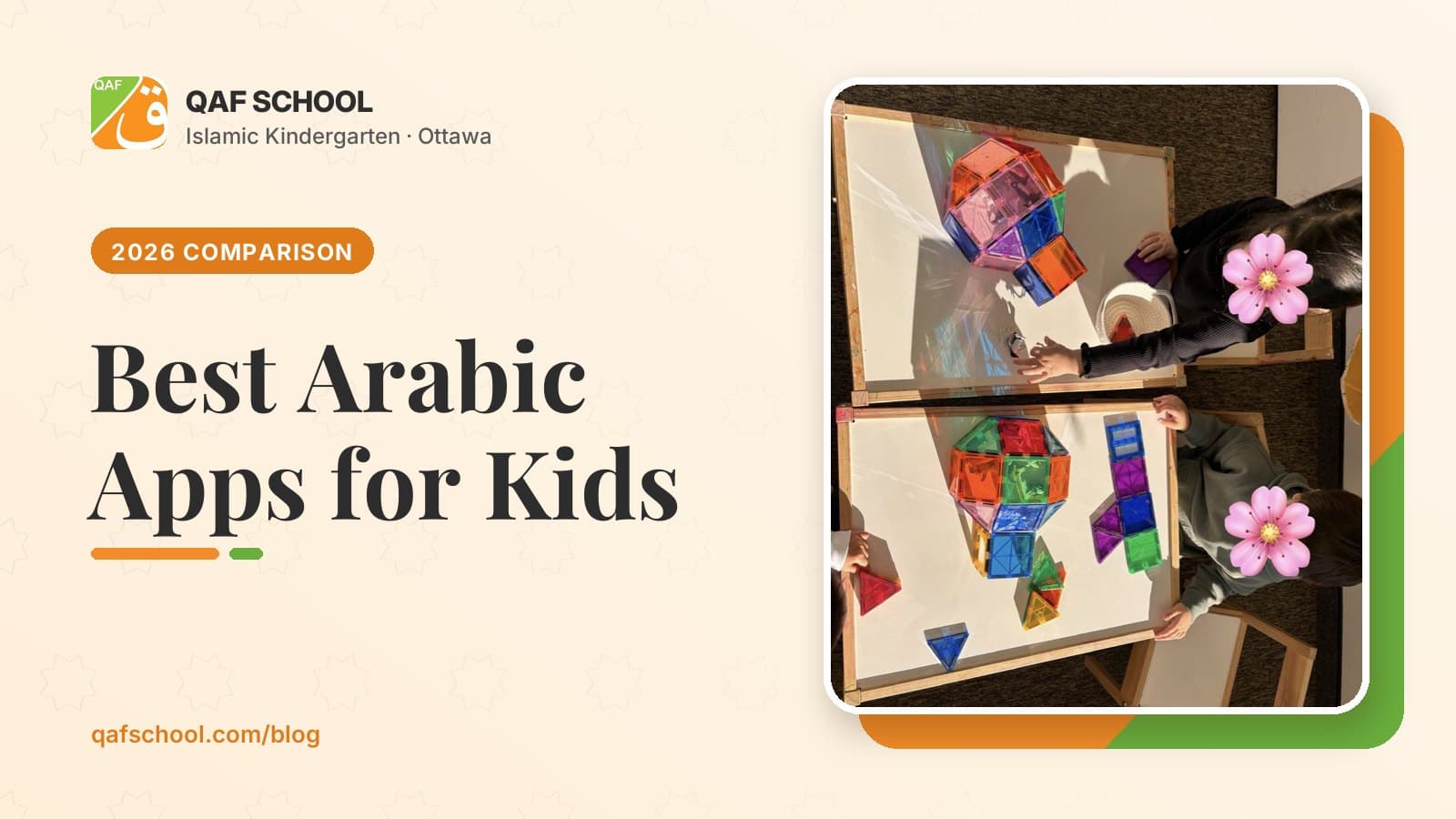
Platforms such as Wordwall let teachers and parents build quick matching games, quizzes and spin-the-wheel activities in any language, including Arabic. Learning apps can help too; our review of the best Arabic apps for kids compares the main options by age and price.
The Canadian Paediatric Society advises about an hour or less a day of routine screen time for children aged 2 to 5, and suggests using screens together and talking about what you see (Caring for Kids). For Arabic, that's good advice at any age: a digital game played side by side, where your child says the words aloud, is worth far more than one tapped through alone.
How to make Arabic games actually work
Games are only as useful as the habit around them. In our classroom we've found these make the biggest difference:
- Play daily, briefly. One five-minute game a day builds more Arabic than an hour on Saturday.
- Repeat favourites. Children love playing the same game many times. Repetition is the learning, so don't rush to novelty.
- Stretch the language. When a child knows the words, raise the bar: from "أَحْمَر" to "هَذَا أَحْمَر" to "أُرِيدُ القَلَمَ الأَحْمَرَ".
- Use real audio. If you're unsure of pronunciation, play a word from a native-speaker app or video first and copy it together.
- Stop while it's fun. End the game before your child is bored, and they'll ask for it tomorrow.
- Celebrate effort. Praise the try, not just the right answer. Mistakes are part of every game.
Games are a supplement, not a full curriculum. Structured reading, writing and speaking still need a teacher or a class. Our guide to Arabic classes for kids in Ottawa covers weekday, weekend and board-run options.
How QAF uses play to teach Arabic
At QAF, our Islamic JK/SK program in Ottawa blends a Montessori-inspired morning work cycle with daily Arabic immersion for children aged 4 and 5. Many of the games above, such as sand tray letters, matching and movement games, look a lot like our classroom routines: short, hands-on and repeated until the words become part of the day.
For older children, our Sunday Arabic and Quran program in Ottawa runs Sundays from 11 AM to 3 PM at 900 Dynes Rd for ages 8 to 15, with separate junior and senior classes. Arabic reading and writing sit alongside Quran, math and STEM, and soccer, so kids get a full, active day.
Is QAF right for your family?
QAF suits families who want Arabic to be a daily habit rather than a weekend extra. If your child is 4 or 5 and you can reach Nepean easily, our full-day kindergarten (September to June, 9 AM to 3 PM) gives them Arabic, Quran and Islamic Studies every day alongside Ontario's kindergarten curriculum. If your child is 8 to 15 and in public school during the week, Sunday Camp adds structured Arabic and Quran for $190 a month.
It's not the right fit if your child is between 6 and 7, or under 4, since our programs don't cover those ages. Families in the far east or west end may also find the drive too long for a daily program. In that case, the games in this post plus a local weekend class or your school board's International Languages program can carry a lot. Our comparison of Islamic schools in Ottawa can help you find options closer to home.
The bottom line
The best Arabic learning games are the ones your child asks to play again. Start with one or two from the list that match your child's age, play them for five minutes a day, and nudge the language up a step each week. Combined with good teaching, those small daily games add up to real Arabic.
Want to see Arabic learning through play in action? Book a visit to our JK/SK classroom at 900 Dynes Rd. Submit an inquiry to arrange a time, or call or WhatsApp us with your questions.