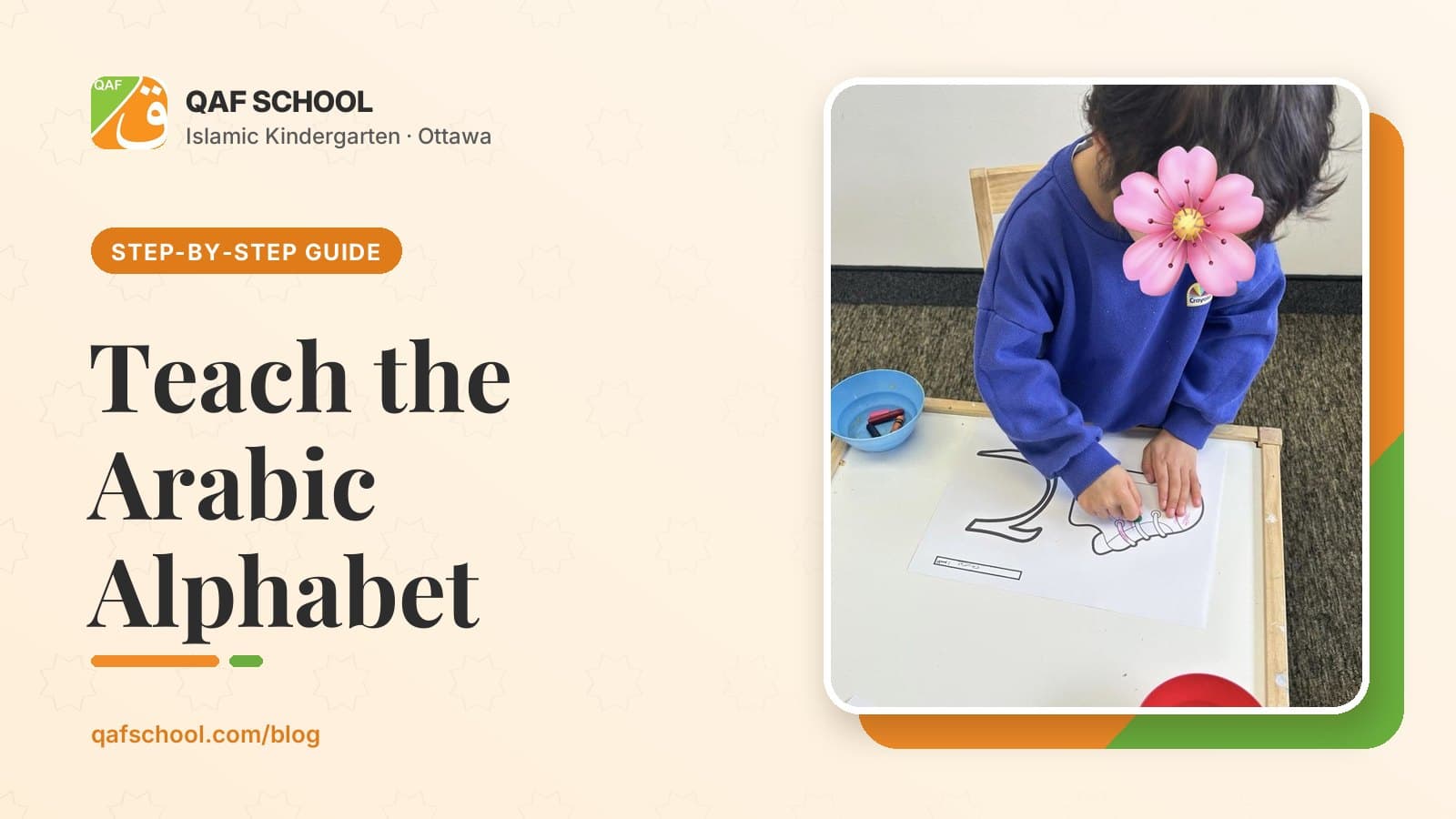
The easiest way to teach the Arabic alphabet to kids is to teach letter sounds before letter names, introduce letters in small groups that share a shape, and let children touch, trace and build each letter before they write it. With 10–15 minutes a day, many 4- to 6-year-olds can recognize all 28 letters within a few months. This step-by-step guide gives you the exact order, activities, a weekly plan and a printable-style letter chart.
Key takeaways
- Arabic has 28 letters, written right to left, and most letters change shape depending on their position in a word.
- Teach the sound first ("ba"), then the name ("baa"). Sounds are what children need to read.
- Group letters by shape: ب ت ث share one body and differ only in their dots.
- Use multisensory play (sand trays, playdough, sky-writing) before pencil-and-paper.
- Add the short vowels (fatha, kasra, damma) early so children can start reading real syllables.
How the Arabic alphabet works
The Arabic alphabet has 28 letters, all of them consonants or long-vowel letters, read and written from right to left. Short vowels are shown with small marks above or below letters, called harakat. There are no capital letters, but most letters connect to their neighbours and change shape depending on whether they come at the start, middle or end of a word.
Three features make Arabic easier for children than parents often expect:
- Shape families. Many letters share the same base shape and differ only in the number or position of dots.
- Regular spelling. Once children know the letters and harakat, a fully vowelled word is read exactly as it is written.
- Six simple non-connectors. Only six letters (ا د ذ ر ز و) never join to the letter after them.
Some charts also list the hamza (ء) separately. For young beginners, start with the 28 standard letters and introduce hamza later.
What age to start teaching the Arabic alphabet
The best age to start teaching the Arabic alphabet is around 3 to 4 for playful exposure (songs, letter hunts, tracing in sand), and 4 to 6 for systematic learning of sounds and shapes. This mirrors when most children are ready for English letter-sound work.
Readiness matters more than birthday. A child is ready when they can sit for a five-minute activity, hold a crayon, and notice small differences between pictures. If those skills are still developing, our JK readiness checklist has ideas for building them through play. And if you're wondering whether starting young is worth it, see why early Arabic immersion matters.
Step 1: Teach letter sounds before letter names
Children read with sounds, not names. If a child learns that ب is called "baa," they may try to read بَاب (door) as "baa-alif-baa." If they learn that ب says "b" (and with a fatha, "ba"), reading comes naturally.
In practice:
- Show the letter and say its sound with a fatha: "ba."
- Have your child repeat it while tracing the letter in the air.
- Name a familiar word that starts with it: بَطَّة (duck), بَاب (door).
- Only after the sound is secure, add the name: "This letter is called baa, and it says ba."
Sounds that don't exist in English (ع, ح, خ, غ, ق) need extra modelling. Exaggerate them, let your child watch your mouth, and use audio from a native speaker if you're unsure. Free apps with native audio, such as those in our guide to the best Arabic apps for kids, help a lot here.
Step 2: Group letters by shape, not just by order
The traditional order (ا ب ت ث ج ح خ…) already places many look-alike letters together. Teaching them as families helps children see the pattern: "Same boat, different dots."
| Shape family | Letters | What changes |
|---|---|---|
| The "boat" | ب ت ث | One dot below, two above, three above |
| The "hook" | ج ح خ | Dot inside, no dot, dot above |
| The "corner" | د ذ | No dot, one dot above |
| The "slide" | ر ز | No dot, one dot above |
| The "teeth" | س ش | No dots, three dots above |
| The "loop with teeth" | ص ض | No dot, one dot above |
| The "tall loop" | ط ظ | No dot, one dot above |
| The "open mouth" | ع غ | No dot, one dot above |
| The "loop on a line" | ف ق | One dot vs two dots, and ق dips lower |
The remaining letters (ا ك ل م ن ه و ي) each have a distinct shape and can be taught one or two at a time.
Tip: Teach dot counting as a game. Hold up ب, ت, ث and ask, "How many dots? Up or down?" Four-year-olds love being the "dot detective."
Step 3: Use multisensory activities before writing
Young children learn letter shapes through their hands long before their pencil grip is ready. Multisensory learning means a child sees, hears, says and feels the letter at the same time. In our classroom we've found these activities work best:
- Sand or salt tray: Pour a thin layer into a baking tray. Your child traces the letter with one finger while saying its sound, then shakes the tray to erase.
- Playdough letters: Roll "snakes" and shape them into letters. Add small balls for the dots.
- Sky-writing: Write giant letters in the air with a straight arm, then smaller ones on the palm of the hand.
- Letter hunt: Hide letter cards around the room. When your child finds one, they say the sound and a word that starts with it.
- Body letters: Lie on the floor to make ا, or curl up to make د.
- Sorting baskets: Put objects or picture cards into baskets labelled with their starting letter.
This hands-on approach is also central to Montessori education. If you're curious how it connects with Islamic learning, read our piece on Montessori and Islamic values.
Step 4: Introduce harakat (short vowels) early
Harakat are the small marks that tell you which short vowel follows a letter. Children can start reading real syllables as soon as they know three or four letters and the first three harakat.
| Mark | Name | Sound | Example |
|---|---|---|---|
| ـَ | Fatha (فَتْحَة) | short "a" | بَ = ba |
| ـِ | Kasra (كَسْرَة) | short "i" | بِ = bi |
| ـُ | Damma (ضَمَّة) | short "u" | بُ = bu |
| ـْ | Sukun (سُكُون) | no vowel | بْ = b |
| ـّ | Shadda (شَدَّة) | doubled letter | بّ = bb |
| ـً ـٍ ـٌ | Tanwin (تَنْوِين) | -an, -in, -un | بًا = ban |
A simple way to explain them: fatha is a little line that "opens your mouth" (a), kasra sits below and "pulls your chin down" (i), and damma is a tiny wāw that "rounds your lips" (u). Practise with three letters in a grid (بَ بِ بُ, تَ تِ تُ, ثَ ثِ ثُ) and let your child point and read.
Save sukun, shadda and tanwin until your child reads fatha, kasra and damma confidently.
Step 5: Teach the letter forms (initial, medial, final)
Most Arabic letters have four forms: isolated, initial (start of a word), medial (middle) and final (end). The good news is that the forms usually keep the letter's core shape; they mainly lose or gain a "tail."
| Letter | Isolated | Initial | Medial | Final |
|---|---|---|---|---|
| Baa | ب | بـ | ـبـ | ـب |
| Jeem | ج | جـ | ـجـ | ـج |
| Seen | س | سـ | ـسـ | ـس |
| Ayn | ع | عـ | ـعـ | ـع |
| Haa | ه | هـ | ـهـ | ـه |
Introduce forms after a child recognizes a letter family in its isolated form. Use colour: write the target letter in red inside a word (for example, the ب in كَلْب, dog) and ask your child to "find the hiding letter."
Remind them that ا د ذ ر ز و never hold hands with the letter after them. A fun rule: "These six letters are shy. They only hold hands on one side."
Step 6: Blend sounds into simple words
Blending is the step where letters become reading. Start with two- and three-letter words made only of letters your child knows:
- بَاب (door)
- أَبٌ (father)
- قَلَمٌ (pen)
- وَلَدٌ (boy)
Point under each letter as your child says the sounds, then slide your finger faster until the sounds merge into a word. Celebrate every success.
If you plan to move toward Quran reading, a structured primer such as the Noorani Qaida follows exactly this progression. Our comparison of Noorani Qaida vs Qaida Baghdadia explains the differences. Once your child is blending, short surahs like Surah Al-Ikhlas on Quran.com become wonderful listening-and-pointing practice.
The 28 Arabic letters: chart with names and sounds
Use this chart as a reference while you teach. Example words are fully vowelled so you can read them aloud with your child.
| # | Letter | Name | Transliteration | Sound (closest English) | Example word |
|---|---|---|---|---|---|
| 1 | ا | أَلِف | alif | long "aa" (carries hamza at the start of words) | أَرْنَب (rabbit) |
| 2 | ب | بَاء | baa | b, as in "bat" | بَاب (door) |
| 3 | ت | تَاء | taa | t, as in "top" | تُفَّاحَة (apple) |
| 4 | ث | ثَاء | thaa | th, as in "think" | ثَعْلَب (fox) |
| 5 | ج | جِيم | jeem | j, as in "jam" | جَمَل (camel) |
| 6 | ح | حَاء | haa (ḥ) | breathy h from the throat | حِصَان (horse) |
| 7 | خ | خَاء | khaa | kh, like "loch" | خَرُوف (sheep) |
| 8 | د | دَال | daal | d, as in "dog" | دُبّ (bear) |
| 9 | ذ | ذَال | dhaal | th, as in "this" | ذُرَة (corn) |
| 10 | ر | رَاء | raa | rolled r | رُمَّان (pomegranate) |
| 11 | ز | زَاي | zaay | z, as in "zoo" | زَرَافَة (giraffe) |
| 12 | س | سِين | seen | s, as in "sun" | سَمَكَة (fish) |
| 13 | ش | شِين | sheen | sh, as in "ship" | شَمْس (sun) |
| 14 | ص | صَاد | saad (ṣ) | heavy s | صَقْر (falcon) |
| 15 | ض | ضَاد | daad (ḍ) | heavy d | ضِفْدَع (frog) |
| 16 | ط | طَاء | taa (ṭ) | heavy t | طَائِرَة (airplane) |
| 17 | ظ | ظَاء | dhaa (ẓ) | heavy th, as in "this" | ظَرْف (envelope) |
| 18 | ع | عَيْن | ayn | deep throat sound, no English match | عَيْن (eye) |
| 19 | غ | غَيْن | ghayn | gargled g, like a French r | غَيْمَة (cloud) |
| 20 | ف | فَاء | faa | f, as in "fan" | فِيل (elephant) |
| 21 | ق | قَاف | qaaf | deep k from the back of the throat | قَمَر (moon) |
| 22 | ك | كَاف | kaaf | k, as in "kite" | كِتَاب (book) |
| 23 | ل | لَام | laam | l, as in "lamp" | لَيْمُون (lemon) |
| 24 | م | مِيم | meem | m, as in "moon" | مَوْز (banana) |
| 25 | ن | نُون | noon | n, as in "net" | نَحْلَة (bee) |
| 26 | ه | هَاء | haa (h) | light h, as in "hat" | هِلَال (crescent) |
| 27 | و | وَاو | waaw | w, or long "oo" | وَرْدَة (rose) |
| 28 | ي | يَاء | yaa | y, or long "ee" | يَد (hand) |
Tip: Print this chart, cut it into cards, and use them for matching, memory games and letter hunts.
A 10-week plan for teaching the Arabic alphabet
This plan suits a 4- to 6-year-old practising 10–15 minutes a day, five days a week. For a 3-year-old, stretch each week into two. For a 7-year-old, you may move faster.
| Week | New letters | Focus |
|---|---|---|
| 1 | ا ب ت ث | Sounds with fatha, dot counting, sand tray |
| 2 | ج ح خ | Throat sounds, playdough letters |
| 3 | د ذ ر ز | Short letters, "shy letters" that don't connect |
| 4 | س ش ص ض | "Teeth" and "loop" letters, letter hunt |
| 5 | ط ظ ع غ | Heavy sounds, ع and غ practice with audio |
| 6 | ف ق ك ل | Loop letters, sorting baskets |
| 7 | م ن ه و ي | Last letters, alphabet song all the way through |
| 8 | Review | Fatha, kasra, damma with all letters |
| 9 | Review | Initial, medial and final forms, "find the hiding letter" |
| 10 | Review | Blending two- and three-letter words, sukun |
What a 15-minute session looks like
- Warm-up (2 minutes): Sing an Arabic alphabet song or review yesterday's cards.
- New letter (3 minutes): Show it, say its sound, trace it in the air.
- Hands-on (5 minutes): Sand tray, playdough or letter hunt.
- Read or write (3 minutes): Point and read syllables, or trace on a worksheet.
- Close (2 minutes): "Which letter did we learn? What starts with it?"
Common mistakes to avoid
- Teaching all 28 letters at once. Small groups lead to faster, steadier progress.
- Drilling names only. A child who can recite the alphabet song may still not be able to read.
- Moving to pencils too soon. Fine-motor control develops gradually. Sand, playdough and large crayons come first.
- Correcting every small error. Keep it joyful. Model the right sound and move on.
- Relying on screens. Apps are helpful, but the Canadian Paediatric Society's guidance recommends about an hour or less of routine screen time a day for ages 2 to 5. Hands-on activities teach shapes better anyway.
If you don't read Arabic yourself
You can still teach the alphabet well. Learn one week ahead of your child, use native-speaker audio for each sound, and let your child see you learning too. Children love being "the teacher" for a parent.
The back-and-forth matters more than perfection. Researchers at the Harvard Center on the Developing Child describe these responsive serve-and-return interactions as central to how young brains build skills. Our full guide on how to teach Arabic at home covers routines, songs and books for non-Arabic-speaking families.
Beyond the alphabet: building real Arabic
Knowing the letters is the doorway, not the destination. Children grow into confident readers and speakers by hearing Arabic used every day, in stories, songs, conversation and Quran.
At QAF, our Junior and Senior Kindergarten children learn Arabic through daily immersion alongside Ontario's Kindergarten Program, with hands-on Montessori-inspired materials during a long morning work cycle. You can see how the pieces fit together on our program page.
Looking for a kindergarten where Arabic is part of every day? QAF offers full-day Islamic JK and SK in Ottawa with daily Arabic immersion, Quran and Islamic Studies. Submit an inquiry to book a visit.