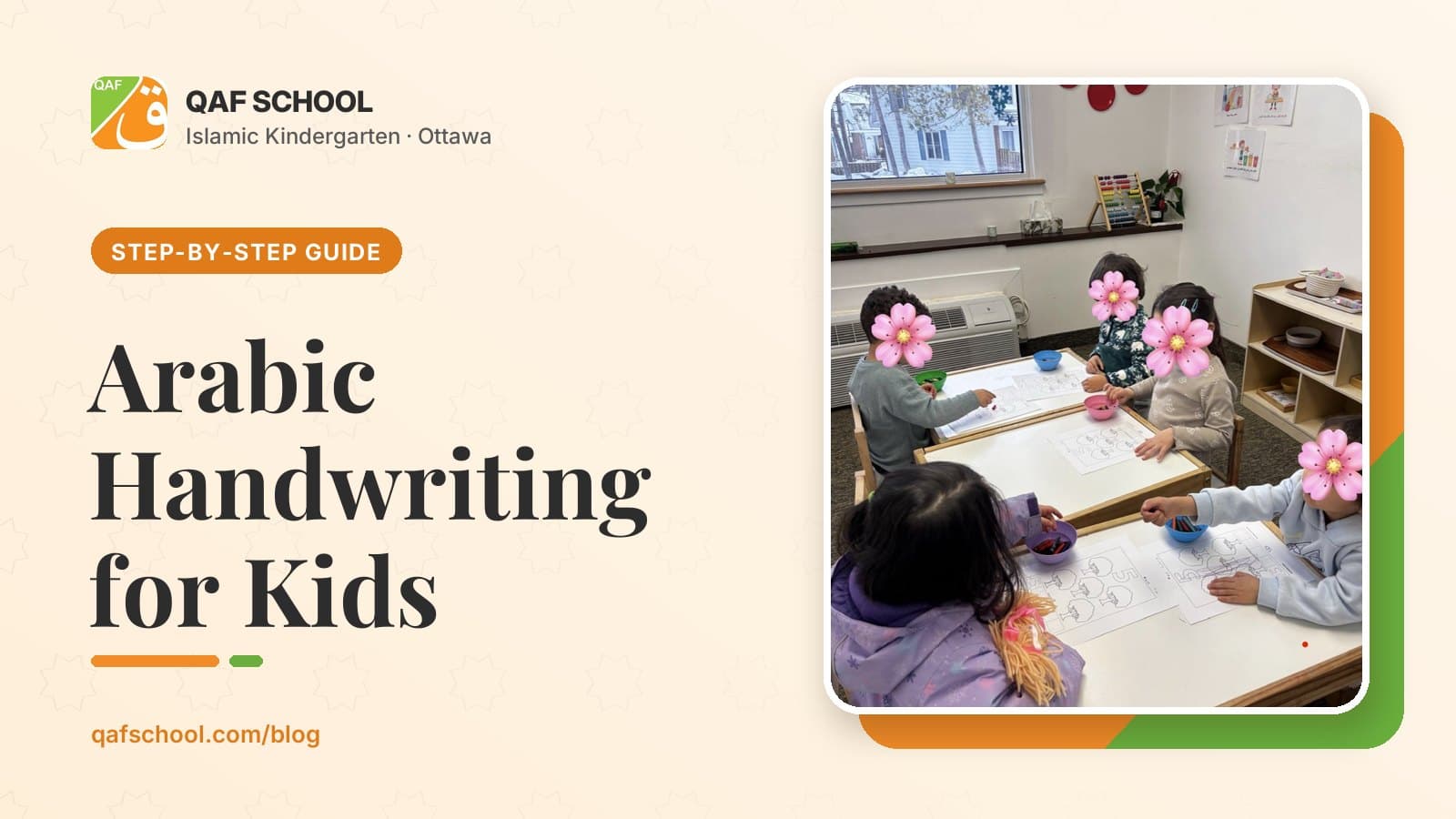
Arabic handwriting for kids starts long before the first letter: with strong little hands, a good pencil grip and the habit of moving from right to left. Once those are in place, children learn letters fastest in shape families (ب ت ث ن together, for example), practising each one through a simple sequence: trace, copy, then write from memory. This guide explains how to teach Arabic letter formation step by step, which letters to start with, how to use worksheets well, and how to help children join letters into words.
Key takeaways
- Ages 3–5 are about pre-writing: drawing lines and curves, playdough, sand trays and a comfortable grip. Most children copy letters more easily around ages 5–6.
- Arabic is written right to left on a baseline. Teach "start on the right" from day one.
- Group letters by shape. Many Arabic letters share a body and differ only in their dots.
- Use worksheets in three stages: trace, copy, write from memory. Five to ten focused minutes beats a page of tired tracing.
- Write the body of a letter or word first, then add the dots. Harakat come last.
Why Arabic handwriting deserves its own practice
Reading and writing Arabic support each other. When a child forms ب with their own hand, they notice the bowl and the single dot below, and that makes the letter easier to recognize on a page. Handwriting also slows children down enough to hear each sound in a word.
There is a special respect for the pen in Islam. One of the first revealed passages describes Allah as the One "ٱلَّذِى عَلَّمَ بِٱلْقَلَمِ", "who taught by the pen" (Surah Al-ʿAlaq 96:4), and Surah Al-Qalam opens with an oath by the pen (68:1). Children love knowing that their pencil practice connects to the Quran.
If your child is still learning letter names and sounds, start with our guide to teaching the Arabic alphabet to kids. This article focuses on the hand: forming, spacing and joining the letters.
When should kids start Arabic handwriting?
The best age to start formal Arabic handwriting is usually around 5 to 6, once a child can hold a pencil comfortably and copy simple shapes. That matches general child-development guidance: Understood.org notes that children typically learn to copy shapes and letters around ages 5 or 6, and that handwriting depends on the small muscles of the hands and wrists.
Before that, ages 3 to 5 are for building the foundations. Pushing worksheets too early often leads to a tight grip, frustration and a child who decides they "hate writing".
| Age | Focus | Good activities |
|---|---|---|
| 3–4 | Hand strength and control | Playdough, tearing paper, pegboards, big crayons, drawing lines and circles |
| 4–5 | Pre-writing strokes, right-to-left movement | Sand trays, finger-tracing big letters, dot-to-dot from right to left, writing the first letter of their name |
| 5–6 | Letter formation | Tracing and copying letter families on lined paper |
| 6–8 | Joining letters, short words | Copying words, writing from memory, simple dictation |
| 8+ | Fluency and neatness | Copying sentences, short writing tasks, spelling |
Children who start Arabic later can move through these stages faster, but older beginners still benefit from a few weeks of careful letter formation.
How to teach Arabic handwriting for kids, step by step
These seven steps take a child from wobbly lines to joined Arabic words. Most families spend a few weeks on Steps 1–3 before formal letter practice begins.
Step 1: Build pre-writing skills
Strong hands come first. For three- and four-year-olds, these count as handwriting practice:
- Rolling and pinching playdough into the shapes of letters.
- Drawing in a tray of sand, salt or semolina with one finger.
- Threading beads, using tongs or pegs, and tearing paper into strips.
- Drawing the basic strokes of Arabic: a straight line down (like ا), a bowl (like ب), a curve (like ر) and a circle (like the head of و).
Make the movement right to left whenever you can. Draw "rainbows" from the right side of the page, and line up toys from right to left.
Step 2: Teach a comfortable grip and posture
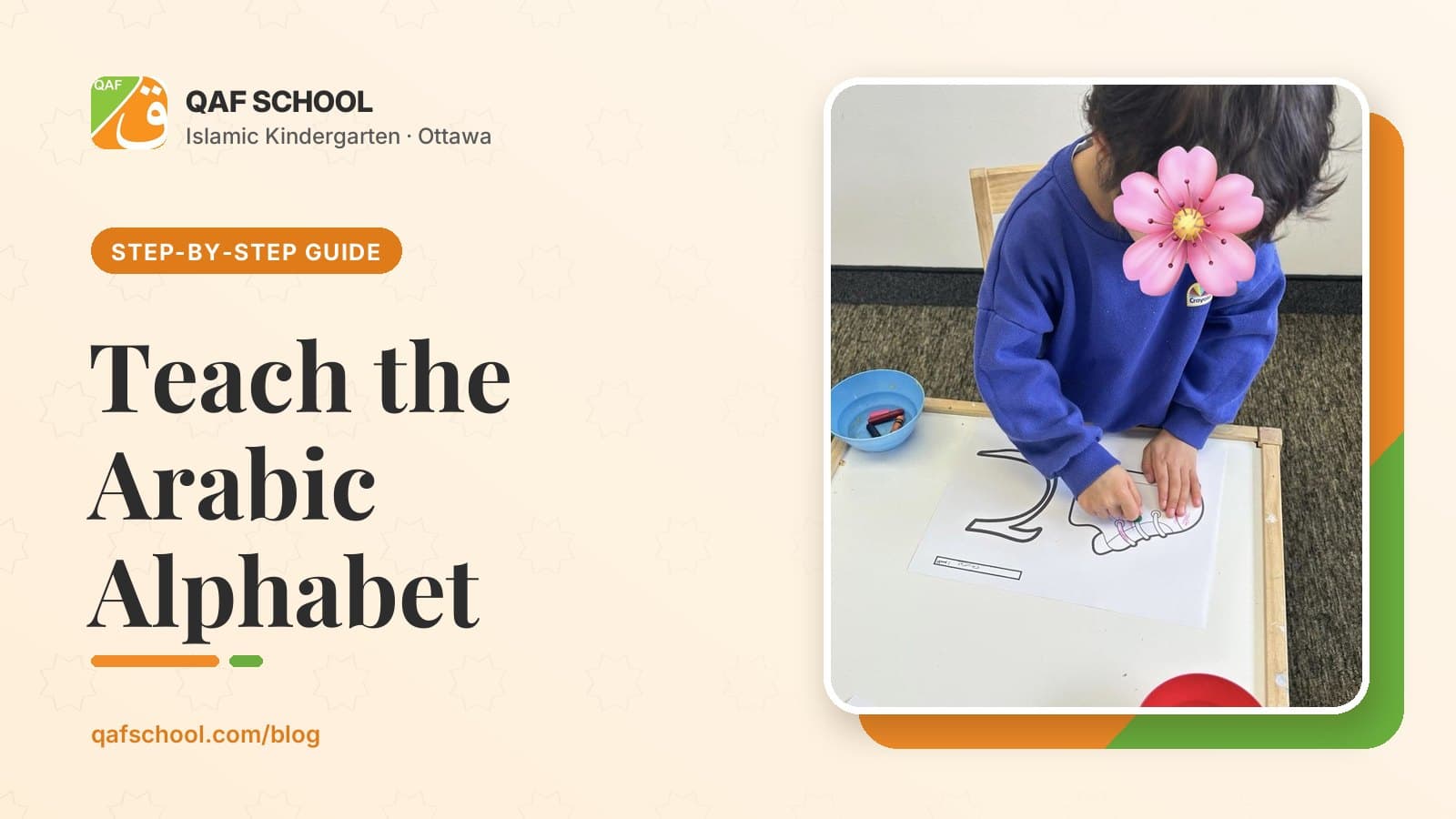
Most children write best with a relaxed tripod grip: the pencil resting between the thumb and index finger, supported by the middle finger. Short crayons and pencils naturally encourage this grip in small hands.
Check posture too: feet flat on the floor, paper tilted slightly, and the non-writing hand holding the paper still.
Tip for right- and left-handed children. Because Arabic moves leftward, a right-handed child's hand often travels over what they have just written. Use pencils rather than markers or gel pens to avoid smudging. Left-handed children often find right-to-left writing comfortable, so there is no need to change their hand.
Step 3: Learn the baseline and right-to-left direction
Arabic letters sit on an imaginary line called the baseline. Some letters rise above it (like ا and ل), and some dip below it (like ر, ز and و, and the final forms of letters such as ن and ي).
For beginners, use paper with a clear baseline and a lighter guide line above it. Arabic handwriting practice books often provide these lines, but you can also draw them yourself with a ruler.
Teach two simple rules from the first day:
- Start on the right. Every word, and most letters, begin on the right.
- Sit on the line. The body of each letter rests on the baseline unless it is one of the letters that dips below.
Step 4: Practise letters in shape families
Many Arabic letters share the same body and are told apart only by their dots. Teaching them in families means one shape unlocks several letters at once.
| Family | Letters | What changes |
|---|---|---|
| Bowl | ب ت ث | One dot below, two dots above, three dots above |
| Bowl (deeper) | ن | One dot above, deeper rounded body |
| Straight line | ا | A single stroke, top to bottom |
| Small hook | د ذ | No dot, one dot above |
| Curve below the line | ر ز | No dot, one dot above |
| Cup with a tail | ح ج خ | No dot, one dot inside, one dot above |
| Teeth | س ش | No dots, three dots above |
| Loop with teeth | ص ض | No dot, one dot above |
| Upright loop | ط ظ | No dot, one dot above |
| Open mouth | ع غ | No dot, one dot above |
| Round head | ف ق | One dot above, two dots above (in the common Eastern style) |
| Tall letters | ك ل | ك has a small mark inside; ل is a tall hook |
| Others | م ه و ي | Learned individually |
A suggested order for beginners is ا, then the bowl family (ب ت ث ن), then د ذ and ر ز, then the others. These first letters use simple strokes and let children write real words early, such as بَاب (door) and بِنْت (girl).
A note for North African families. In Maghrebi (North African) handwriting, ف is traditionally written with a dot below and ق with a single dot above. Both styles are correct; just be consistent with what your child's teacher or Quran teacher uses.
Step 5: Use the trace, copy, write method
Worksheets help most when they follow a clear sequence. For each letter or family:
- Trace with a finger. Trace a large letter in the air, on the table or in sand while saying its sound.
- Trace with a pencil. Use a worksheet with a starting dot and an arrow showing direction. Three or four careful tracings are enough.
- Copy. Look at a model letter and write it beside the model on the baseline.
- Write from memory. Cover the model and write the letter while saying its sound.
- Use it in a word. Write the letter inside a short, familiar word.
Keep sessions short. For children aged 5 to 6, five to ten minutes of focused writing is plenty. Stop while your child still wants to do "one more", not after they are tired.
Good worksheets have big letters, starting dots and arrows, clear baselines, and plenty of white space. Avoid pages crammed with 30 rows of the same letter: children stop paying attention after the first few, and practise mistakes instead. Digital platforms such as 3asafeer also include worksheets alongside their stories, which can be useful once your child is writing words.
Step 6: Teach the dots, then the harakat
A simple habit makes Arabic handwriting neater: write the body first, then add the dots. Many teachers ask children to finish a whole word's skeleton before going back to add its dots, which keeps the hand moving smoothly from right to left.
Harakat (short vowel marks) come last:
- Fatḥa ( ـَ ) is a small slanted line above the letter.
- Kasra ( ـِ ) is the same line below the letter.
- Ḍamma ( ـُ ) is a small curl, like a tiny و, above the letter.
- Sukūn ( ـْ ) is a small circle above the letter.
- Shadda ( ـّ ) looks like a small w above the letter and means the sound is doubled.
Writing the harakat by hand helps children notice them when reading, which matters for Quran reading too.
Step 7: Join letters into words
Arabic is a joined script: most letters connect to the next letter in a word, and each letter changes shape slightly depending on its position.
The most important rule for children is that six letters never join to the letter after them: ا د ذ ر ز و. After one of these letters, the next letter starts fresh, so the word has a small gap. For example, in دَار (house), none of the letters join.
Other things to teach as they come up:
- لا (lām-alif) is written as a special combined shape, not as ل followed by ا.
- ة (tāʾ marbūṭa) appears only at the end of a word, as in مَدْرَسَة (school).
- Teeth and bowls shrink when letters join. A beginner's ب in بَيْت (house) is just a small tooth with a dot.
Start with words made only from letters your child knows, then build to short phrases like بِسْمِ اللَّهِ. For word ideas by theme, see our list of 100 Arabic words for kids.
Naskh or ruqʿah: which handwriting style?
Children should learn naskh first. Naskh is the clear, rounded style used in children's books, school textbooks and most printed Arabic, including the familiar style of many printed copies of the Quran, so it matches what children read.
Ruqʿah is a faster, simpler style used for everyday handwriting in many Arab countries. Older children may meet it later, but it is not the place to start. If an Arabic-speaking relative writes in ruqʿah, it is fine to explain that "grown-ups have a quick style too".
Common Arabic handwriting mistakes (and fixes)
- Writing left to right. Very common in children who also write English. Put a green "start" dot on the right side of each line.
- Letters floating above the line. Draw a thicker baseline and say "sit on the line" as a cue.
- Mixing up dots. Practise ب ت ث together and say the dots out loud: "one below, two above, three above."
- Joining after ا د ذ ر ز و. Highlight these six letters in a colour on your alphabet chart as "the letters that don't hold hands".
- Gripping too hard. Try a thicker pencil, a pencil grip or a short crayon, and include more playdough and drawing.
- Long, boring sessions. Shorter practice, more often, works better at every age.
A 12-week Arabic handwriting plan
| Weeks | Focus | Example words to write |
|---|---|---|
| 1 | Pre-writing strokes, right-to-left lines, ا | — |
| 2–3 | ب ت ث ن | بَاب، بِنْت، نَبَات |
| 4 | د ذ ر ز و | دَار، وَرْد، وَزْن |
| 5 | س ش | سَبْت، شَبَاب |
| 6 | ح ج خ | جَدّ، خُبْز |
| 7 | ص ض ط ظ | صَبْر، طَبْخ |
| 8 | ع غ ف ق | عِنَب، قِرْد |
| 9 | ك ل م | كَلْب، لَبَن، قَلَم |
| 10 | ه ي، plus لا and ة | يَد، مَدْرَسَة |
| 11 | Harakat by hand | Short words with full harakat |
| 12 | Joining and short phrases | بِسْمِ اللَّهِ، الْحَمْدُ لِلَّهِ |
Each week's example words use only letters your child has already practised. Move faster or slower depending on your child. Some children need two weeks for a single family, and that is perfectly fine.
Arabic writing at QAF School
At QAF School, our Islamic kindergarten in Ottawa for 4- and 5-year-olds follows a Montessori-inspired approach, with a long morning work cycle from 9:20 to 11:00 in a prepared environment. That hands-on style suits pre-writing well, because Montessori-style practical activities build the hand control children need for writing, alongside daily Arabic immersion, Quran and Islamic Studies. The program runs full-day, September to June, at 900 Dynes Rd in Nepean, and is aligned with Ontario's kindergarten curriculum.
For ages 8 to 15, our Sunday Quran and Arabic camp in Ottawa includes Arabic reading and writing, along with Quran, math and STEM, and soccer, on Sundays from 11 AM to 3 PM. To compare other programs across the city, see our guide to Arabic classes for kids in Ottawa.
Is QAF right for your family?
Our kindergarten suits families with a 4- or 5-year-old who can reach Nepean each weekday and want Arabic, Quran and Islamic values built into a full school day. It is a good fit if you'd like your child's first Arabic letters to come from teachers who see them every day, rather than from occasional practice at home.
Sunday Camp suits children aged 8 to 15 who attend another school during the week and need steady, structured Arabic reading and writing practice, at $190 per month from September to June. QAF may not be practical for children aged 6 or 7, or for families who live far from Nepean. For those families, our guide to weekend Islamic schools in Ottawa lists other options, and the plan above works well at home.
Small hands, steady practice
Beautiful Arabic handwriting comes from short, regular practice and lots of encouragement, not from long worksheets. Build strong hands first, teach right to left from day one, learn the letters in shape families and celebrate every neat ب along the way.
See how young children learn Arabic at QAF. Book a visit to our JK/SK classroom in Nepean, or ask about Sunday Camp for ages 8–15. Submit an inquiry to choose a time, or call or WhatsApp us with questions.