The kindergarten report card Ontario schools use is called the Kindergarten Communication of Learning. It has no letter grades, marks or levels. Instead, your child's educators write comments in four areas of learning, describing what your child can do, how they have grown and what comes next. Here is how to read each part, what the comments really mean, and what to do after it arrives.
Key takeaways
- Ontario kindergarten report cards use written comments, not grades. Each comment covers Key Learning, Growth in Learning and Next Steps in Learning.
- Families get three formal reports a year: an Initial Observations report (late October to November), then two full Communications of Learning.
- From 2026–27, reports follow the four strands of the new kindergarten curriculum: Foundations of Language and Mathematics, Problem Solving and Innovating, Self-Regulation and Well-Being, and Belonging and Contributing.
- The Year 2 report has a line for Early Reading Screening: whether it was completed and whether the benchmark was met.
- The most useful part for parents is Next Steps. Use it to plan two or three small habits at home.
What is the kindergarten report card Ontario schools use?
The Kindergarten Communication of Learning is the official reporting form that publicly funded Ontario schools use for Junior Kindergarten (Year 1) and Senior Kindergarten (Year 2). The province describes it as working like a report card: educators observe and assess your child, then give feedback meant to be clear, meaningful and timely.
There are no A–D grades or levels 1–4 in kindergarten. Those begin in Grade 1. Kindergarten reporting is descriptive because four- and five-year-olds develop unevenly, and a number would hide more than it shows.
If you want the bigger picture of what children learn in JK and SK, read our Ontario kindergarten program explained guide first. This post focuses on the report itself.
When do kindergarten reports come home?
| Report | Typical timing | What it covers |
|---|---|---|
| Initial Observations | Late October to November | One comment box on how your child has settled and early learning, growth and next steps |
| Communication of Learning (first) | Usually mid-year, around February | Comments in all four strands |
| Communication of Learning (second) | End of the school year, June | Comments in all four strands, plus September placement |
The province confirms the Initial Observations window and that two further reports follow during the year. For Grades 1 to 8, Ontario issues report cards between January 20 and February 20, and again in June. Kindergarten reports usually follow a similar rhythm, but your board sets the exact dates.
The Initial Observations report
The Initial Observations report is the first formal report of the year. The 2026 version has a single comment box rather than four sections. It is designed to describe your child's learning in the fall and to open a conversation between home and school.
Expect it to be short and focused on settling in: separating at drop-off, following routines, making friends, and early signs of interest in letters, numbers or building. It is not a verdict on the year. Many children who struggle in October are flourishing by February.
How to read each section of the full report
The full Kindergarten Communication of Learning form runs four pages. Here is what you will find, top to bottom.
1. The header
- Year 1 or Year 2: JK or SK.
- French: whether your child is in French Immersion, Core or Extended French.
- Days absent and times late: for this period and the year so far.
- Teacher and early childhood educator: an ECE is required in classes of 16 or more children.
- Placement in September: on the June report, either Kindergarten Year 2 or Grade 1.
2. Four strand sections
Each strand has its own comment box with three parts: Key Learning, Growth in Learning and Next Steps in Learning. Each box also has ESL and IEP checkboxes (see below).
3. Early Reading Screening line (Year 2 only)
The SK report includes a line showing whether Early Reading Screening was completed, the date, and whether the benchmark was met. A screener is a quick check of early reading skills such as hearing sounds in words and knowing letter sounds. It is not a pass-or-fail test. A "no" next to the benchmark means your child may benefit from extra support, and that is exactly what screening is for.
4. Signatures and the ECE line
The report is signed by the teacher and principal. A line names the early childhood educator(s) who contributed to the assessment. The original is placed in your child's Ontario Student Record (OSR), so keep your copy.
5. The parent response slip
The last part is a tear-off form you complete and return. It asks you to finish two sentences: "I notice that my child has shown growth in the following areas" and "I will help my child to". You can also tick a box asking the educators to contact you to discuss the report.
The four strands, in plain language
Since September 2026, reports follow the four strands of The Ontario Curriculum, Kindergarten, 2026. Here is what each one looks at, based on the descriptions printed on the report.
| Strand | What educators are looking at | What it looks like at home |
|---|---|---|
| Foundations of Language and Mathematics | Talking and listening, early reading and writing, number sense, patterns, shapes and problem solving with math | Retelling a story, spotting the first sound in a word, counting forks for dinner |
| Problem Solving and Innovating | Curiosity, asking questions, experimenting, designing and creating | Building a ramp that works, trying a new way when the first fails |
| Self-Regulation and Well-Being | Naming and managing feelings (alone or with an adult's help), coping with distraction, thinking about consequences, health | Calming down after frustration, waiting for a turn |
| Belonging and Contributing | Identity, relationships, empathy, caring for the community and living things, and expression through art, music, dance and drama | Helping a sibling, singing, caring for a plant |
What the comments really mean
Kindergarten comments follow a pattern. Once you know it, the report is easier to read.
Key Learning names the most important skills, interests or knowledge your child showed during the period. Example: "Amira uses her knowledge of letter sounds to label her drawings with the first sound of each word."
Growth in Learning describes progress: a more complex stage, a new skill or more confidence. Example: "She now joins group games independently and uses words to solve conflicts."
Next Steps in Learning sets one or two goals, often with an idea for home. Example: "Amira will practise blending three sounds to read simple words. At home, play 'I spy' with sounds."
These examples are illustrations written for this guide, not official wording, but real comments follow the same structure.
Reading between the lines
- Phrases like "with support," "beginning to" or "with prompting" mean the skill is emerging. That is normal in JK and early SK.
- "Independently" or "consistently" means the skill is secure.
- A next step in self-regulation is common and not a red flag. Managing feelings is a core kindergarten goal.
- If a section feels generic, ask for a specific example during a conversation. Educators keep photos, notes and work samples.
ESL and IEP checkboxes
An ESL tick means expectations were adjusted because your child is learning English. That is common for children who speak Arabic, Somali, French or another language at home, and it is not a criticism. Your home language is an asset. See our guide to raising trilingual kids in Canada.
An IEP tick means your child has an Individual Education Plan, which sets out accommodations or modified expectations for a child with special education needs. If you see it and were not expecting it, contact the school right away.
What to do after the report arrives
Step 1: Read it alone first, then once more with your child's strengths in mind.
Step 2: Underline every next step. Pick two that you can support at home with small daily habits.
Step 3: Share the good news with your child. "Your teacher says you are a kind friend and you are learning your sounds." Praise effort, not being smart.
Step 4: Fill in the response slip honestly. Mention what you see at home, including skills in your home language.
Step 5: Request a conversation if anything surprises you. Bring one or two questions, such as "What does this look like in class?" or "What should we practise?"
Step 6: Keep every report. Comparing the fall, mid-year and June reports shows real growth, which is easy to forget.
For everyday ways to build these skills, our JK readiness checklist and preparing your child for Grade 1 guides have simple activities.
Private and Islamic school kindergarten reports
Private schools in Ontario, including Islamic schools, are not required to use the provincial Communication of Learning form. Many use their own reports, portfolios, parent apps or conferences. When you tour Islamic schools in Ottawa, ask:
- How often will I receive formal written feedback?
- Do reports follow Ontario's four kindergarten strands?
- How do you report on Quran, Arabic and Islamic studies?
- How do I see day-to-day progress between reports?
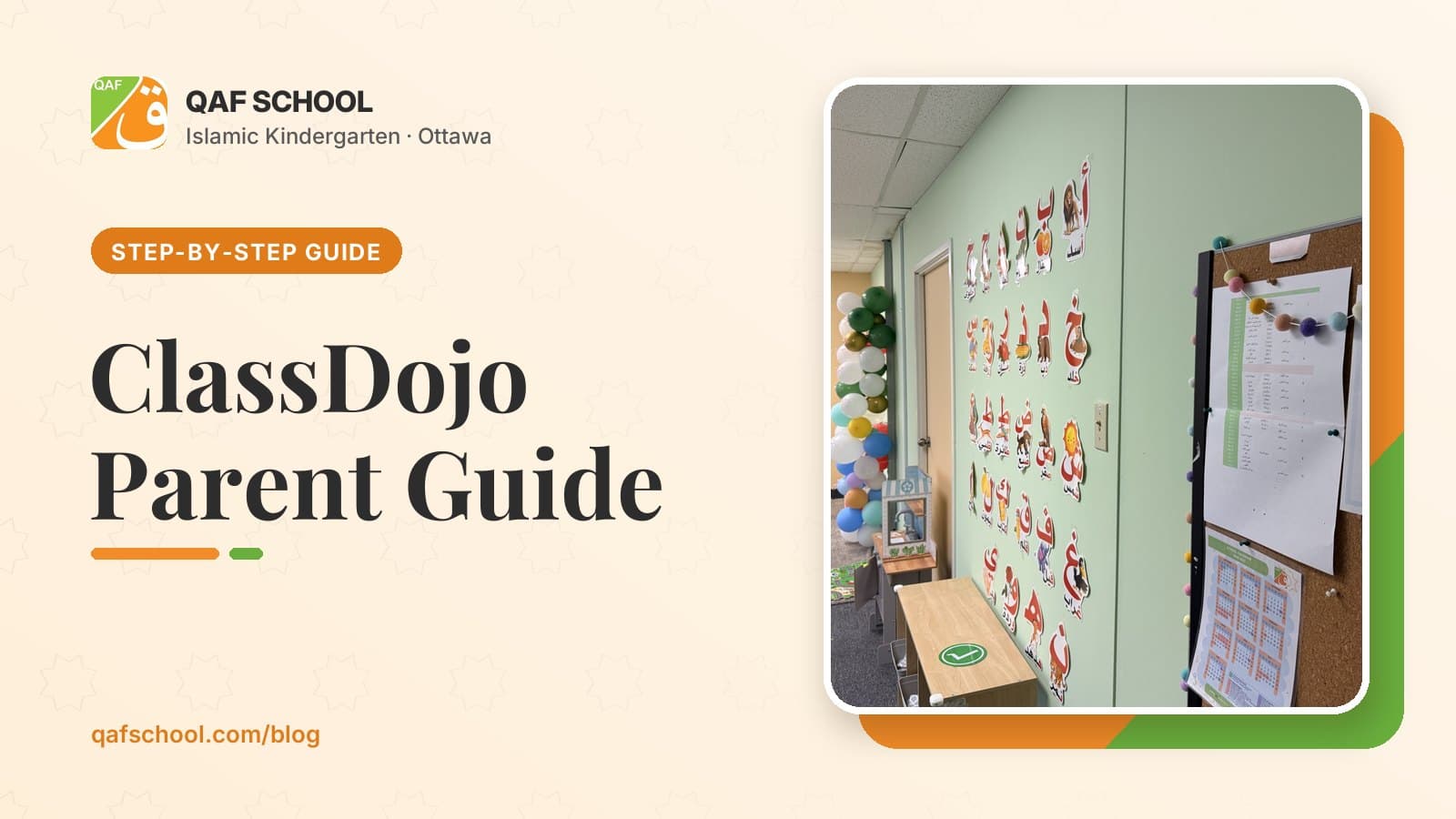
At QAF, families follow their child's learning through ClassDojo, with daily photos and videos, progress updates, announcements and direct messaging with the teacher. Our parent guide to ClassDojo explains how it works.
Is QAF right for your family?
QAF School is a full-day Islamic JK and SK program for children aged 4 and 5 at 900 Dynes Rd in Nepean, Ottawa, aligned with Ontario's kindergarten curriculum. Alongside early literacy and math, children learn Arabic every day, memorize short surahs from Juz Amma, and practise duas and adab. Parents see learning as it happens through ClassDojo instead of waiting months for a report.
QAF is a good fit if you want close, frequent communication with your child's teacher and Islamic learning built into the school day. It may not fit if your child is outside the 4–5 age range, if you need a school on the east or west edge of the city, or if you specifically want the provincial report form. Tuition is $690 a month for 10 months (September to June) plus a $190 annual resource fee.
The bottom line
An Ontario kindergarten report card is a conversation starter, not a grade. Read the Key Learning to see your child's strengths, the Growth to see how far they have come, and the Next Steps to know exactly what to practise. Return the response slip, ask for a meeting when you need one, and keep every report to see the full year of growth.
Want a closer view of your child's learning every day? Visit QAF's Islamic JK/SK classroom in Nepean and see how we share progress with families. Submit an inquiry to book a visit, or call or WhatsApp us.