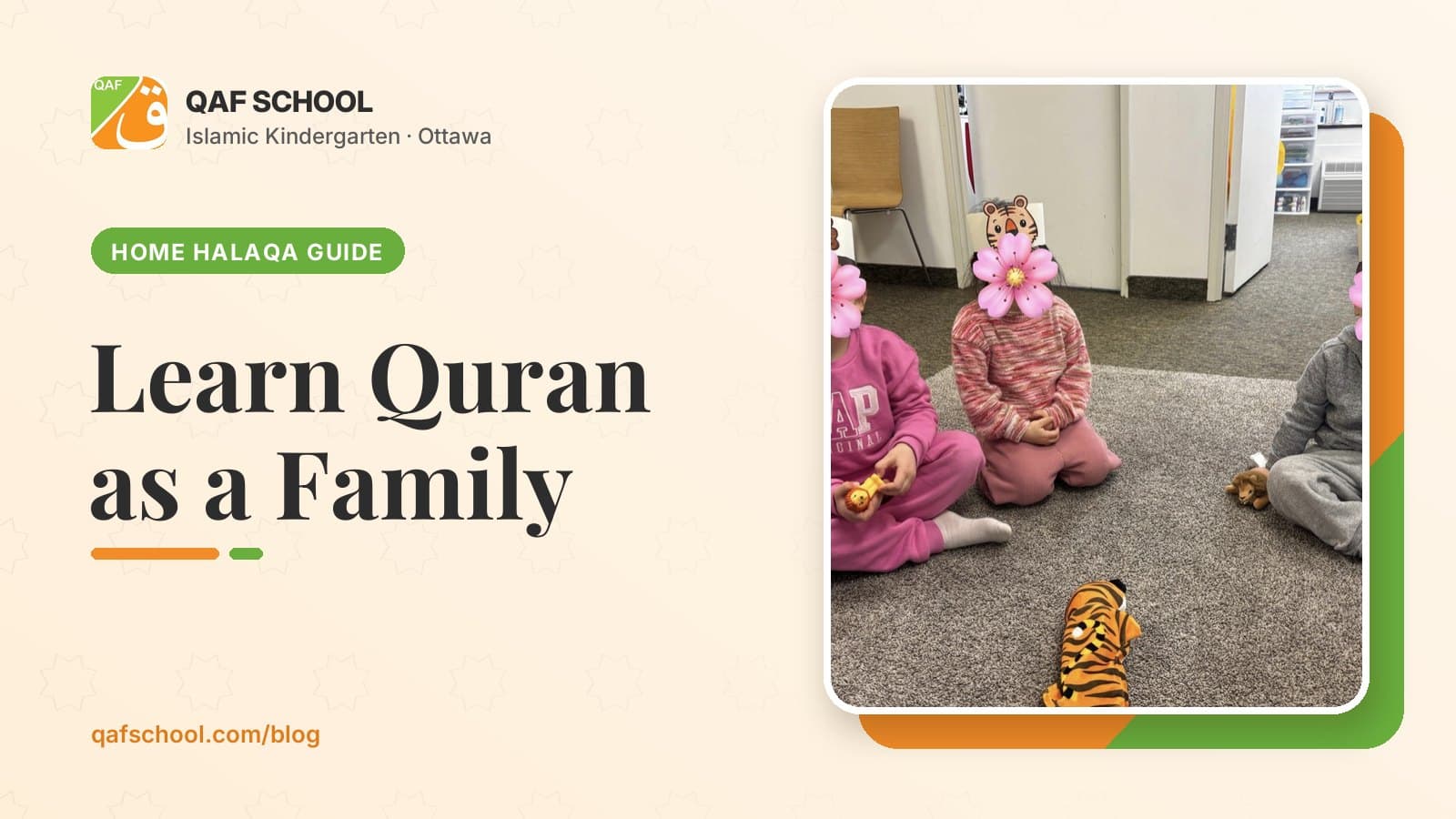
The easiest way to learn Quran as a family is a short, regular family halaqa at home: 15 to 30 minutes, at the same time each week (or each evening), where everyone recites a little, learns one meaning, and listens to each other. You do not need to be a scholar or even a fluent reader. You need a fixed time, a simple plan and a warm atmosphere.
This guide shows you how to set up a family Quran halaqa step by step, with a sample session, ideas for mixed ages and levels, and honest fixes for the obstacles most families hit.
Key takeaways
- A family halaqa works best when it is short, regular and predictable, not long and occasional.
- Every session can follow the same simple flow: recite, learn one meaning, reflect, make dua.
- Parents do not need to be experts; learning alongside your children is powerful modelling.
- Give each family member a role suited to their age, from toddlers to teens.
- Home learning pairs best with a teacher who corrects recitation regularly.
Why learn Quran as a family?
Allah addresses parents directly:
يَـٰٓأَيُّهَا ٱلَّذِينَ ءَامَنُوا۟ قُوٓا۟ أَنفُسَكُمْ وَأَهْلِيكُمْ نَارًا
“O you who have believed, protect yourselves and your families from a Fire…” (Surah At-Tahrim 66:6, Sahih International)
The Prophet ﷺ said that each of us is a guardian responsible for those in our care, and that a man is the guardian of his family and is responsible for them, and a woman is the guardian of her husband’s house (Sahih al-Bukhari 893). Teaching the Quran at home is one of the most direct ways to fulfil that trust.
Homes themselves benefit from recitation. The Prophet ﷺ said: “Do not make your houses as graveyards. Satan runs away from the house in which Surah Baqara is recited” (Sahih Muslim 780).
And there is something beautiful in hearing the Quran from the people you love. The Prophet ﷺ asked Abdullah ibn Mas‘ud to recite to him, saying, “I like to hear it from others” (Sahih al-Bukhari 5049). When a child recites to a parent, or a parent to a child, the family is following a prophetic practice.
What children gain from a family halaqa
- Modelling. Children copy what they see. A parent reciting and learning is more convincing than any lecture.
- Regular revision. Surahs learned at school or weekend class get recited at home every week.
- Meaning. Short explanations at home connect memorized words to real life.
- Belonging. The Quran becomes part of family identity, not just a class.
What is a family halaqa?
A family halaqa is a small, regular gathering at home where family members sit together to recite, learn and reflect on the Quran. The word halaqa means a circle, after the way students traditionally sat around their teacher.
The Prophet ﷺ described the great blessings on people who gather in one of the houses of Allah (the mosques) to recite the Book of Allah and study it together: tranquility descends on them, mercy covers them, angels surround them and Allah mentions them to those near Him (Sahih Muslim 2699). A family halaqa at home builds the same habit of reciting and studying together, and prepares children to love those gatherings in the masjid.
| Element | At a glance |
|---|---|
| How often | Once a week to start; a few minutes daily if you can |
| How long | 15–30 minutes (shorter with toddlers) |
| Who leads | A parent, rotating with older children over time |
| What you need | A Mushaf, a simple translation or children’s tafsir, a notebook |
| Core flow | Recite → learn a meaning → reflect → dua |
How to start a family Quran halaqa: step by step
Step 1: Choose a fixed time. Pick a time that already exists in your week: after Maghrib on Friday, Sunday after breakfast, or the 15 minutes after dinner. Put it in the family calendar.
Step 2: Choose a small, fixed place. A corner of the living room with a rug, cushions and a shelf for Mushafs signals “this is our Quran time.” Phones go in another room.
Step 3: Pick your focus surah. Start with a short surah from Juz Amma that everyone can manage. Stay with it for a few weeks, so children learn the words, the meaning and the lessons together.
Step 4: Give everyone a role. Toddlers can hand out Mushafs or say “Ameen.” Younger children recite a surah they know. Older children read the translation or ask the reflection question. Teens can lead.
Step 5: Follow the same flow each time. Predictability helps children settle. The sample session below is a good template.
Step 6: Keep it positive. Correct mistakes gently, praise effort and end before attention runs out. If a child is tired, a five-minute halaqa is still a halaqa.
Step 7: Review monthly. Ask everyone what they enjoy and what they would change. Adjust the time, length or activities accordingly.
A sample 30-minute family halaqa
| Time | Activity | Who |
|---|---|---|
| 0–3 min | Bismillah and a short opening dua | Parent or child |
| 3–10 min | Each person recites a surah they know (youngest first) | Everyone |
| 10–15 min | Read the focus ayat together, slowly | Everyone |
| 15–20 min | One meaning or story behind the ayat, in simple words | Parent or older child |
| 20–25 min | Reflection question: “What is Allah teaching us here?” | Everyone |
| 25–30 min | One action for the week, then dua | Everyone |
For families with very young children, shrink this to 10–15 minutes: two surahs, one story, one dua. Allah says in the Quran, “so recite what is easy from it” (Surah Al-Muzzammil 73:20). Start with what is easy, and grow from there.
Learning together at different levels
Most families have a mix: a parent who reads fluently, another who is still learning, a child who knows ten surahs and a toddler who knows none. That is normal, and it can be a strength.
If you are not confident reading Arabic yourself
Many parents worry about this. Be honest with your children: “I am learning too.” Use audio from a clear reciter on Quran.com during recitation time, and recite along. Consider taking a class yourself; children are deeply encouraged when they see a parent learning. Remember the Prophet ﷺ said the one who falters in recitation and finds it difficult will have two rewards (Sahih Muslim 798a).
For toddlers and preschoolers (2–5)
Let them sit on a lap, hold a Mushaf, repeat the last word of an ayah and say “Ameen” after dua. Listening is learning at this age. Keep their part to a few minutes.
For school-age children (6–11)
Give them responsibility: reciting their newest surah, reading the translation aloud or telling the story from memory. Our list of Quran stories for kids makes good halaqa material, and our guide on how to teach a child to read Quran helps if they are still learning to read.
For teens (12+)
Hand over leadership. Ask a teen to prepare a two-minute reflection on the focus ayat, or to lead the recitation. Respect their questions; a family halaqa is a safe place to talk about faith honestly.
Ideas to keep family Quran time fresh
- Ayah of the week. Write one ayah and its meaning on a whiteboard in the kitchen.
- Word of the week. Learn one Quranic Arabic word (like rahmah, mercy) and spot it in recitation.
- Story night. Once a month, tell a full story from the Quran, then read the ayat it comes from.
- Recite to grandparents. A video call where children recite their newest surah is a joy for everyone.
- Family tracker. Keep a chart of the surahs each person knows; our hifz tracker guide has templates.
- Reflection journal. Each person writes or draws one thing they learned.
- Family khatm in Ramadan. Divide the juz among family members according to ability, and finish the Quran together. More ideas are in our Ramadan activities for kids.
- Bedtime surahs. End the day with the same short surahs together; see our Islamic bedtime routine for a full plan.
Common obstacles and how to fix them
- “We never find the time.” Attach it to an existing routine, like after dinner on a fixed night. Ten minutes that happen beat an hour that doesn’t.
- “The kids fight or get silly.” Shorten the session, give each child a clear role and sit them apart. End on a positive note, even if it was brief.
- “My teen won’t join.” Invite rather than order, ask for their help leading, and keep it short. Pressure usually backfires.
- “We started strong and stopped.” Restart without guilt. Choose one small, regular slot and protect it.
- “I’m not sure our recitation is correct.” Use reliable audio and have a qualified teacher check your children regularly. Home is for practice and love; a teacher is for correction.
Support beyond the home in Ottawa
A family halaqa is the heart of Quran learning, but children also need a teacher who corrects tajweed and sets a clear path. Our guide to Quran classes for kids in Ottawa compares local formats for different ages and schedules.
At QAF, children aged 8 to 15 study Quran every Sunday from 11 AM to 3 PM at 900 Dynes Rd in our Sunday Quran and Arabic camp in Ottawa, alongside Arabic reading and writing, math and STEM, and soccer. QAF also runs Quran and hifz halaqat with a parent portal that shows attendance and hifz progress, which makes it easy to choose what to revise in your family halaqa each week. For 4- and 5-year-olds, our Islamic kindergarten in Ottawa includes daily Quran with short surahs from Juz Amma, so your youngest arrives at the family circle with something to recite.
Is QAF right for your family?
QAF is a good fit if you have children aged 4–5 who need a full-day Islamic JK/SK, or children aged 8–15 who attend school during the week and would benefit from a structured Sunday of Quran and Arabic. Sunday Camp is $190 per month from September to June, with junior and senior classes, in Nepean near Prince of Wales Drive. Many siblings of different ages can each find a fit across the two programs.
It may not be the right fit if your children are 6 or 7 (between our kindergarten and Sunday Camp ages), if you live far from Nepean, or if you want intensive daily hifz. In those cases, a local mosque class or tutor, plus a strong family halaqa, can be the right combination.
Final thoughts
You do not need a perfect plan to learn Quran as a family. Choose a time, sit together, recite what is easy, learn one meaning and make dua. Repeated week after week, that small circle becomes one of your children’s strongest memories of home, and one of the deepest roots of their faith.
Want a teacher alongside your family halaqa? QAF Sunday Camp offers weekly Quran, Arabic and more for ages 8–15 in Nepean. See QAF Sunday Camp, or call/WhatsApp us to ask about our Quran halaqat.