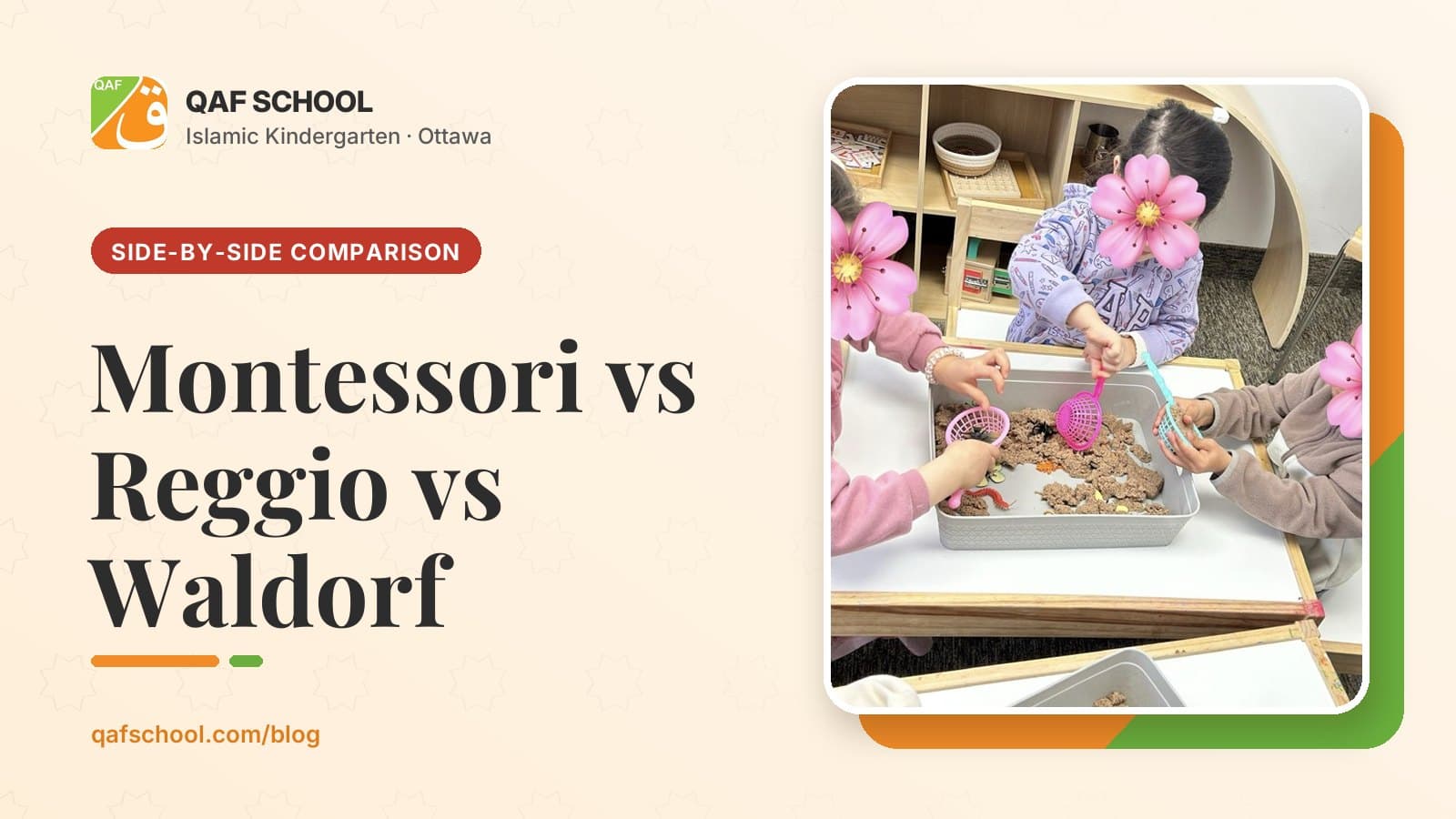
Montessori vs Reggio vs Waldorf comes down to one question: who leads the learning, and with what? Montessori puts the child in charge of purposeful work with specially designed materials. Reggio Emilia builds long projects out of children's own questions, and Waldorf protects imaginative play and delays formal academics. Ontario's full-day kindergarten borrows from all of them, and any of the four can be paired with a strong Islamic education if the school is intentional about it.
Key takeaways
- Montessori suits children who like order, independence and hands-on "real work"; it is the most structured of the three.
- Reggio Emilia suits curious, social children who love to build, draw and investigate; it is project-based and documentation-heavy.
- Waldorf suits dreamy, imaginative children; it emphasizes rhythm, storytelling and nature, and postpones formal reading.
- Ontario's kindergarten is play-based and inquiry-based, with explicit literacy and math instruction strengthened in the 2026 curriculum.
- The label on the door matters less than what you see in the classroom. Use the tour questions below to check.
Montessori vs Reggio vs Waldorf at a glance
Here is a side-by-side comparison of the four approaches parents most often weigh for children aged 3 to 6.
| Montessori | Reggio Emilia | Waldorf | Play-based (incl. Ontario FDK) | |
|---|---|---|---|---|
| Origin | Maria Montessori, Rome, 1907 | Loris Malaguzzi and families of Reggio Emilia, Italy, after WWII | Rudolf Steiner, Stuttgart, 1919 | Broad tradition; Ontario full-day kindergarten since 2010 |
| Who leads | Child chooses from a prepared set of activities | Children and teachers co-design projects | Teacher leads a predictable daily rhythm | Mix of child-led, guided and educator-led play |
| Classroom feel | Calm, orderly, open shelves, child-sized tools | Studio-like, natural light, art materials, displays of children's work | Homelike, soft colours, natural toys, seasonal table | Learning centres: blocks, sand, dramatic play, reading corner |
| Materials | Specific Montessori materials (pink tower, sandpaper letters, bead chains) | Open-ended "loose parts," clay, wire, paint | Silks, wooden toys, beeswax crayons, simple dolls | Varied; often commercial toys plus open-ended materials |
| Reading and math | Introduced early, through hands-on materials, when the child is ready | Emerges through projects; not drilled | Formal reading usually waits until about age 7 | Explicit phonics and number sense alongside play (Ontario 2026) |
| Age grouping | Mixed ages, typically 3–6 | Usually same-age groups | Often mixed ages 3/4–6 | Ontario: JK and SK, often combined |
| Teacher's role | Guide who observes and presents materials | Co-researcher who documents learning | Warm authority figure children imitate | Teacher and early childhood educator team |
| Assessment | Observation records | Pedagogical documentation (photos, transcripts, panels) | Observation; no testing in the early years | Observation plus formal report cards |
What is Montessori education?
Montessori is a child-centred method in which children learn by choosing purposeful, hands-on work in a carefully prepared environment. Maria Montessori opened her first Casa dei Bambini (Children's House) in Rome in 1907, and the approach is now practised worldwide. The Association Montessori Internationale, which she founded, describes the goal as helping children become motivated, active and independent learners.
What you will see in a Montessori classroom
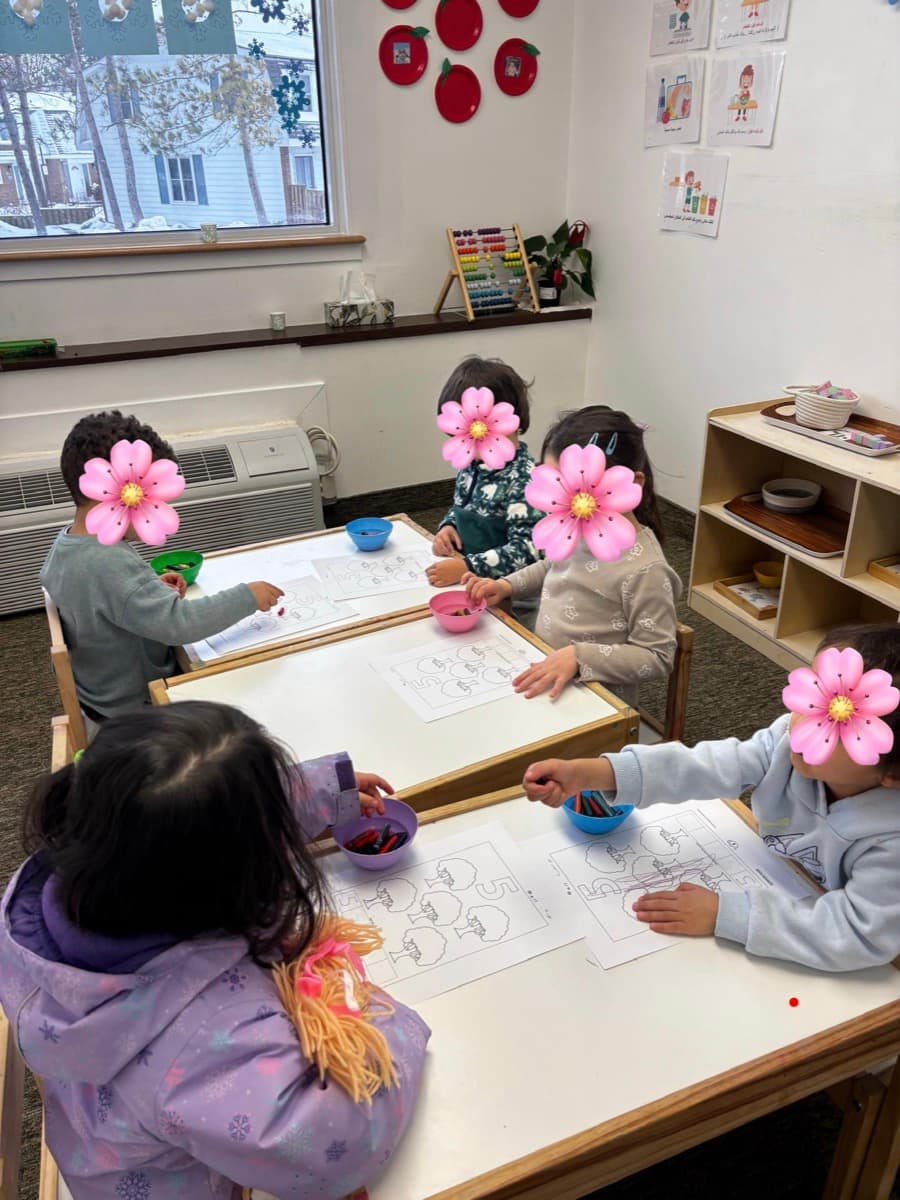
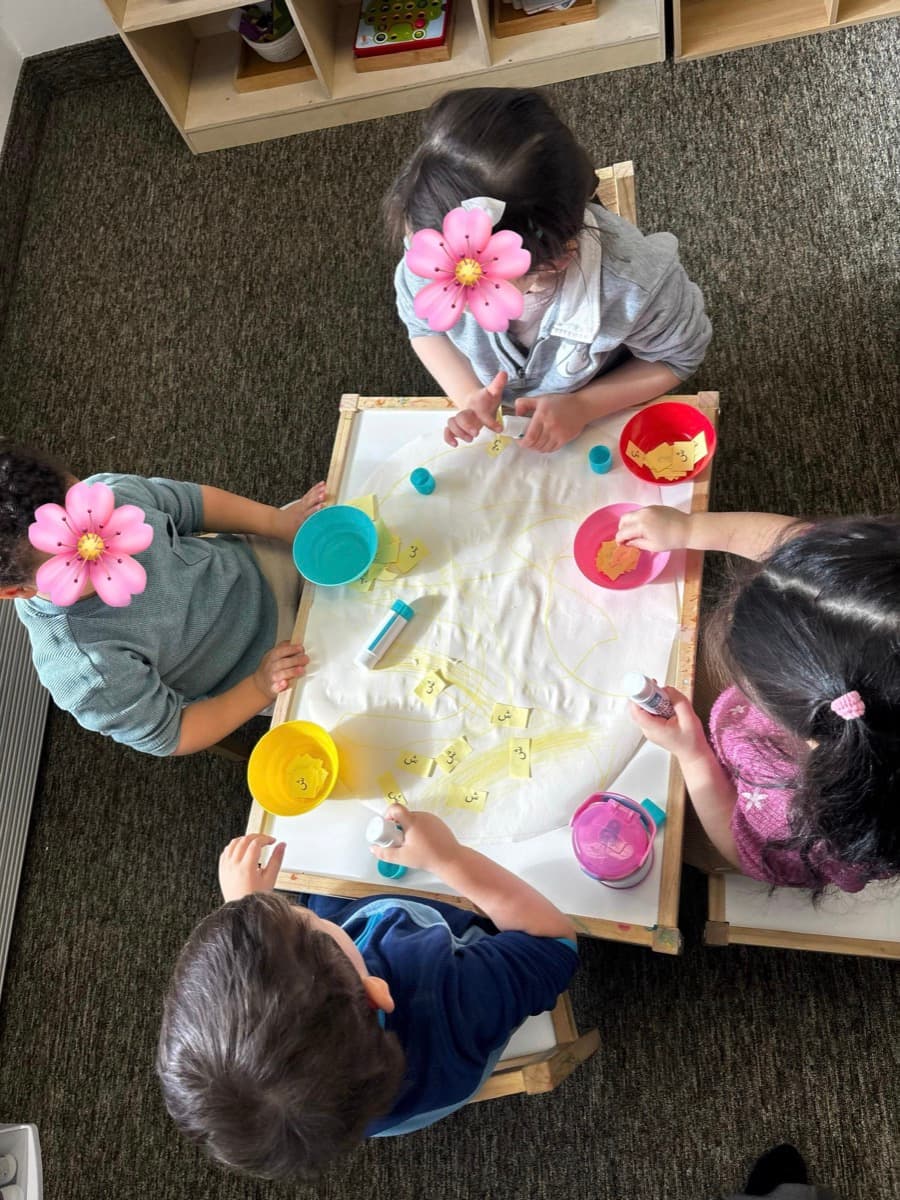
- Open, low shelves with materials arranged from simple to complex.
- A long, uninterrupted work period in the morning, during which children choose their own activities.
- Practical life work: pouring, sweeping, buttoning, preparing snack.
- Sensorial and academic materials that make abstract ideas concrete, such as sandpaper letters for phonics and golden beads for place value.
- Mixed ages, so younger children learn by watching older ones and older children consolidate by helping.
Strengths and trade-offs
Montessori's strengths are independence, concentration and early, concrete academics. A frequently cited 2017 lottery-based study in Frontiers in Psychology followed 141 children in two public Montessori schools and found better overall outcomes for the Montessori group, with the income-based achievement gap narrowing. The authors themselves call for larger studies, so treat it as encouraging rather than conclusive.
The trade-off is that pretend play and group art get less attention in classical Montessori than in Reggio or Waldorf. "Montessori" is also not a protected name, so quality varies widely. We cover how to tell the difference in our guide to choosing an Islamic Montessori school in Ottawa.
What is the Reggio Emilia approach?
The Reggio Emilia approach is an early childhood philosophy that sees the child as capable and full of potential, learning through relationships and long-term projects. It grew out of the municipal preschools of Reggio Emilia, in northern Italy, with educator Loris Malaguzzi as its central figure. Reggio Children, the organization that promotes the approach, highlights the "hundred languages" of children, the environment as educator, and the participation of families.
What you will see in a Reggio-inspired classroom
- Projects that last weeks or months, sparked by a child's question ("Where do the ducks go in winter?").
- An atelier (art studio) and often an atelierista, a teacher with an arts background.
- Documentation everywhere: photos, quotes from children and drawings displayed on panels so the learning is visible.
- Natural light, mirrors, plants and loose parts that invite investigation.
Strengths and trade-offs
Reggio builds curiosity, collaboration, communication and creative thinking. Children learn to revisit and improve their ideas, which is a powerful habit.
The trade-off is that there is no fixed curriculum, so literacy and numeracy depend heavily on the skill of each teacher. Outside Italy, almost every school is "Reggio-inspired" rather than Reggio, so ask how projects are chosen and how reading and math are woven in.
What is Waldorf (Steiner) education?
Waldorf education is an approach founded by Austrian philosopher Rudolf Steiner in 1919 that emphasizes imagination, rhythm, the arts and a gradual approach to academics. The first school opened in Stuttgart, Germany, for the children of workers at the Waldorf-Astoria factory. Early childhood programs are coordinated in North America by the Waldorf Early Childhood Association of North America.
What you will see in a Waldorf kindergarten
- A strong daily and weekly rhythm: baking day, painting day, circle time with songs and verses.
- Imaginative free play with simple, natural toys that children transform (a silk becomes a river, a cape, a tent).
- Oral storytelling instead of reading from picture books.
- Lots of outdoor time in most weather.
- Formal reading and writing usually postponed until around age 7 (Grade 1).
Strengths and trade-offs
Waldorf protects childhood. Many children thrive with the predictable rhythm, the rich oral language and the time outdoors. Families who want limited screen time often appreciate Waldorf's typical stance on media.
The trade-offs matter for Muslim families. Waldorf is rooted in Steiner's spiritual philosophy, anthroposophy, and most programs celebrate a cycle of seasonal festivals, several of them drawn from the Christian calendar. Late formal reading can also make a later move into a conventional Grade 1 feel abrupt.
What does play-based mean, and where does Ontario's kindergarten fit?
Play-based learning is not a single method; it is a broad approach in which children learn academic and social skills through play, with adults setting up the environment and stepping in to extend thinking. Most Canadian preschools and child care centres describe themselves as play-based.
Ontario's full-day kindergarten is the most important play-based program for Ontario families because it is free and province-wide. Starting in the 2026–27 school year, all Ontario kindergarten programs follow The Ontario Curriculum, Kindergarten, 2026, which replaced the 2016 Kindergarten Program. It keeps play and inquiry at the centre but adds more explicit, systematic teaching of early reading, writing and math. Classes with more than 16 children have an educator team of a teacher and an early childhood educator.
In practice, Ontario kindergarten blends ideas from all three philosophies:
- From Reggio: inquiry projects and pedagogical documentation.
- From Montessori: self-regulation, independence and hands-on materials.
- From the play tradition broadly: learning centres and a mix of child-directed, guided and educator-directed play.
For a detailed walk-through of strands, report cards and what children learn, read Ontario's kindergarten program explained.
Which approach suits which child?
There is no best method in the abstract; there is a best fit for your child and your family. These patterns are a starting point, not a rule.
| If your child… | Consider |
|---|---|
| Lines up toys, loves sorting, wants to "do it myself" | Montessori |
| Asks endless "why" questions and loves building and drawing | Reggio-inspired |
| Lives in pretend play, loves stories and songs, is sensitive to noise | Waldorf or a gentle play-based program |
| Is very social and thrives in groups with lots of variety | Play-based / Ontario kindergarten or Reggio-inspired |
| Needs predictable structure to feel safe | Montessori or Waldorf (both have strong routines) |
| Is already curious about letters and numbers | Montessori or Ontario kindergarten |
Also think about the next step. If your child will enter a public or Islamic school for Grade 1, a program that builds solid early literacy and numeracy will make that transition easier. Our JK readiness checklist can help you gauge where your child is today.
Where Islamic education fits each approach
Islamic education in the early years is not just a subject; it is a way of being: adab (manners), duas through the day, love of Allah and the Prophet ﷺ, Quran and often Arabic. Each philosophy offers a different "home" for it.
Montessori and Islamic education
Montessori is the most natural fit. Grace and courtesy lessons map directly onto adab, practical life mirrors the Prophetic emphasis on serving others and caring for one's surroundings, and the prepared environment can easily include wudu practice, prayer mats and Arabic letter materials. We explore this connection in depth in Montessori meets Islamic values.
Reggio Emilia and Islamic education
Reggio's project approach can work beautifully with Islamic content: a project on the moon can lead to the Hijri calendar and Ramadan, and a project on bees can lead to Surah An-Nahl. The challenge is that Quran memorization and Arabic need consistent, structured time, which a purely emergent program may not provide.
Waldorf and Islamic education
Waldorf's rhythm, reverence and storytelling resonate with many Muslim parents, and its limits on screens are attractive. The tension is philosophical: anthroposophy and the Christian-rooted festival cycle sit at the heart of most Waldorf programs. Families who choose Waldorf usually supplement Islamic learning at home or through weekend programs.
Play-based programs and Islamic education
Secular play-based programs, including public kindergarten, will not include religious content, though many educators welcome children sharing about Eid or Ramadan. Families often add Quran classes or a weekend Islamic school. For a fuller comparison, see Islamic school vs public school in Ontario.
Questions to ask on a school tour
Whatever the label, these questions reveal how a program really works:
- What does a typical day look like, hour by hour? Look for a long uninterrupted work or play block, not constant transitions.
- Who chooses what children do, and when? The answer tells you how child-led the program truly is.
- What training do your teachers have? Ask about Montessori diplomas, Waldorf training, ECE registration or Ontario teaching certification.
- How do you teach early reading and math? Ask to see the materials.
- How do you document and share progress with parents? Photos, portfolios, report cards, apps.
- How do you handle conflict and big emotions? Listen for coaching, not just time-outs.
- How much time is spent outdoors?
- Where does faith fit into the day? For Islamic schools: when do children learn Quran, duas and Arabic, and how are adab and Islamic values taught through daily routines rather than only in a lesson?
- How do children transition to Grade 1 from here?
- Can I observe a class in session? A confident school will say yes.
Tip: Visit mid-morning on a regular weekday. The first 20 minutes of the day and the last 20 minutes before pick-up rarely show you how the classroom really works.
How QAF approaches it in Ottawa
At QAF School in Ottawa, our full-day Islamic JK and SK program is Montessori-inspired: children work in a prepared environment during a long morning work cycle from 9:20 to 11:00, and our program is aligned with Ontario's kindergarten expectations. Daily Arabic immersion, short surahs from Juz Amma, duas and adab are part of the rhythm of the day rather than an add-on. You can see how it all fits together in what a day looks like at QAF or on our program page.
We are not the right fit for every family. If you are drawn to Waldorf's delayed academics or a fully emergent Reggio curriculum, a different program may suit you better, and that is a perfectly good choice. Visiting two or three different programs before you decide is always worthwhile.
The bottom line
Montessori, Reggio Emilia, Waldorf and play-based programs all respect young children; they simply trust different things: materials, projects, rhythm or play. Pick the philosophy that matches your child's temperament and your family's values, then judge the individual school on what actually happens in the room. For Muslim families, the deciding question is often whether faith and Arabic are woven into the day or left for evenings and weekends.
See a Montessori-inspired Islamic classroom in action. Book a visit to QAF School at 900 Dynes Rd and watch a morning work cycle for yourself. Submit an inquiry and we will find a time that works for you.