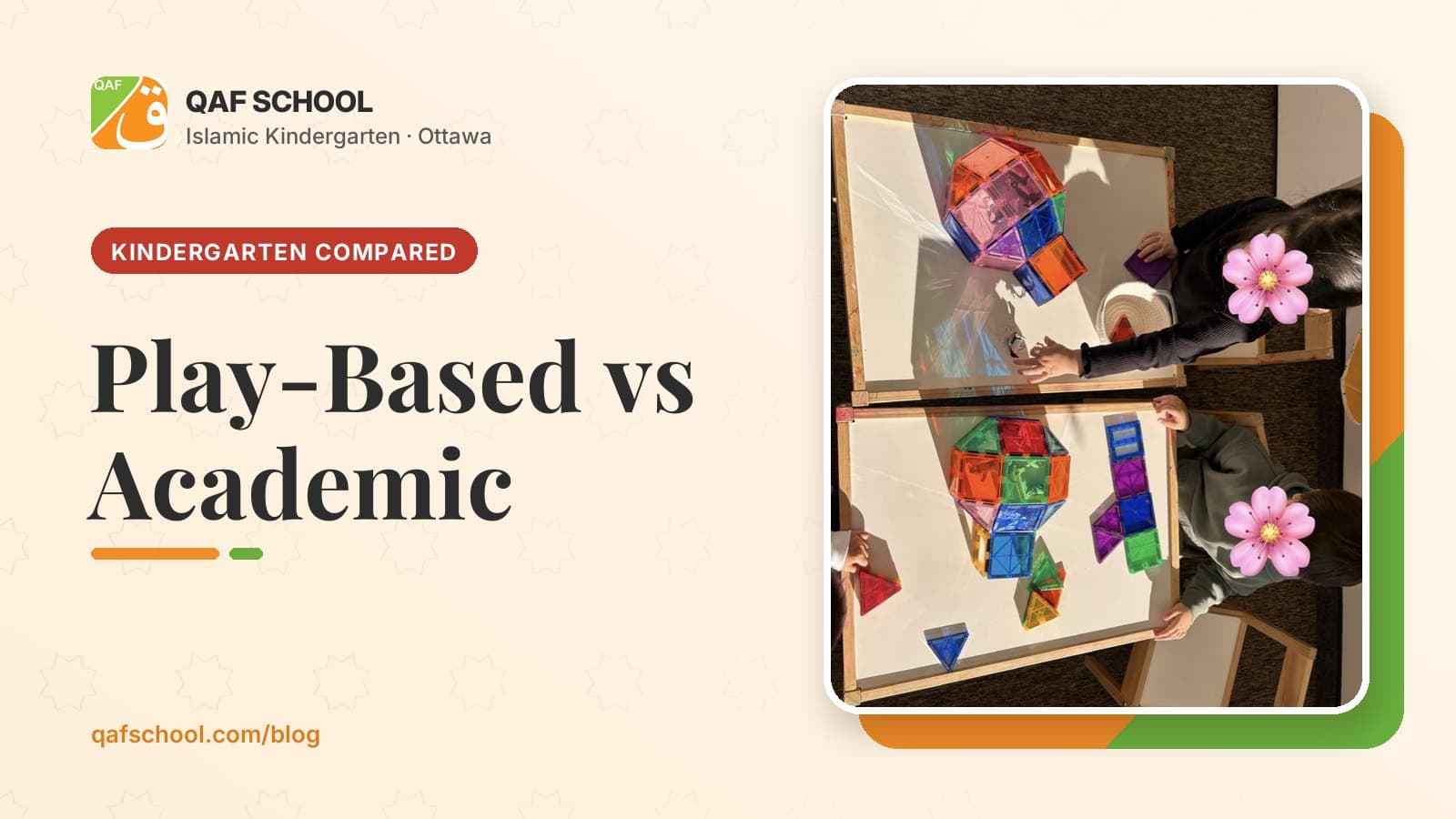
Play-based vs academic kindergarten is one of the first choices parents meet when they tour schools. The short answer: the research does not support a strict either/or. Children of four and five learn best in well-planned play with an active teacher, plus short, explicit lessons in early reading and math. The real question is how a school balances the two, and how it does it day to day.
Key takeaways
- A play-based kindergarten teaches through purposeful play, centres and inquiry. An academic kindergarten teaches through teacher-led lessons, worksheets and set skill targets.
- Research favours guided play: child-led activity with an adult who steers the learning. Across studies it was at least as effective as direct instruction for early literacy and math.
- Ontario's 2026 kindergarten curriculum blends both. Play stays central, and early reading is now taught explicitly and systematically.
- Judge the classroom, not the label. Watch how long children sit, who chooses the activity and how reading is taught.
Play-based vs academic kindergarten at a glance
| Play-based kindergarten | Academic kindergarten | Balanced (guided play + explicit teaching) | |
|---|---|---|---|
| Typical day | Learning centres, inquiry projects, outdoor play, read-alouds | Whole-class lessons, seatwork, worksheets, drills | Long play and work periods, plus short focused lessons |
| Who leads | Mostly the child, with educators observing and extending | Mostly the teacher | Shared: child chooses, adult guides and teaches |
| Reading and math | Taught through games, stories and real tasks; can be uneven if teaching is not intentional | Taught directly and early, often with workbooks | Explicit phonics and number lessons, practised through play |
| Strengths | Self-regulation, language, curiosity, social skills | Early skill exposure, clear benchmarks | Combines both sets of strengths |
| Risks | "Just playing" if the teacher is passive | Long sitting, less movement, early stress or disengagement | Needs skilled educators to get the balance right |
| Best for | Most four- and five-year-olds when play is well designed | Few children at this age; may suit an eager early reader for short periods | Most children |
What is a play-based kindergarten?
A play-based kindergarten is a program where children build academic and social skills through purposeful play. Educators set up the room with intention: a block area for measuring and building, a pretend store for counting and reading labels, a writing table, sand and water, art materials and books. Then they join the play to ask questions, add vocabulary and stretch thinking.
Play-based learning is not unstructured babysitting. In a strong program, every centre has a learning goal, and the teacher knows which children need more practice with which skill. Researchers usually describe a range of play:
- Free play: children choose and lead, with adults nearby.
- Guided play: children lead, while an adult shapes the activity with prompts, hints and questions.
- Educator-directed play: the adult designs a playful game to teach a specific skill, such as a rhyming game or a counting race.
What is an academic kindergarten?
An academic kindergarten is a program built around teacher-led instruction and set skill targets: letters, sounds, sight words, handwriting, counting and early addition. Children spend more of the day at tables, often with workbooks, and progress is measured against benchmarks.
This model spread widely in the United States in the 2000s. A University of Virginia study, Is Kindergarten the New First Grade?, compared US kindergarten classrooms in 1998 and 2010. The share of teachers who expected children to leave kindergarten reading rose from 31% to 80%. Time on child-selected activities, music, art and discovery areas fell over the same period. The authors also noted that exposure to more advanced content can help learning, so the picture is not simply good or bad.
What does the research say?
The most useful finding for parents is that play and academics are not opposites.
Play and academics work together. A scoping review of 168 studies on play-based kindergarten by Angela Pyle and colleagues (Review of Education, 2017) found two strands of research. One focused on free play and child development. The other found that play with an active teacher supports academic learning, including early literacy. The authors called for treating different types of play as complementary rather than incompatible.
Guided play holds its own against direct instruction. A 2022 University of Cambridge meta-analysis in Child Development looked at 39 studies of children aged about three to eight. It found that guided play was as effective as adult-led instruction on the outcomes measured. It showed a stronger effect for some early math skills, including shape knowledge.
Self-regulation is built, not born. Harvard's Center on the Developing Child explains that executive function skills (working memory, mental flexibility and self-control) develop through experience. Pretend play, turn-taking games and multi-step projects give four-year-olds daily practice with exactly these skills.
Early reading needs explicit teaching. Few children work out the alphabetic code just by being around books. That is why Ontario now requires systematic teaching of sounds and letters in kindergarten (more below). Play can carry the practice, but someone has to teach the code.
Where Ontario kindergarten fits
Ontario is a balanced model. The Ontario kindergarten program has been play-based since full-day kindergarten began in 2010. In September 2026, The Ontario Curriculum, Kindergarten, 2026 took effect. Queen's University researchers describe explicit, systematic reading instruction as the biggest change. They also note that play-based learning is kept and defined more precisely, and that explicit teaching does not mean rows of desks and worksheets.
The four strands are Belonging and Contributing, Self-Regulation and Well-Being, Foundations of Language and Mathematics, and Problem Solving and Innovating. For a full walkthrough, see our guide to the Ontario kindergarten program explained.
So if you live in Ontario, public, Catholic and most private kindergartens are not choosing between play and academics. They are choosing how much of each, and how well they do both.
Pros and cons for your child
Benefits of play-based kindergarten
- Language grows fast. Pretend play and conversation with adults build vocabulary and storytelling, which later support reading comprehension.
- Self-regulation gets daily practice. Waiting for a turn, sticking to a role in a game and solving a conflict over blocks are real lessons.
- Motivation stays high. Children who choose their work tend to stay with it longer.
- Movement is built in. Four-year-olds are not designed to sit for long periods, and play lets them move while learning.
Drawbacks to watch for
- Passive teaching. If adults only supervise, some children avoid letters and numbers all year.
- Uneven progress. Without regular checks, a child who needs extra reading support may not be spotted early.
Benefits of academic kindergarten
- Clear goals. Parents know what is being taught each week.
- Early skill exposure. Children meet letters, sounds and numbers directly.
Drawbacks to watch for
- Too much sitting. Long seatwork can lead to restlessness, frustration or a child who says "I hate school" at five.
- Shallow gains. Worksheet skills without understanding can look impressive in October and fade by Grade 1.
- Less time for social skills, which teachers consistently say matter most for a smooth start.
How to tell which model a school really uses
Brochures often use the same words. Visit, watch a morning and ask:
- How long is the longest play or work period? Look for a long, uninterrupted block, not 10-minute rotations.
- How do you teach letters and sounds? A good answer names a sequence (for example, sounds first, then blending) and short daily lessons.
- What does a child do who finishes early or struggles? This shows whether teaching is individualized.
- How much of the day is spent sitting at tables? For a four-year-old, short lessons are a good sign. Most of the morning at desks is not.
- How do you track progress, and how will I hear about it? Ask to see a sample report or portfolio.
- Is there outdoor time every day? Including in winter.
Our list of questions to ask on a school tour goes further, and our Montessori vs Reggio vs Waldorf comparison explains the named philosophies you will hear about.
Where Montessori and Islamic kindergartens fit
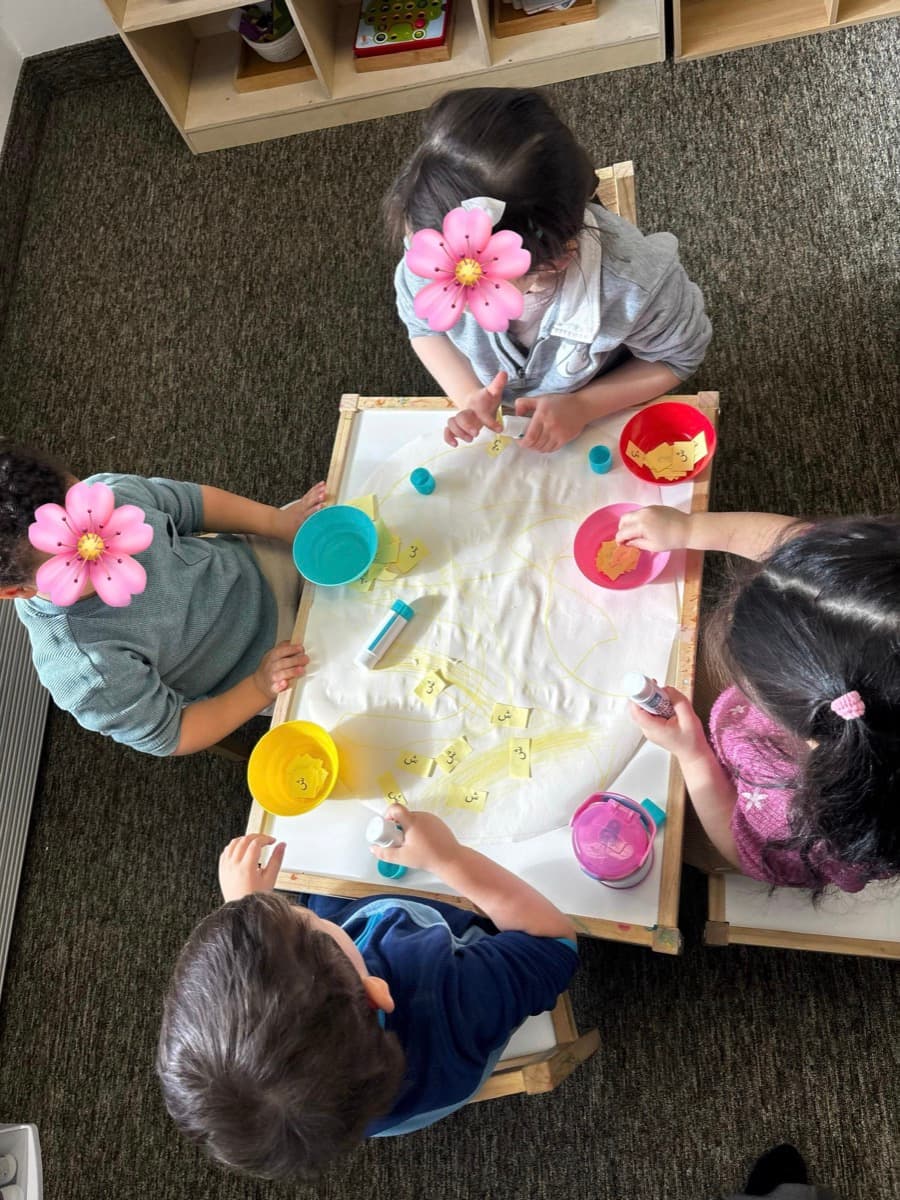
Montessori is neither purely play-based nor academic in the worksheet sense. Children choose from hands-on materials (sandpaper letters, number rods, practical life work) during a long work cycle, while the teacher gives short individual lessons. Many families see it as a structured middle path.
Islamic kindergartens add a layer: Quran memorization, duas and Arabic. Done well, these fit naturally into a balanced day. Children chant short surahs together during circle time, learn Arabic vocabulary through songs and objects, and practise adab while sharing materials. Done poorly, they become long periods of sitting and repeating. Ask how much time children spend seated for Quran, and how teachers keep it joyful.
When comparing Islamic schools in Ottawa, ask each one where it sits between play and direct teaching. Answers vary a lot. For the Montessori angle specifically, see Montessori meets Islamic values.
Is QAF right for your family?
QAF School is a full-day Islamic JK and SK program for children aged 4 and 5 at 900 Dynes Rd in Nepean, Ottawa. Our approach is balanced. The day is Montessori-inspired, with a long morning work cycle from 9:20 to 11:00 where children choose hands-on work and teachers give short, focused lessons. Learning is aligned with Ontario's kindergarten curriculum, alongside daily Arabic immersion, short surahs from Juz Amma, duas and adab. You can see the whole day in what a day looks like at QAF.
QAF suits families who want structure and early literacy without long seatwork, and who want Islamic learning woven through the day. It may not suit you if you want a heavily worksheet-based program, if your child is outside the 4–5 age range, or if a daily commute to Nepean is not realistic. Tuition is $690 a month for 10 months (September to June) plus a $190 annual resource fee.
The bottom line
The play-based vs academic kindergarten debate is mostly a false choice. Four- and five-year-olds learn best when educators plan playful, hands-on experiences and also teach early reading and math directly, in short, lively lessons. Choose the school where you see children busy, talking and moving, and where the teacher can clearly explain how your child will learn to read.
See a balanced kindergarten morning for yourself. Book a visit to our Islamic JK/SK classroom in Nepean and watch the morning work cycle in action. Submit an inquiry to choose a time, or call or WhatsApp us with questions.